

A practical guide for SME owners, finance admins, and B2B sales teams on using customer records, invoices, payment history, overdue balances, and sales handover discipline to make better decisions before accepting larger repeat orders or extending informal credit.
Why Customer Credit Control Matters Before More Orders Are Accepted
For many SMEs, repeat customers are valuable. They already know your products or services, they may order regularly, and the sales process can feel easier than winning a new account. But repeat orders can also create risk when the team accepts larger requests without checking how the customer has been paying.
Customer credit control is not about stopping sales. It is about helping sales, finance, and operations make better decisions before committing stock, manpower, delivery slots, or production capacity.
A customer may have a good relationship with the sales team but still have overdue invoices, irregular payment habits, or several partial payments that need review. When those details are hidden in separate spreadsheets, chat messages, or accounting notes, the business may accept new work without seeing the full picture.
Review Customer Records Before Extending Informal Credit
Informal credit often happens quietly in SMEs. A familiar customer asks for goods first and payment later. A service client requests extra work before settling the previous invoice. A distributor accepts a high-value order because the customer has bought before.
Before saying yes, teams should review the customer record clearly:
- Is the billing information complete and up to date?
- Who is the main contact for ordering and payment follow-up?
- What payment terms were agreed previously?
- Are there old invoices still open?
- Has the customer made partial payments that are not yet fully reconciled?
- Has the customer frequently paid late, even if they eventually paid?
For service businesses, this may mean checking whether previous project milestones were paid on time before starting a larger scope. For distributors, it may mean checking whether the customer has unsettled invoices before releasing more stock. For B2B suppliers, it may mean confirming whether the buyer has a pattern of delaying payment after delivery.

Use Invoice And Payment History To Understand Behaviour
A single overdue invoice does not always tell the full story. The useful view is the pattern across invoices, payments, and balances.
For example, a repeat customer may place orders every month and usually pay 20 days late. Another customer may pay on time for smaller invoices but delay payment when the order value becomes larger. A third customer may make partial payments, leaving small balances unpaid across several invoices.
Finance admins and SME owners should look for practical signals:
- Number of unpaid invoices
- Total overdue balance
- Oldest unpaid invoice date
- Frequency of partial payments
- Average payment delay
- Recent changes in payment behaviour
- Whether the customer pays only after repeated reminders
This helps the business decide whether to proceed normally, request partial payment first, reduce the order size, ask for approval, or pause until finance has reviewed the account.
Handle High-Value Orders With A Clear Review Step
High-value orders deserve extra discipline because the impact of non-payment is larger. The order may use more stock, require supplier purchases, block delivery capacity, or involve special pricing.
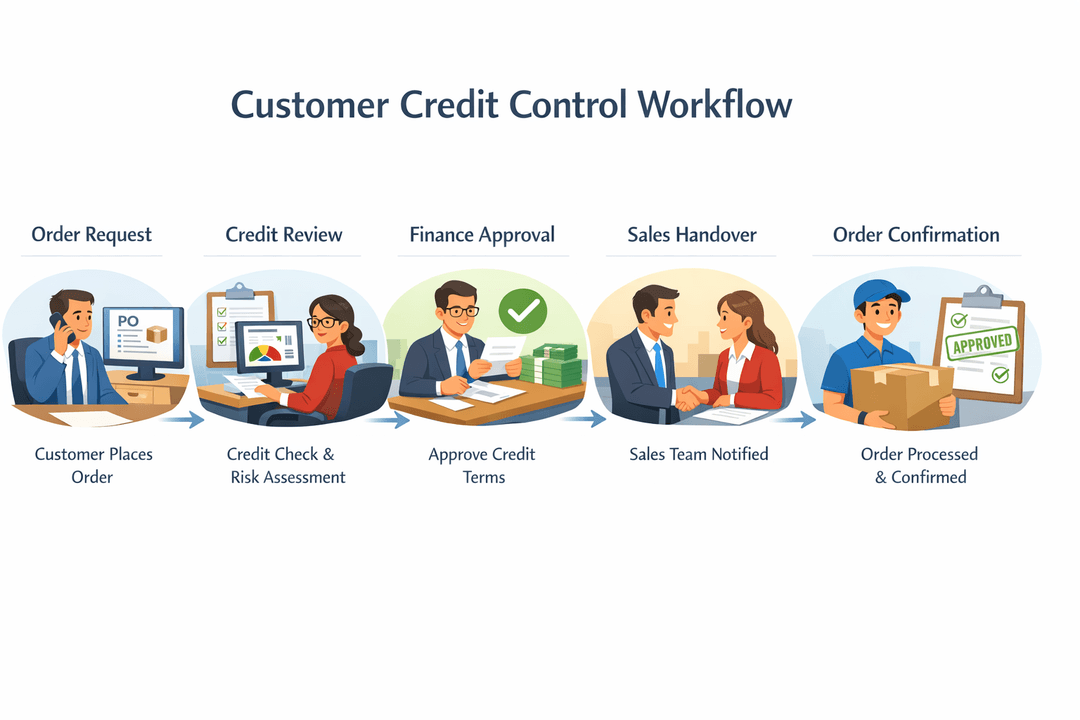
A practical workflow can be simple:
- Sales receives a larger repeat order.
- Sales checks whether the customer has overdue balances.
- Finance reviews invoice and payment history.
- Any concerns are discussed before the order is confirmed.
- The team records the decision so operations knows whether to proceed.
This protects the business without creating unnecessary friction. Sales can still move quickly, but larger commitments are made with clearer payment visibility.
Sales pressure is normal, especially when the customer is important or the order value is attractive. A structured review step gives the team a neutral process to follow, so the decision does not depend only on urgency, relationship, or verbal promises.
Make Partial Payments And Overdue Balances Visible
Partial payments can be useful, but they can also make customer balances harder to understand when records are scattered. A customer may pay RM3,000 against a RM5,000 invoice, then place another order before the remaining RM2,000 is settled. If sales only sees that the customer “paid something”, the remaining balance may be missed.
To reduce confusion, SMEs should make these details easy to see:
- Original invoice amount
- Amount paid so far
- Remaining balance
- Payment date and method
- Whether the payment was linked to the correct invoice
- Whether there are multiple unpaid invoices under the same customer
For B2B suppliers and wholesalers, this visibility is important because repeat orders may happen before the previous cycle is fully settled. For service businesses, it helps prevent new work from starting while earlier invoices are still only partly paid.

Improve Sales Handover Discipline Between Teams
Credit control works better when sales and finance share the same customer view. Problems often happen when sales confirms an order based on relationship history, while finance later discovers overdue invoices or unclear payment records.
A good sales handover should include:
- Customer name and account reference
- Requested order value or service scope
- Expected delivery or fulfilment date
- Existing unpaid invoices or overdue balances
- Any promised payment date from the customer
- Any special terms requested by the customer
- Whether finance review is required before confirmation
This does not need to slow the business down. The goal is to prevent missing context. When finance and sales work from the same customer record, the team can respond faster and with fewer misunderstandings.
Practical Credit Control Advice For Different SME Teams
Different SMEs face different customer payment risks, so the workflow should match the business model.
For service businesses:
- Review unpaid invoices before starting a new project phase.
- Check whether previous milestones were paid according to the agreed schedule.
- Avoid relying only on verbal confirmation when additional scope is requested.
- Make sure the sales or account team shares payment context before operations starts work.
For distributors:
- Check overdue balances before releasing more stock.
- Review payment history for customers requesting larger order quantities.
- Flag fast-moving inventory that should not be heavily committed to customers with unresolved balances.
- Confirm whether partial payments are linked correctly before approving another order.
For B2B suppliers:
- Review repeat customer behaviour before offering informal credit.
- Use high-value orders as a trigger for finance review.
- Keep customer payment notes visible to both sales and admin teams.
- Record decisions clearly so future orders can be assessed with context.
The focus should be consistency. SMEs do not need a complicated credit policy to start improving control. Even a simple review process can reduce avoidable risk.
How TREX Grow Can Help Solve This
TREX Grow can help SMEs improve customer credit control by connecting customer records, invoices, payment histories, overdue balances, and sales documents in one operational workflow.
Instead of checking payment behaviour across separate files or relying on memory, teams can work towards a clearer process:
- Keep customer records organised with relevant business details.
- Create sales documents and invoices under the correct customer account.
- Track payments against invoices, including partial payments.
- Review outstanding and overdue balances before confirming larger orders.
- Give sales and finance teams a shared view of customer payment status.
- Keep order decisions more traceable when customer risk needs review.
This is useful for SME owners, finance admins, and B2B sales teams that want better visibility before accepting more work, releasing stock, or extending informal credit.
Businesses that want clearer customer payment visibility can explore TREX Grow as part of a more controlled sales, invoicing, payment, and customer management workflow.
A Simple Checklist Before Accepting A Larger Repeat Order
Before accepting a larger repeat order or extending informal credit, ask these questions:
- Does the customer have unpaid invoices?
- Is any invoice overdue?
- Are there partial payments with remaining balances?
- Has the customer’s payment behaviour changed recently?
- Is this order significantly larger than usual?
- Will this order require extra purchasing, stock reservation, delivery effort, or service capacity?
- Has finance reviewed the customer account if the risk is higher?
- Has sales handed over the payment context clearly?
This checklist helps SMEs make more informed decisions without using aggressive collection language or slowing every order unnecessarily. The aim is to support healthy sales growth with better payment visibility, cleaner customer records, and stronger coordination between sales and finance.