

Many Malaysian SMEs run more than one related company while sharing admin, sales, purchasing, or finance staff. That setup can work well until invoices, purchase orders, customer records, and supplier records are created under the wrong company context. This article explains practical document ownership best practices for group business owners who want cleaner day-to-day operations. It covers common confusion points, examples across billing and purchasing, and how TREX Grow can help teams keep company context clear across company records, members, invoices, purchase orders, and customer or supplier data.
Why document ownership becomes a problem in multi-company operations
Many Malaysian SMEs grow by adding related companies for different activities such as trading, services, project billing, property holding, or regional operations. The legal structure may be clear to the owner, but day-to-day work often becomes blurred when the same admin or finance team supports several entities.
The confusion usually starts with simple assumptions:
- one shared team handles billing for all companies
- the same salesperson deals with the same customer across multiple entities
- one purchaser buys from the same supplier for different companies
- management wants combined visibility, so staff stop checking which company should own each document
When that happens, staff may create an invoice under the wrong company, raise a purchase order from the wrong entity, or update a customer record without confirming which company relationship it belongs to. The issue is not only clerical. It affects customer communication, supplier coordination, internal reporting, and the reliability of daily decisions.
For owners, document ownership matters because every invoice, purchase order, customer record, and supplier record should clearly reflect the company that is actually transacting.
What clear company context looks like in practice
Clear company context means each operational record is tied to the correct business entity before work moves forward. This is especially important when shared staff switch between tasks quickly.
In practice, that means the team should be able to answer basic questions before creating a document:
- Which legal entity is selling or buying?
- Which company owns this customer or supplier relationship?
- Which bank account, billing details, and company information should appear on the document?
- Which internal team members should have access to this company's records?
- Which company should this transaction appear under in internal reporting?
Here are common examples:
- A shared finance admin prepares invoices for two sister companies. If the wrong company is selected, the customer receives a bill from an entity they did not purchase from.
- A purchasing executive buys stock for Company A but raises the purchase order under Company B because both companies use the same supplier.
- A sales coordinator updates one customer record and assumes it applies across the whole group, even though billing terms differ by company.
- Management reviews monthly sales by entity, but transactions were created inconsistently, so the internal report is harder to trust.
For group business owners, the goal is simple: shared staff can still work efficiently, but they must operate with an obvious company context at every key document step.

Where cross-company document confusion usually shows up
Cross-company confusion is usually not caused by one major mistake. It builds from repeated small errors in routine work.
The most common problem areas include:
| Workflow area | Typical confusion | Operational effect |
|---|---|---|
| Customer billing | Invoice created under the wrong company | Customer queries, rework, delayed payment |
| Supplier purchasing | Purchase order issued from the wrong entity | Supplier clarification, approval delays |
| Customer records | One record treated as universal across companies | Inconsistent billing and contact details |
| Supplier records | Shared supplier used without entity-level clarity | Wrong company reference on buying documents |
| Shared staff access | Staff can enter multiple company areas without clear separation | More accidental record creation in the wrong context |
| Internal reporting | Transactions recorded under mixed entities | Weak visibility by company |
A practical example for a Malaysian SME group:
- Company A handles equipment sales.
- Company B handles maintenance services.
- The same customer buys equipment from Company A and annual servicing from Company B.
- One shared admin team handles both sales support and invoicing.
If the team does not keep company ownership clear, the servicing invoice may be issued by the equipment company, or the customer record may carry the wrong billing details for the service entity. Even if the mistake is corrected later, it wastes time and creates avoidable back-and-forth.
This is why owners should treat document ownership as an operational discipline, not just a finance cleanup task.
Best practices for clearer document ownership across shared teams
The most effective approach is to make company context visible before staff create or update records. That reduces preventable mistakes without slowing the team down.
Practical best practices include:
- Set up each company as a distinct operational record rather than relying on memory or naming shortcuts.
- Make sure team members know which company they are acting for before creating invoices, purchase orders, customers, or suppliers.
- Avoid treating one customer or supplier profile as automatically interchangeable across all related companies.
- Review billing details, company names, and document ownership before finalizing customer-facing documents.
- Limit shared access where possible so staff only work in the companies relevant to their role.
- Use consistent internal naming and approval habits so the correct entity is easier to identify.
- Check internal reports by company regularly to spot transactions that look out of place.
Owners can also reinforce this with simple operating rules:
- No invoice should be created until the issuing company is confirmed.
- No purchase order should be sent until the buying entity is confirmed.
- No customer or supplier update should be made without checking which company owns that relationship.
- Shared staff should be trained to pause when switching between entities.
These habits are especially useful when a business has central admin support but separate legal entities for billing, sales, or purchasing.
If you are also reviewing broader process separation, see Why Multi-Company Businesses Need Clear Workflow Separation.

How TREX Grow Can Help Solve This
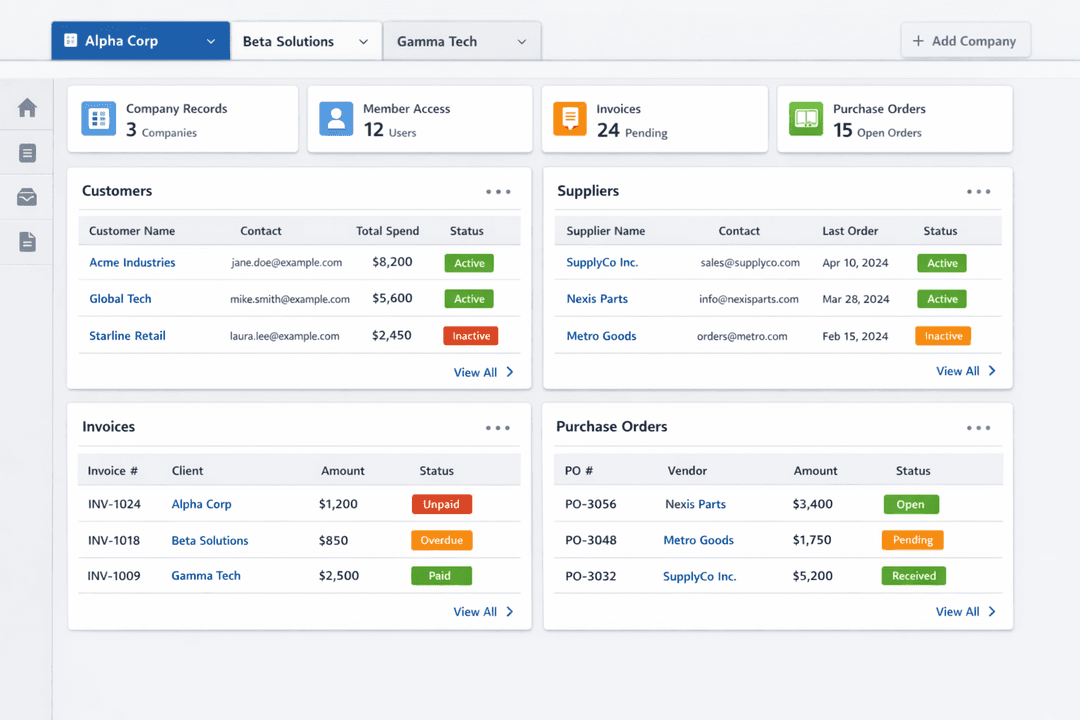
TREX Grow can help multi-company SMEs keep company context clearer by structuring operations around company records, member access, and entity-specific documents.
A practical setup in TREX Grow can include the following steps:
-
Create separate company records for each legal entity you operate. This gives your team a clearer foundation for which business is issuing invoices, creating purchase orders, and managing customer or supplier relationships.
-
Add members based on the companies they actually support. Shared admins, finance staff, sales coordinators, and purchasers can be assigned access according to operational responsibility instead of giving broad access by default.
-
Create invoices under the correct company record. Before sending any customer billing document, confirm the issuing company, customer details, and document ownership in the right company context.
-
Create purchase orders from the correct buying entity. When the same supplier serves more than one related company, make sure the purchasing document is raised from the company that is actually buying.
-
Maintain customer and supplier data with company context in mind. If the same external party deals with multiple companies in your group, your team should still verify which entity the relationship belongs to when creating or updating records.
-
Use member visibility and process discipline together. Software structure helps, but teams also need a habit of checking the active company before creating documents.
-
Review internal reporting by company. With cleaner document ownership, owners can compare activity by entity with more confidence and identify exceptions earlier.
For example, a shared finance team can log into TREX Grow, work within the appropriate company record, prepare invoices for that entity, and avoid mixing customer billing between sister companies. A purchasing team can do the same for supplier orders, especially when vendors are common across the group.
If billing data quality is also part of your review, these related guides may help:
- How Malaysian Finance Teams Can Prepare for Consolidated E-Invoice Handling
- LHDN E-Invoicing Source Data Checklist for Malaysian SMEs
- LHDN e-Invoice Phase 4 Preparation Checklist for Malaysian SMEs
A simple ownership checklist for owners and managers
If you run more than one related company, use this quick checklist to test whether document ownership is clear enough in daily operations.
- Can staff immediately tell which company should issue a customer invoice?
- Can staff distinguish which company should create a purchase order to a supplier?
- Are customer records reviewed in the context of the correct company relationship?
- Are supplier records managed with clear entity ownership?
- Do shared team members have access only where needed?
- Can management review reports by company without second-guessing document ownership?
- Are staff trained to confirm the active company before creating key documents?
If several of these answers are uncertain, the problem is usually not headcount. It is process clarity.
Small improvements in company separation can prevent repeated billing confusion, cleaner supplier coordination, and more reliable internal reporting over time.
Final thoughts
For Malaysian SMEs with multiple related companies, document ownership should be obvious long before month-end review. When shared staff know exactly which company they are acting for, invoices, purchase orders, customer records, and supplier records become easier to manage and easier to trust.
The practical goal is not to make operations rigid. It is to reduce avoidable cross-company confusion while keeping shared teams productive.
If your business is looking for a more structured way to separate multi-company workflows without overcomplicating daily work, it may be worth exploring how TREX Grow supports clearer company-level records, member access, and document handling.

