

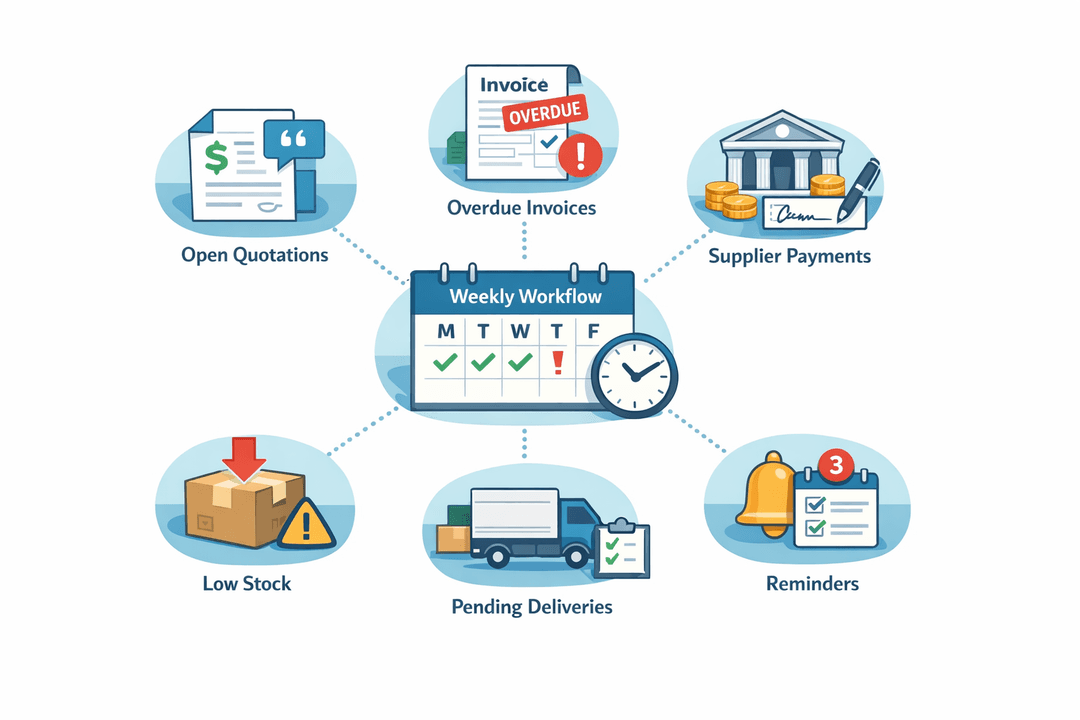
A practical weekly operational review helps SME owners turn everyday workflow data into early warning signals. By checking open quotations, overdue invoices, supplier payment dates, low stock, pending deliveries, and unresolved reminders, owners can identify delays, assign follow-up actions, and keep teams aligned without building a complex reporting process.
Why A Weekly Operational Review Matters
Many SME problems begin as small delays in daily work. A quotation is not followed up, an invoice passes its due date, a supplier payment is missed, or a delivery remains pending without a clear owner. Each issue may look manageable on its own, but several unresolved items can quickly affect cash flow, customer service, and stock availability.
A weekly operational report gives owners and managers a regular time to review these signals together. The purpose is not to create a complex dashboard. It is to identify what needs attention, who should act, and which problems may become more serious if they remain unresolved.
Start With Open Quotations And Sales Follow-Ups
Open quotations show where potential sales are waiting for a response, decision, revision, or internal follow-up. During the weekly review, check quotations that have been open for several days, quotations near their validity date, and quotations with no recent activity.
For example, a distributor may have ten open quotations, but only three have a clear next action. A service business may be waiting for a customer to confirm scope, while the sales admin assumes the owner is following up. The report should make these gaps visible.
Useful weekly questions include:
- Which quotations are still open?
- Which customers need a follow-up call or revised document?
- Which quotations have no assigned owner?
- Which opportunities should be closed, updated, or escalated?

Review Overdue Invoices And Supplier Payment Due Dates
A weekly report should show both money expected from customers and payments due to suppliers. Overdue invoices require clear follow-up, while upcoming supplier payment dates help the business plan cash movement and avoid last-minute surprises.
For example, a finance admin may be chasing an overdue customer invoice while also preparing payment for a key supplier. If both items are reviewed separately, the owner may not see the full picture. A weekly review connects customer collections, supplier commitments, and the operational consequences of delayed payment.
The review should highlight:
- Customer invoices that are overdue
- Large invoices approaching their due dates
- Supplier payments due within the next one or two weeks
- Payments that need supporting documents or manager approval
- Follow-up contacts and the latest communication status
Watch Low Stock And Purchasing Signals
Low stock is most useful when reviewed together with demand, open orders, and supplier lead times. A simple weekly stock review can help owners decide which items need replenishment and which apparent shortages can wait.
For a wholesaler or supplier, the report may show that a fast-moving item is below its preferred quantity while several customer orders are still pending. For a service business, the same principle may apply to commonly used materials, spare parts, or consumables.
A practical weekly stock check should cover:
- Items below the preferred stock level
- Products required for confirmed orders or upcoming jobs
- Purchase orders that have not been fulfilled
- Repeated urgent purchases that suggest poor planning
- Slow-moving items that should not be reordered automatically
Track Pending Deliveries And Unresolved Reminders
Pending deliveries often involve several teams, including sales, warehouse, drivers, and finance. A weekly report should show which deliveries are ready, delayed, partially completed, or waiting for customer confirmation.
Unresolved reminders are another important signal. These may include customer callbacks, supplier confirmations, invoice follow-ups, document checks, or internal tasks. When reminders remain open across several weeks, they usually indicate unclear ownership or missing information.
Review these items together:
- Deliveries that are past the planned date
- Orders waiting for stock, packing, or customer confirmation
- Partial deliveries that still require completion
- Reminders that remain unresolved from the previous week
- Tasks with no clear owner or next date
How To Keep The Weekly Review Practical
For most Malaysian SMEs, a useful weekly review can be completed in 30 to 60 minutes if the information is prepared consistently. The focus should remain on exceptions and actions rather than reading every transaction line by line.
A simple review process is:
- Choose a fixed day and time each week.
- Review the same operational categories in the same order.
- Focus on overdue, delayed, low-stock, or unassigned items.
- Record the next action, owner, and due date for each issue.
- Check the previous week's unresolved items before adding new actions.
Distributors may place more emphasis on stock and deliveries. Suppliers may focus on purchase commitments and customer collections. Service businesses may focus on quotations, job progress, billing, and reminders. The review format can stay simple while the priorities reflect the business model.

How TREX Grow Can Help Solve This
TREX Grow brings sales, purchasing, inventory, finance, delivery, and follow-up records into a more connected workflow. This makes it easier for owners and managers to review open quotations, overdue invoices, supplier payment due dates, low-stock items, pending deliveries, and unresolved reminders without collecting updates from multiple spreadsheets or chat messages.
By keeping daily records structured, TREX Grow helps teams produce a clearer weekly operational picture and assign follow-up actions with better context. SME owners can explore TREX Grow as a practical way to improve weekly operational visibility without turning the review into a complex reporting exercise.