

A pro forma invoice helps a business communicate an expected payment before the final invoice is issued. It is useful for deposits, advance payments, and milestone billing when the sale or project is already moving forward but final billing is not yet ready. This blueprint explains how a pro forma invoice differs from a quotation and a final invoice, where it fits in an SME workflow, and how teams can keep a clear document trail from confirmed work to completed billing.
What a Pro Forma Invoice Is Used For
A pro forma invoice is a preliminary billing document that communicates what a customer is expected to pay before the final invoice is issued. It can show the planned amount, payment due date, deposit requirement, milestone description, and payment instructions.
For example, a B2B service company may receive approval for a RM20,000 project and request a 30% deposit before work begins. The pro forma invoice can clearly state the RM6,000 advance payment, the due date, and the project reference so both the customer and the finance team understand what the payment relates to.
The document supports payment coordination, but it should not be treated as the completed final invoice. Its role is to clarify an expected payment while the sale, project, delivery, or billing process is still in progress.
How It Differs From a Quotation and a Final Invoice
A quotation presents a proposed price and scope before the customer confirms the purchase. It may include products, services, quantities, validity dates, and commercial terms for the customer to review.
A pro forma invoice is usually prepared after there is stronger purchase intent or a confirmed order. It focuses on the amount the customer is expected to pay before final billing, such as a deposit, advance payment, or agreed milestone amount.
A final invoice is issued when the business is ready to record and request the completed bill according to its normal invoicing process. It should reflect the final items, services, quantities, adjustments, and amounts that apply.
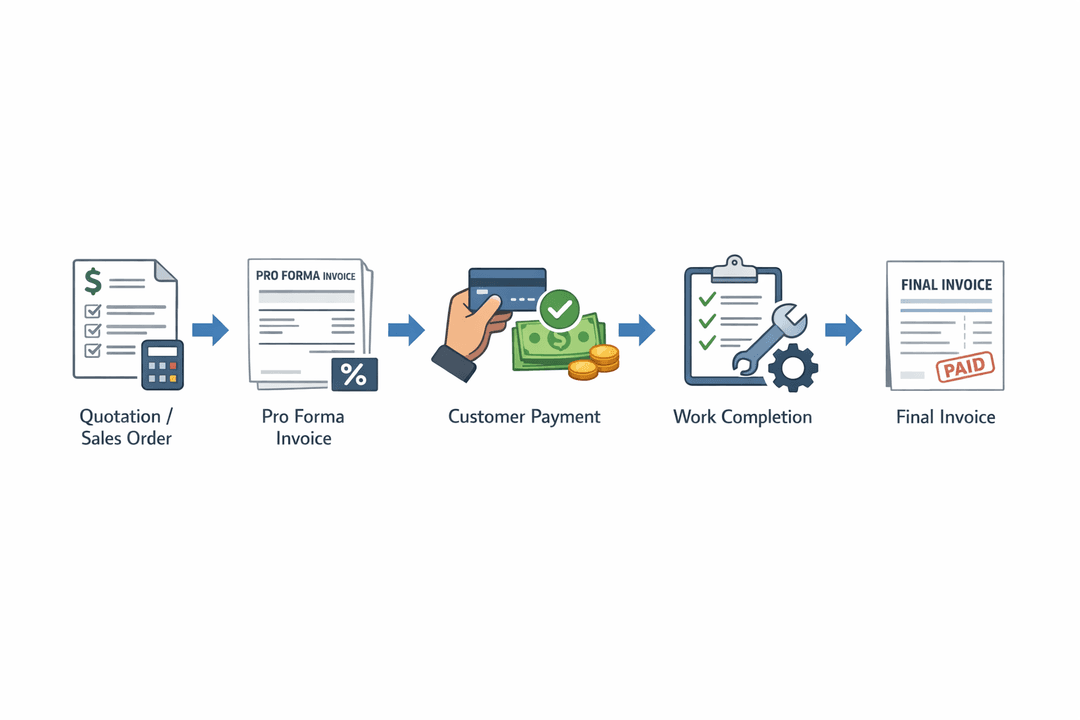
A practical document trail may look like this:
- The business sends a quotation.
- The customer accepts the quotation or confirms a sales order.
- The business issues a pro forma invoice for the required deposit.
- The customer makes the advance payment.
- The business completes the agreed work or delivery stage.
- The business issues the final invoice with the confirmed billing details.

Where Pro Forma Invoices Make Payment Expectations Clearer
Pro forma invoices are especially useful when payment is required before the full transaction is completed.
Common situations include:
- A supplier requesting a customer deposit before ordering materials.
- A project-based SME requesting payment after completing an agreed milestone.
- A service business requesting an advance payment before allocating staff or starting work.
- A distributor requesting partial payment before releasing a large order.
- A business confirming a due date for a pre-invoice payment that was agreed in the quotation or sales order.
For a project with three payment stages, the first pro forma invoice may request 30% before work starts. A second may request 40% after an approved milestone. The remaining amount can then be reflected in the final invoice after the project is completed.
This approach gives the customer a clear payment reference and helps internal teams understand which stage has been requested, paid, or still pending.
Keep the Document Trail Connected
A pro forma invoice should be linked to the commercial documents and operational records that explain why the payment is being requested. This may include the accepted quotation, confirmed sales order, project reference, customer purchase order, or milestone approval.
Finance and sales operations teams should check that the following details remain consistent:
- Customer name and billing contact.
- Quotation or sales order reference.
- Products, services, or milestone description.
- Deposit or advance-payment percentage.
- Amount requested and due date.
- Payment terms and payment instructions.
- Person responsible for following up.
For example, a supplier may convert an accepted quotation into a sales order and then prepare a pro forma invoice for a 50% deposit. When the goods are ready, the finance admin can review the deposit already received and prepare the final invoice using the confirmed order details.
Keeping these records connected reduces the risk of teams relying on separate spreadsheets, email threads, or chat messages to understand the payment status.
Handle Revised Pro Forma Invoices Carefully
Payment expectations may change before the final invoice is issued. A customer may reduce the order quantity, request an additional service, move a project milestone, or agree to a different deposit amount.
When this happens, the business should revise the pro forma invoice rather than quietly changing the original record without explanation. The revised version should show the updated amount, due date, items, milestone, or payment terms and remain traceable to the same quotation, sales order, or project.
For example, a customer initially agrees to a RM10,000 supply order with a 50% advance payment. Before paying, the customer reduces the quantity and the order value becomes RM8,000. The revised pro forma invoice should request RM4,000 instead of RM5,000 and clearly replace the earlier version.
Practical controls include:
- Use clear document numbers and revision references.
- Record why the amount changed.
- Confirm which version was sent to the customer.
- Avoid collecting payment against an outdated version.
- Review all payments received before preparing the final invoice.

Practical Workflow for Deposits and Milestone Payments
B2B service businesses, suppliers, and project-based SMEs can use a simple workflow to control pre-invoice payments.
- Confirm the scope, items, quantities, prices, and payment terms in the quotation or sales order.
- Identify whether a deposit, advance payment, or milestone payment is required.
- Create a pro forma invoice that states the exact amount, purpose, and due date.
- Assign responsibility for sending the document and following up with the customer.
- Record whether the payment is unpaid, partially paid, or fully received.
- Revise the pro forma invoice when the agreed amount or scope changes.
- Review the confirmed order, completed work, and payments received before issuing the final invoice.
The process should be easy for sales, operations, and finance teams to follow. Each team should know which document confirms the order, which document requests the advance payment, and when the final invoice is ready to be issued.
How TREX Grow Can Help Solve This
TREX Grow can help SMEs maintain a clearer workflow from quotation or sales order through pro forma invoicing and final billing. Teams can keep customer details, payment terms, due dates, document references, revisions, and responsible staff connected instead of managing them across separate files and messages.
A more structured record can help finance admins see why an advance payment was requested, sales operations teams confirm which version was sent, and business owners review pending deposits or milestone payments before work continues.
Explore TREX Grow for a more controlled pre-invoice payment workflow and clearer handover between sales, operations, and finance.