Trading and distribution SMEs
You need customer documents, purchasing, suppliers, stock, warehouse activity, approvals, finance handoff, and Malaysia e-Invoice work to remain connected.

Compare six credible starting points across focused SME operations, Malaysian accounting-led software, modular ERP, and partner-led ERP. No product wins every category; the useful choice is the one that completes your non-negotiable workflows with acceptable implementation, control, and exit effort.

This guide is for Malaysian SMEs that have outgrown disconnected spreadsheets or narrow tools and need to decide how much system breadth is justified. It is most useful before a shortlist, demo, implementation proposal, or management approval—not after a vendor and architecture have already been chosen.
Operational pressure
When records live in different places, the person responsible has to reconstruct what happened before they can make a confident decision or follow up.
You need customer documents, purchasing, suppliers, stock, warehouse activity, approvals, finance handoff, and Malaysia e-Invoice work to remain connected.
You need to determine whether operational documents are enough or whether project accounting, resource planning, service management, time, or billing depth should lead the decision.
You want one controlled operating view but do not yet know whether the right next step is a focused workflow platform, accounting-led system, modular ERP, or full implementation programme.
You already control finance but need to test whether sales, purchasing, inventory, approvals, warehouse, CRM, and supporting records are deep enough in the same product.
Several people now create or approve records, so permissions, ownership, status, traceability, integrations, and shared master data matter more than a single-user feature list.
You need a defensible record of requirements, assumptions, implementation scope, total cost, risks, evidence, and exit options before committing.
ERP is not simply a larger feature list. It is a decision about how many core processes, entities, controls, integrations, and reporting responsibilities must share one governed system. Start with the operating centre before comparing brands.
Choose this path when sales documents, purchasing, inventory, warehouse work, approvals, customers, suppliers, RFQ, catalog, appointments, and operational visibility are the main problem.
Choose this path when Malaysian accounting, bank work, statutory reporting, sales, purchases, and practical stock records are central and the wider process scope remains manageable.
Choose this path when the business wants to assemble CRM, sales, accounting, inventory, manufacturing, HR, projects, ecommerce, or other apps with configuration and integration flexibility.
Choose this path when mature finance, supply chain, manufacturing, service, projects, multi-company work, governance, extensions, and formal implementation support justify a larger programme.
Choose a specialist product when regulated traceability, industry costing, field service, construction, professional services, payroll, POS, ecommerce, or production control is the non-negotiable centre.
Use one requirement matrix for every candidate. A system should only score well when the team can demonstrate the workflow, control, output, and responsibility—not because a brochure uses the right module name.
List the quote-to-cash, procure-to-pay, stock, warehouse, finance, service, project, manufacturing, people, and management processes that must share data.
Test chart of accounts, receivables, payables, bank reconciliation, tax, period close, financial statements, audit support, accountant access, and Malaysia localisation.
Test the actual documents, quantities, locations, returns, adjustments, approvals, exceptions, service events, projects, or production records used every day.
Verify the exact MyInvois, e-Invoice, SST, currency, local reporting, language, support, partner, and regulatory-review path required by the business.
Check user types, roles, segregation, approval responsibility, audit context, mobile access, training effort, and what each employee may see or change.
Confirm APIs, imports, exports, bank, ecommerce, payroll, payment, logistics, reporting, identity, and any industry-system connections using the exact edition and plan.
Compare self-service, vendor-led, partner-led, cloud, hosted, and on-premise options together with migration, configuration, customisation, testing, support, and upgrade ownership.
Estimate the full operating cost and internal workload, then test data ownership, usable exports, cancellation, renewal, custom-code dependency, and migration-out options.
Most expensive ERP problems begin before configuration. The business buys a category or brand before agreeing which processes must change, which evidence will prove fit, and who is accountable for the result.
Recurring issues usually point to workflow-control gaps, not one isolated data-entry mistake.
A broad label can push the team toward unnecessary scope before it has defined the specific records, controls, reports, and handoffs that are failing.
Two products may both list inventory, purchasing, CRM, accounting, or manufacturing while supporting very different transactions, controls, exceptions, and outputs.
A polished quote, order, or invoice says little about partial receipts, returns, approval delays, credit adjustments, stock differences, failed integrations, or close-period corrections.
MyInvois submission is important, but it does not prove the product meets the business's accounting, tax, document, reporting, support, or exception-handling requirements.
Licences do not clean master data, settle process decisions, map accounts, configure roles, test integrations, train users, or manage cutover.
Early custom work can encode old habits, increase upgrade dependency, and hide whether the standard product already supports a simpler operating method.
A buyer may learn too late that attachments, history, audit context, custom fields, or relationship data are difficult to retrieve in a usable form.
This is a fit comparison, not a paid ranking. Product and pricing claims below were checked against each provider's official pages and current TREX Grow sources on 22 August 2026. Features, promotions, taxes, currencies, editions, localisation, limits, and terms can change, so verify the official pages and a written proposal before purchase.
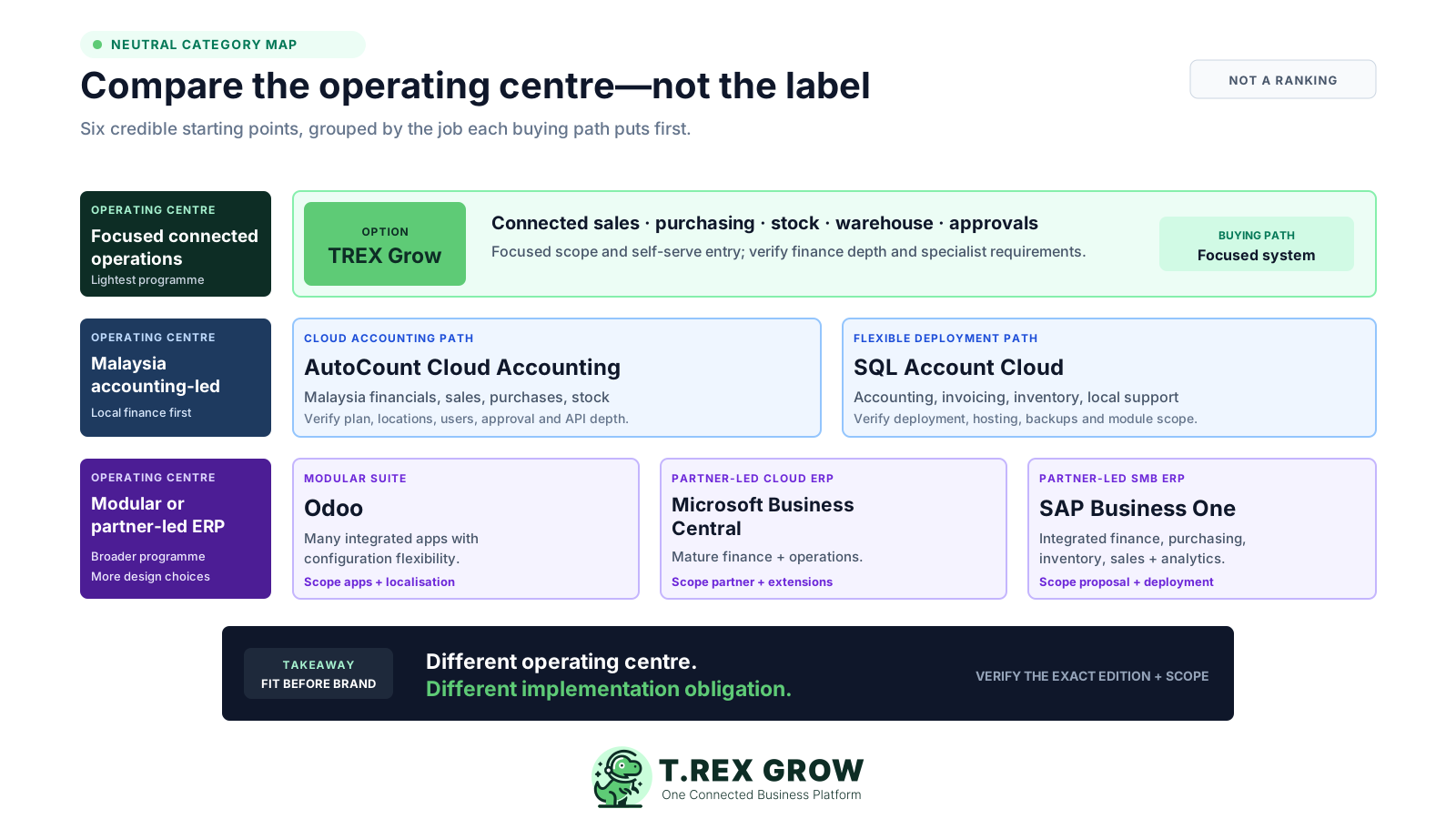
Published starting points and practical checks, reviewed 22 August 2026. Prices exclude any unlisted tax, foreign exchange, partner, implementation, migration, integration, hosting, hardware, customisation, support, renewal, or internal project cost.
| Option | Best fit | Published starting point | Verify before choosing |
|---|---|---|---|
| TREX Grow | Malaysian SMEs prioritising connected sales, purchasing, inventory, warehouse, approvals, RFQ, catalog, appointments, operational documents, and supported e-Invoice work without a heavyweight ERP rollout. | Free Forever covers core records and customer documents. The official page currently lists Starter at USD 40/year, Essential at USD 100/year, and Premium at USD 125/year; all plans list unlimited users and products, while paid plans include a 30-day trial. | Treat Accounting Beta as beta: setup, explicit activation, and qualified review are required. Evaluate another path when mature full finance, manufacturing MRP, payroll or HR, service management, project accounting, complex consolidation, or extensive customisation is essential. |
| AutoCount Cloud Accounting | Malaysia accounting-led SMEs that want local financials, sales and purchase documents, LHDN e-Invoice, inventory, multi-location options, reports, and dealer or support resources in one cloud product. | The official monthly table lists Plus at RM 140/month for trading products and Pro at RM 180/month for multi-warehouse; both list 3 included users. Displayed prices exclude SST, and promotional annual pricing has separate terms. | Confirm the chosen plan's users, stock depth, variants, locations, approval, API, payroll, manufacturing, project, implementation, on-site service, support, promotion, renewal, and data-export requirements. |
| SQL Account Cloud | Malaysian SMEs prioritising accounting, invoicing, sales and purchase documents, inventory reports, LHDN e-Invoice, SST, training, support, and flexible public, private, or local deployment choices. | The official page lists Pro at RM 109/month for accounting, invoicing, and inventory, with RM 60/month per additional user. Essential is listed at RM 79/month without inventory tracking. | Confirm locations, item traceability, approvals, payroll, manufacturing, projects, API, hosting, backups, implementation, support, migration, and the exact differences between public, private, and local deployment. |
| Odoo | Businesses willing to configure a modular suite spanning CRM, sales, accounting, inventory, purchasing, manufacturing, HR, projects, ecommerce, POS, and other integrated apps. | The official global page lists One App Free at US$ 0 with one app and unlimited users. It currently displays Standard at US$ 24.90 and Custom at US$ 49.00 per user/month on yearly billing, subject to regional display and current terms. | Scope the required apps, Malaysia localisation and MyInvois configuration, hosting, users, companies, API, Studio, migration, partner services, customisation, support, upgrade path, and total implementation effort. |
| Microsoft Dynamics 365 Business Central | SMEs that need mature finance, sales, purchasing, inventory, supply chain, projects, warehouse, Microsoft 365 integration, extensions, and a partner-led cloud ERP path; Premium adds service and manufacturing. | Microsoft's Malaysia page lists Essentials at USD 80/user/month and Premium at USD 110/user/month, paid yearly before tax. A free 30-day trial is listed; purchase and implementation use Microsoft's partner network. | Confirm Malaysian localisation and e-Invoice approach, partner scope, implementation, extensions, integrations, environments, storage, licence mix, accountant access, support, migration, renewal, and total cost. |
| SAP Business One | Small and midsize companies or subsidiaries needing integrated accounting and financials, purchasing, inventory, sales and CRM, reporting, analytics, extensibility, and a structured partner-led ERP implementation. | SAP's official page uses request-a-quote pricing rather than one public fixed subscription amount. Deployment, database, licences, partner services, localisation, implementation, and support depend on the agreed scope. | Request a Malaysian written proposal covering localisation, e-Invoice, deployment, database, users, modules, implementation, migration, integrations, customisation, support, upgrades, training, timeline, responsibilities, and exit options. |
The best practice is to make the next action clear before the situation becomes urgent.
A vendor tour explains the intended product. A controlled proof-of-fit shows whether the exact edition, configuration, localisation, data, roles, outputs, integrations, and implementation model fit your business. Use the same representative scenario and evidence record for every option.
Record the current facts in one shared place.
Confirm what is known and what needs attention.
Make the next decision or follow-up accountable.
Complete the next task and record the outcome.
Refresh the shared view when facts change.
A dependable workflow keeps the shared record and the next action aligned.
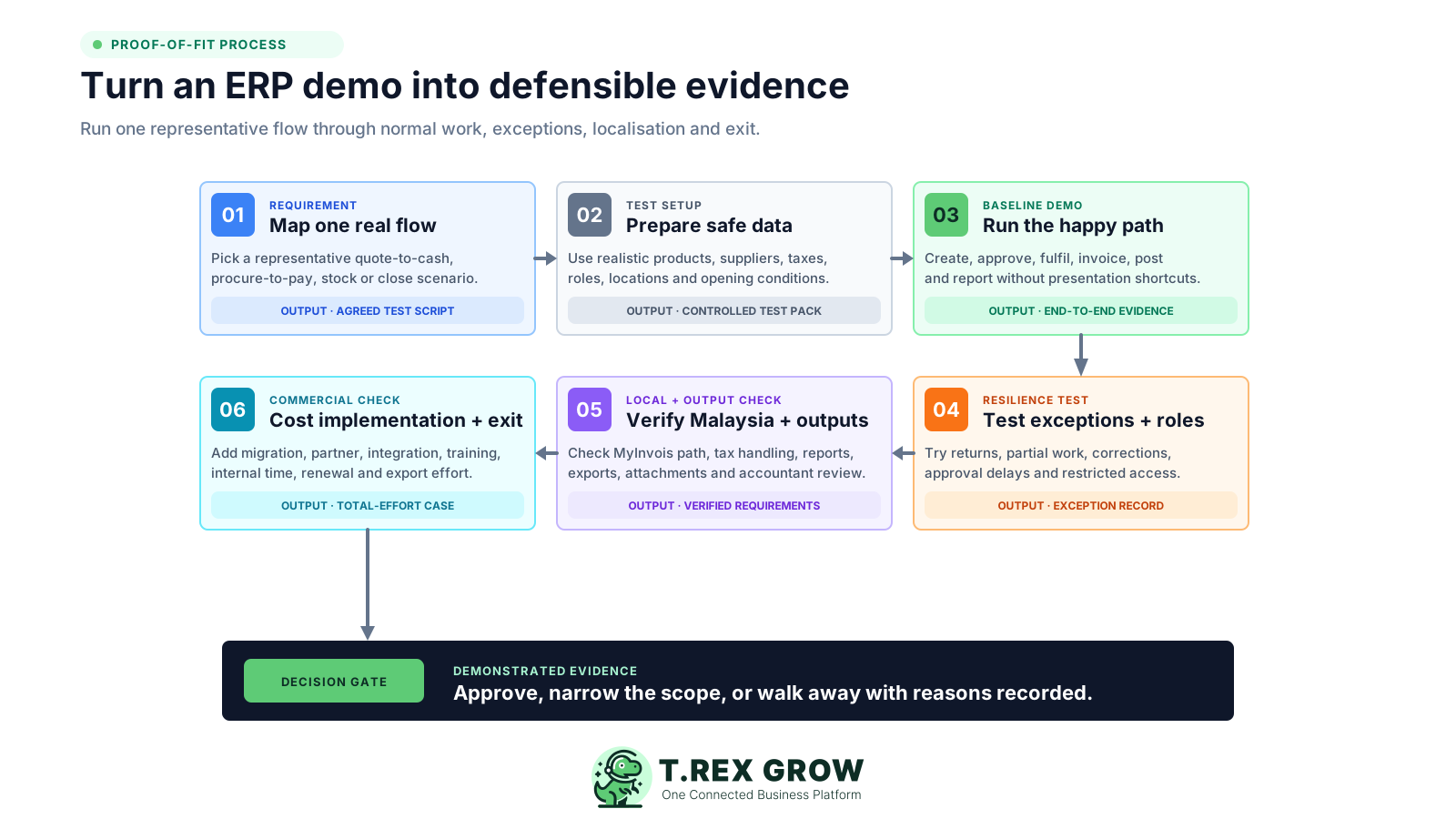
1. Map one must-run flow: choose a representative quote-to-cash, procure-to-pay, stock, service, project, manufacturing, or finance-close scenario and write down its start, records, exceptions, approvals, outputs, and owner.
2. Prepare safe representative data: use realistic customers, suppliers, products, accounts, locations, tax fields, currencies, users, documents, and opening assumptions without exposing live confidential data.
3. Run the happy path: make the provider or implementation partner complete the scenario in the proposed edition, plan, localisation, deployment, and user model rather than a generic demonstration database.
4. Test exceptions and control: include a partial event, return, adjustment, approval delay, permission restriction, correction, period issue, failed integration, or other normal exception the team handles today.
5. Verify outputs and ownership: inspect documents, reports, Malaysia e-Invoice handling, audit context, exports, API or integration evidence, backup responsibility, support route, and who owns every configuration decision.
6. Cost implementation and exit: compare licence, partner, migration, integration, customisation, training, support, internal time, renewal, parallel tools, data export, and migration-out effort over a practical planning horizon.
TREX Grow fits document-driven SMEs that want connected daily operations without beginning with a large ERP programme. Its value is the continuity between records, documents, permissions, approvals, stock, warehouse work, and next actions; its boundary is equally important for a fair decision.
Use products, customers, quotations, invoices, RFQ, appointments, users, and supported Malaysia e-Invoice submission in the Free Forever workspace.
Starter adds broader sales documents, attachments, multi-currency, and Accounting Beta for teams that need more document depth.
Essential adds suppliers, purchase orders, supplier billing, stock entries, adjustments, returns, and core inventory operations.
Premium adds custom locations, location ledgers, delivery picking, picking-list PDFs, and structured inventory-count sessions.
Company memberships, module access, approval responsibility, record status, reviewer context, and supporting documents help teams control operational handoffs.
Free access and paid-plan trials let an SME test representative workflows before deciding whether it needs broader system or implementation scope.
TREX Grow should not be treated as a verified replacement for mature full accounting, manufacturing MRP, payroll or HR, service management, project accounting, complex multi-entity consolidation, or extensive industry customisation. Accounting Beta requires setup and qualified review.
The dashboard brings current operational attention into one screen: unpaid customer and supplier invoices, delivery activity, purchase-order receipts, low-stock attention, quotation follow-up, reminders, search, document creation, and the user manual. It is product proof for TREX Grow's operating centre—not evidence that every full ERP module exists.
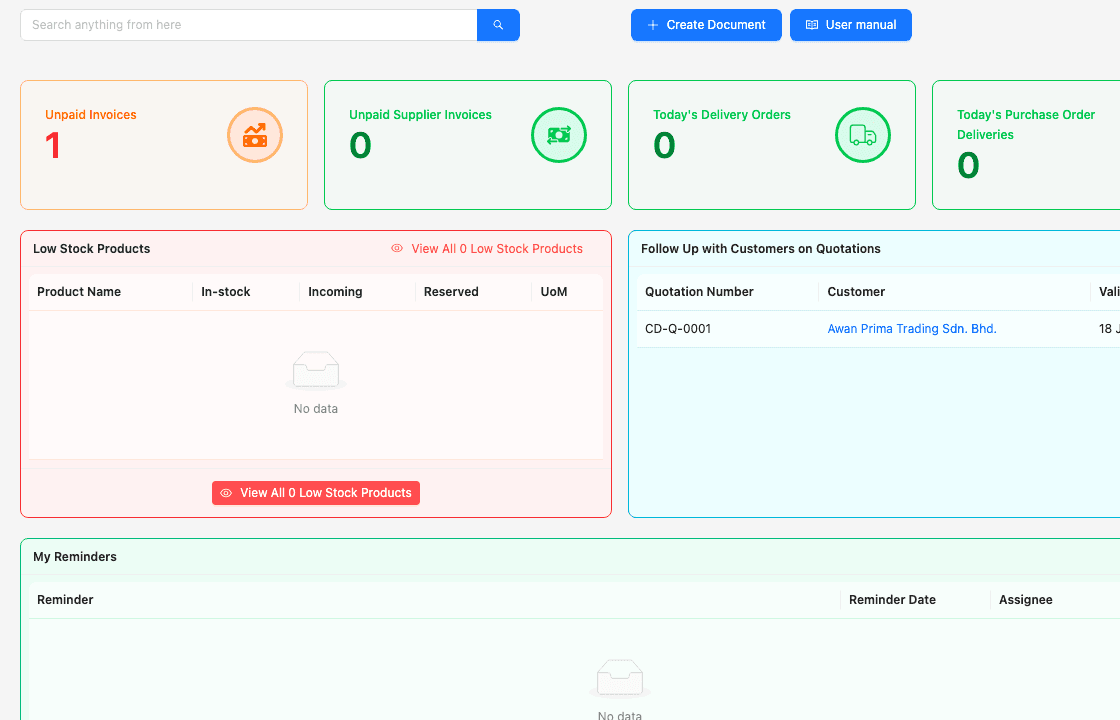
Customer, supplier, delivery, purchasing, stock, quotation, and reminder signals appear in one operating view.
The dashboard points users toward the document or record that needs follow-up instead of summarising detached totals only.
The product is organised around the daily documents and exceptions a small operations team needs to find and act on.
Use the dashboard as evidence of connected operations, then separately test finance, manufacturing, HR, projects, service, consolidation, integrations, and industry controls when required.
A low headline price can still support an expensive rollout, while a higher licence may reduce other work. Build one total-effort model for every option and separate one-time implementation from recurring operation so management can see what it is approving.
Map full, limited, approval, device, accountant, portal, API, company, location, storage, transaction, and add-on licences to real users and workloads.
Include discovery, process design, project management, configuration, localisation, testing, cutover, go-live, hypercare, and any travel or on-site service.
Cost extraction, mapping, deduplication, opening balances, item and customer cleanup, transaction history, attachments, validation, reconciliation, and archive access.
Include APIs, middleware, bank, payment, ecommerce, logistics, payroll, reporting, identity, industry systems, extensions, custom code, testing, and future upgrades.
Budget process decisions, key-user time, documentation, role training, support triage, change communication, user acceptance, and the internal owner after the partner leaves.
Record every spreadsheet, legacy system, portal, manual reconciliation, or duplicate entry that remains because it is part of the real operating cost.
Model foreign exchange, tax, price changes, support renewal, hosting, version upgrades, custom-code maintenance, export work, contract terms, and migration-out cost.
A shortlist is not ready for management approval until the team has tested current Malaysia requirements, security responsibilities, data handling, support, contract terms, and an exit path. Keep provider answers, screenshots, proposals, assumptions, and unresolved risks with the decision record.
Check the latest HASiL guidelines and MyInvois SDK material, then verify the product's exact submission, intermediary, consolidated, self-billed, cancellation, rejection, error, and update path relevant to the business.
Have qualified advisers review chart of accounts, SST, tax treatment, financial outputs, period close, statutory responsibilities, and any localisation or integration assumptions.
Ask about authentication, permissions, administrator access, encryption, backups, recovery, monitoring, incidents, vendors, hosting, retention, and the customer's own responsibilities.
Test who may create, edit, approve, post, reverse, export, configure, and administer; then inspect what identity, date, status, change, and source context remains visible.
Export master data, open documents, transactions, balances, attachments, history, custom fields, and relationships in a form another system or archive can actually use.
Confirm service hours, severity handling, escalation, recovery responsibilities, planned maintenance, release communication, partner dependencies, and the business continuity workaround.
Review term, renewal, cancellation, data return, deletion, price changes, implementation acceptance, scope changes, custom work, intellectual property, and responsibility boundaries.
The best practice is to make the next action clear before the situation becomes urgent.
TREX Grow is intentionally not positioned as every type of ERP. Let the most difficult non-negotiable process lead the shortlist, then test how the remaining operations will connect and what implementation capability the company can sustain.
A full ERP may lead when the business needs dependable multi-ledger finance, fixed assets, budgeting, consolidation, intercompany, complex revenue, audit controls, and formal close management.
Choose deeper ERP or specialist MRP when bills of materials, routings, work centres, capacity, production orders, quality, traceability, costing, maintenance, or planning are essential.
A fuller platform may be required for several legal entities, currencies, tax localisations, intercompany flows, shared services, group reporting, and governed master data.
Evaluate project or service ERP depth when estimates, resource planning, time, expenses, contracts, field service, service orders, warranties, billing, and profitability drive the business.
Use an ERP or specialist people system when employee records, payroll, leave, time, claims, recruitment, performance, statutory work, and workforce planning must connect.
A modular or partner-led ERP may fit when the company has the budget, governance, technical ownership, and long-term operating model for extensions, integrations, custom process, and formal release management.
Start Free with TREX Grow and run one representative customer-document workflow. Use the 30-day paid-plan trial when purchasing, inventory, warehouse, or Accounting Beta is part of the test. Score the same scenario, exceptions, outputs, ownership, implementation, cost, and exit evidence against every other shortlisted system.
There is no universal winner. TREX Grow can fit document-driven SMEs that prioritise connected sales, purchasing, inventory, warehouse, approvals, and supported e-Invoice work with a light rollout. AutoCount and SQL Account suit accounting-led evaluation; Odoo suits modular configuration; Microsoft Business Central and SAP Business One suit fuller partner-led ERP evaluation. Test your non-negotiable process before choosing.