
Cash-flow software guide for Malaysian SMEs

Unpaid Invoice Tracking Software: A Practical SME Guide

Unpaid invoice tracking software should make the next collection action visible—not just show a list of balances. This guide explains the records, payment states, ownership, evidence, and review habits that help Malaysian SMEs work from one dependable view.

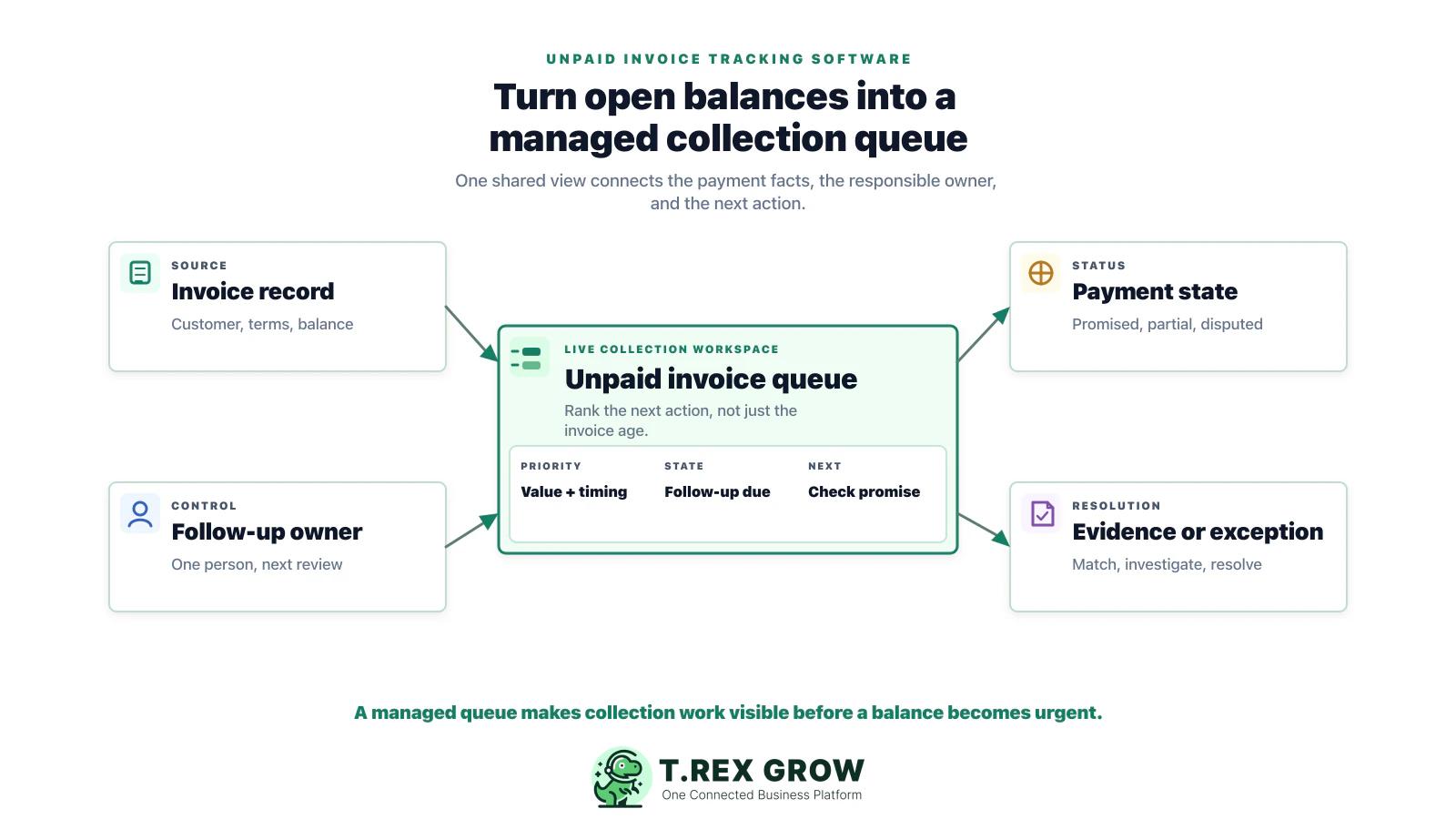
Unpaid invoice collection queue showing an invoice record connected to payment status, follow-up ownership, evidence and cash-flow priority

Primary keyword

unpaid invoice tracking software

Audience

Malaysian SME owners, finance administrators, accounts assistants, sales coordinators, account managers, and operations teams that need a reliable shared view of unpaid customer invoices, payment promises, collection actions, and cash-flow risk.

Goal

Teach Malaysian SMEs the controls to look for in unpaid invoice tracking software—one record, useful states, ownership, payment evidence, exceptions, and a review queue—then softly show how TREX Grow can support a connected operating view.

Problem

Why an unpaid invoice list is not enough

A spreadsheet can tell you that money is outstanding. It often cannot tell the team which invoice is most important, what the customer last said, whether payment proof has arrived, or who is responsible for the next action. The result is a balance list that still needs manual detective work before anyone can collect confidently.

Operational pressure

The next action is easy to lose when context is scattered.

When records live in different places, the person responsible has to reconstruct what happened before they can make a confident decision or follow up.

Scattered recordsUnclear ownershipAvoidable surprises
High risk

The list does not show collection priority

A large balance, a broken payment promise, a dispute, and an invoice that is not yet due should not all sit in one undifferentiated unpaid column. The team needs a way to see risk, timing, and next action together.
Customer context is outside the invoice

A billing contact may ask for a statement, explain a short delay, dispute a line, or send a remittance reference by email or WhatsApp. If that context is not attached to the invoice record, the next colleague starts again from zero.

Payment status is too vague

An invoice can be due soon, overdue, promised, partially paid, paid pending match, disputed, or waiting for an internal document. A single unpaid label does not guide the right response.

High risk

Ownership changes without a handover

Sales may know the relationship while finance knows the amount and operations holds delivery evidence. Without an owner and a recorded next action, collection work pauses whenever a person is unavailable.

Cash expectations are based on stale dates

The due date is an agreed deadline, not always a current prediction. A collection view should let the team distinguish it from a credible expected-payment date and revisit that expectation when facts change.

Payment matching happens too late

When a bank reference or remittance advice is not linked promptly, staff may chase a customer who has paid, or close an invoice before its remaining balance and deduction are understood.

Education

What unpaid invoice tracking software should make visible

The useful unit is not an ageing spreadsheet alone. It is a live collection record for each open invoice, placed in a shared queue that shows what is true now and what the team should do next.

A useful record supports the next decision

The work is easier when the team can see the current facts, the responsible person, and the next action without reconstructing the history from separate tools.

Shared operating context
Clear ownership and status
A visible next action

Set up the team view

1

Define the shared fields

  • - Use current facts
  • - Keep details consistent
2

Assign the next action

  • - Name an owner
  • - Set a review date
3

Keep it current

  • - Record changes
  • - Resolve exceptions
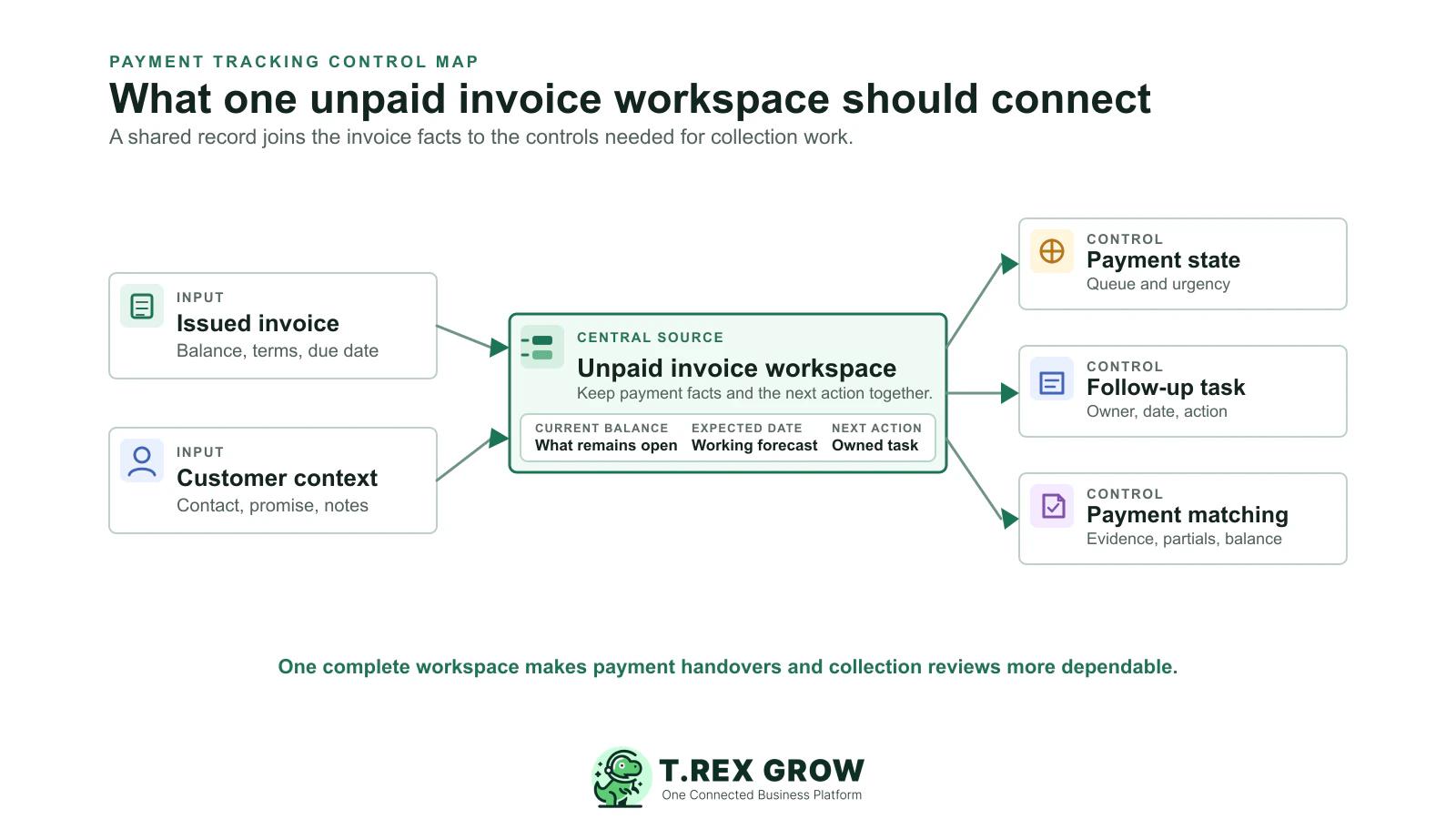
Single-source collection workspace connecting issued invoice and customer context to payment state, follow-up task and payment matching

One live collection record

The invoice number, customer, contact, original amount, current balance, payment terms, and source reference should be easy to retrieve from one place rather than rebuilt from several tools.

Due date and expected date

Keep the formal due date and the latest credible expected-payment date separate. This gives the team both a contractual reference and a current collection forecast.

Useful payment states

Look for states such as not due, due soon, follow-up due, payment promised, partially paid, paid pending match, disputed, and resolved. States should lead naturally to a next action.

A named owner and next review

Every open balance needs a responsible person, a next task, and a review date. The queue should show this without staff opening every invoice or searching through notes.

Payment evidence and matching

A practical tool keeps payment references, received amounts, remittance advice, and allocation decisions close to the invoice so the team can explain the balance with confidence.

Exception context

Disputes, deductions, missing purchase orders, delivery questions, and requested extensions should have a reason, owner, and recovery plan—not become a vague note with no follow-up.

Workflow

A practical way to assess an unpaid invoice tracking tool

Test the tool against one real collection scenario from start to finish. The goal is to see whether it helps the team keep the payment story, responsibility, and next action together as facts change.

A repeatable operating workflow

Capture

Record the current facts in one shared place.

Check

Confirm what is known and what needs attention.

Assign

Make the next decision or follow-up accountable.

Act

Complete the next task and record the outcome.

Review

Refresh the shared view when facts change.

A dependable workflow keeps the shared record and the next action aligned.

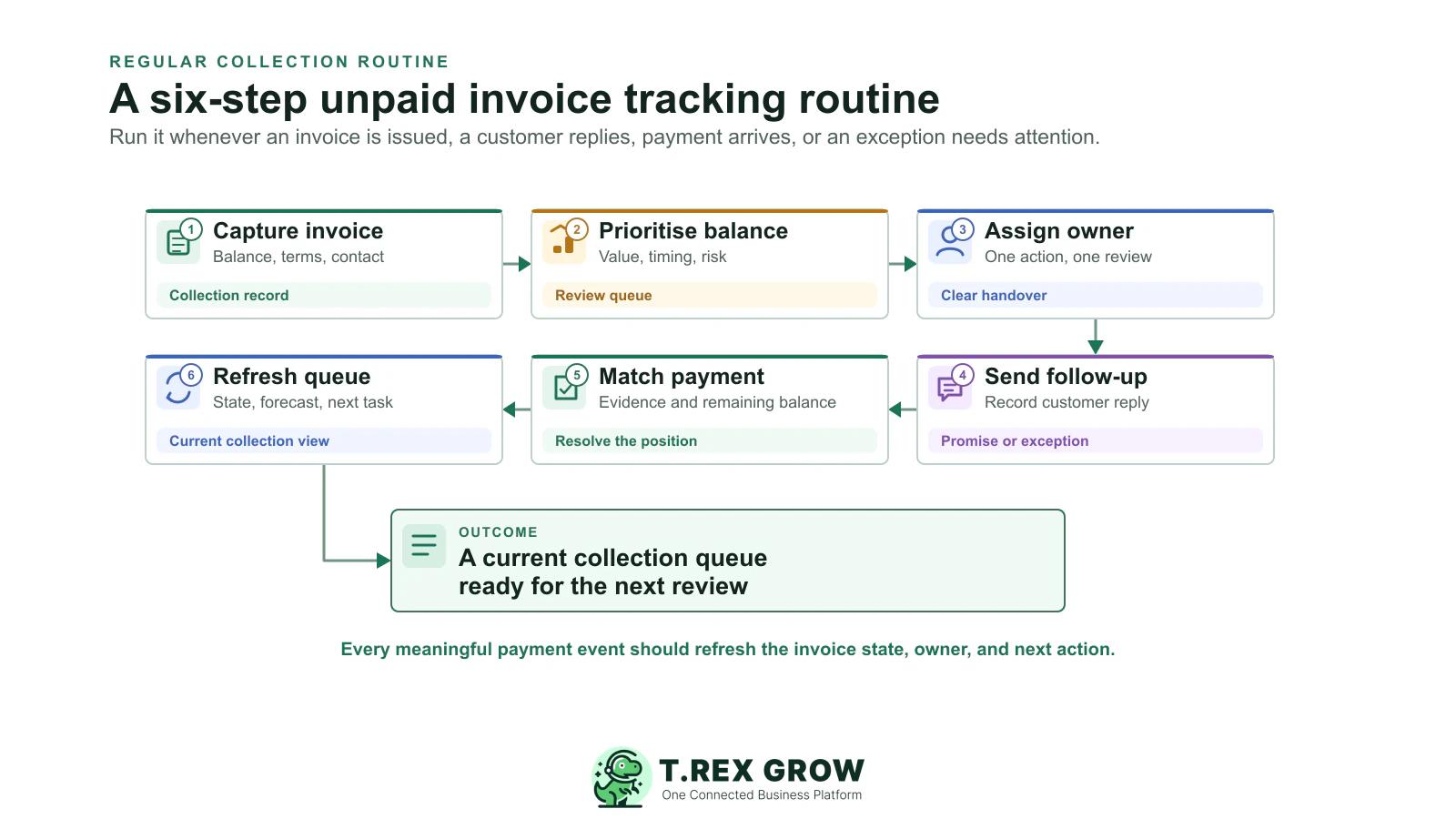
Six-step unpaid invoice tracking routine from capturing an invoice to refreshing the collection queue after payment or an exception
1

Capture the issued invoice with the customer, contact, balance, agreed payment terms, due date, and the source document or service reference that explains the charge.

2

Prioritise the balance using meaningful signals: value, due timing, expected-payment date, payment promise, dispute, missing evidence, and any customer pattern the team needs to consider.

3

Assign one owner, one next action, and one next review date. If ownership moves from sales to finance or operations, record the handover in the collection record.

4

Send or complete the appropriate follow-up. Record the contact channel, what was requested, the customer reply, and whether a new expected-payment date is credible enough to use in the working forecast.

5

Match payment evidence or flag an exception. Keep the payment reference, amount received, remaining balance, deduction, dispute, or unverified claim visible until the position is resolved.

6

Refresh the queue after every meaningful event. Update the state, cash expectation, owner, and next action so managers see a current collection picture rather than an old list of invoices.

Mistakes

Software choices that recreate manual collection work

A tracking tool can still create a spreadsheet problem if it captures only invoice totals and leaves the team to manage customer context, ownership, and exceptions elsewhere.

Most issues are not tax knowledge problems. They are workflow control problems.

Common

Buying a dashboard without testing the record behind it

A polished ageing chart is not enough. Ask whether staff can open the relevant invoice and immediately see the current balance, customer context, evidence, owner, and next action.

High risk

Using one unpaid status for every situation

Not due, payment promised, disputed, partly paid, and long overdue need different treatment. If the software cannot distinguish them clearly, the queue cannot guide work.

Common

Treating reminders as the whole workflow

Automated messages can save time, but they do not replace a clear owner, a record of the customer response, or a decision about what to do when payment does not arrive.

High risk

Closing an invoice before payment matching is clear

A payment can be short, combined with another invoice, offset by a credit, or missing a usable reference. The remaining position should remain visible until it is genuinely resolved.

Common

Leaving sales and finance with separate queues

When relationship notes sit with sales and invoice status sits with finance, neither person has enough context to act well. Test how the tool supports a shared, controlled view.

High risk

Measuring only overdue totals

An overdue total hides promises, disputes, next actions, and high-risk invoices. Review the makeup of the queue, not merely the sum at the bottom of a report.

Best practices

Controls that make a tracking tool useful every day

The strongest unpaid invoice tracking setup is simple enough to maintain and specific enough to tell the team what to do next. These practices matter more than an impressive dashboard.

Do this

Use the invoice as the collection anchor

Keep the amount, terms, customer context, source references, payment evidence, and follow-up history connected to the same invoice record whenever possible.

Do this

Separate the due date from the working forecast

Retain the agreed payment term while updating a separate expected date only when the team has a reliable reason. Review expired promises instead of letting them silently become forecasts.

Do this

Make next actions more visible than old notes

A useful queue leads with the owner, next task, review date, state, and balance. Older messages remain available as context, but they should not hide the current decision.

Do this

Design partial-payment handling before it happens

Agree how the team records the amount received, remaining balance, deduction reason, evidence, and next action so that a partial payment does not disappear from the collection view.

Do this

Review exceptions by recovery path

Group disputes, missing documents, credit questions, and payment promises by the person or action needed to resolve them. This makes the queue operational rather than descriptive.

Do this

Use manager review to remove blockers

A weekly collection review should focus on the balances that need a decision, escalation, document, or relationship intervention—not repeat every invoice already progressing normally.

The best practice is to make the next action clear before the situation becomes urgent.

Solution

How TREX Grow can support a more connected collection view

Once the team has agreed its collection routine, TREX Grow can help keep invoice, customer, sales-document, payment, and follow-up context closer together. The aim is to make open balances easier to understand and act on without rebuilding the story from separate files.

Operations work better when records and next actions are connected

Connect invoice and customer context

Keep the invoice closer to the records that explain who is being billed, what was agreed, and which source documents support the charge.

Make operational status visible

Use a shared view to help the team see which invoice needs review, a customer reply, payment matching, an exception decision, or a follow-up action.

Support clearer ownership

Give sales, finance, and operations a way to share the current position and hand over the next action with less reliance on memory or private message threads.

TREX Grow Operations Hub

Retain a useful record trail

Keep payment activity, document references, and operational notes available when the team needs to answer a customer or review a collection decision.

Build a better base for cash-flow review

When open invoice states and next actions are maintained consistently, collection conversations can focus on current risk and decisions rather than reconstructing the numbers.

Next step

Start by testing one real unpaid invoice

Take an open invoice with a customer reply, a partial payment, or a missing document. Ask whether the tracking tool lets the next person see the balance, due and expected dates, owner, evidence, exception, and next action without opening several files. That single test will reveal whether the software can support your collection routine.

Explore how TREX Grow works

It is a tool or connected workflow that helps a business monitor open customer invoices and the work around them: balances, due dates, expected payment dates, collection states, owners, customer replies, payment evidence, exceptions, and next actions. The useful outcome is a shared collection view, not only an overdue report.