The order starts before the decision
Staff call the request urgent, contact the supplier or confirm delivery first, then ask a manager to regularise the purchase afterwards.

A useful purchase approval workflow does more than collect a yes. It gives the right decision-maker a clear need, supplier and commercial facts, supporting evidence and an identifiable version before the business issues the purchase order.

The real commitment is defined by the supplier, items or service, quantity, price, terms, timing and current version. If the approver sees only a message or copied total, the business cannot be sure that the eventual purchase order represents the decision that was actually made.
Operational pressure
When records live in different places, the person responsible has to reconstruct what happened before they can make a confident decision or follow up.
Staff call the request urgent, contact the supplier or confirm delivery first, then ask a manager to regularise the purchase afterwards.
The request omits the purpose, supplier basis, product or service detail, quantity, total cost, delivery need, terms or supporting quotation.
Without measurable and categorical triggers, routine purchases create bottlenecks while unusual or sensitive commitments receive the same superficial review.
A convenient manager approves outside a documented limit, or staff borrow access because the named decision-maker is absent.
Supplier, item, quantity, unit price or terms are edited after approval without a visible return to the decision gate.
Returned, held or declined work vanishes into chat, so the requester does not know what evidence is missing, who owns the next action or whether a new decision is required.
Purchase approval should happen after the need and decision facts are sufficiently clear but before the SME makes the supplier-facing commitment. Keep later receipt, supplier-invoice review and payment authorisation as connected but distinct controls; an approved PO does not prove that goods arrived, an invoice is correct or payment occurred.
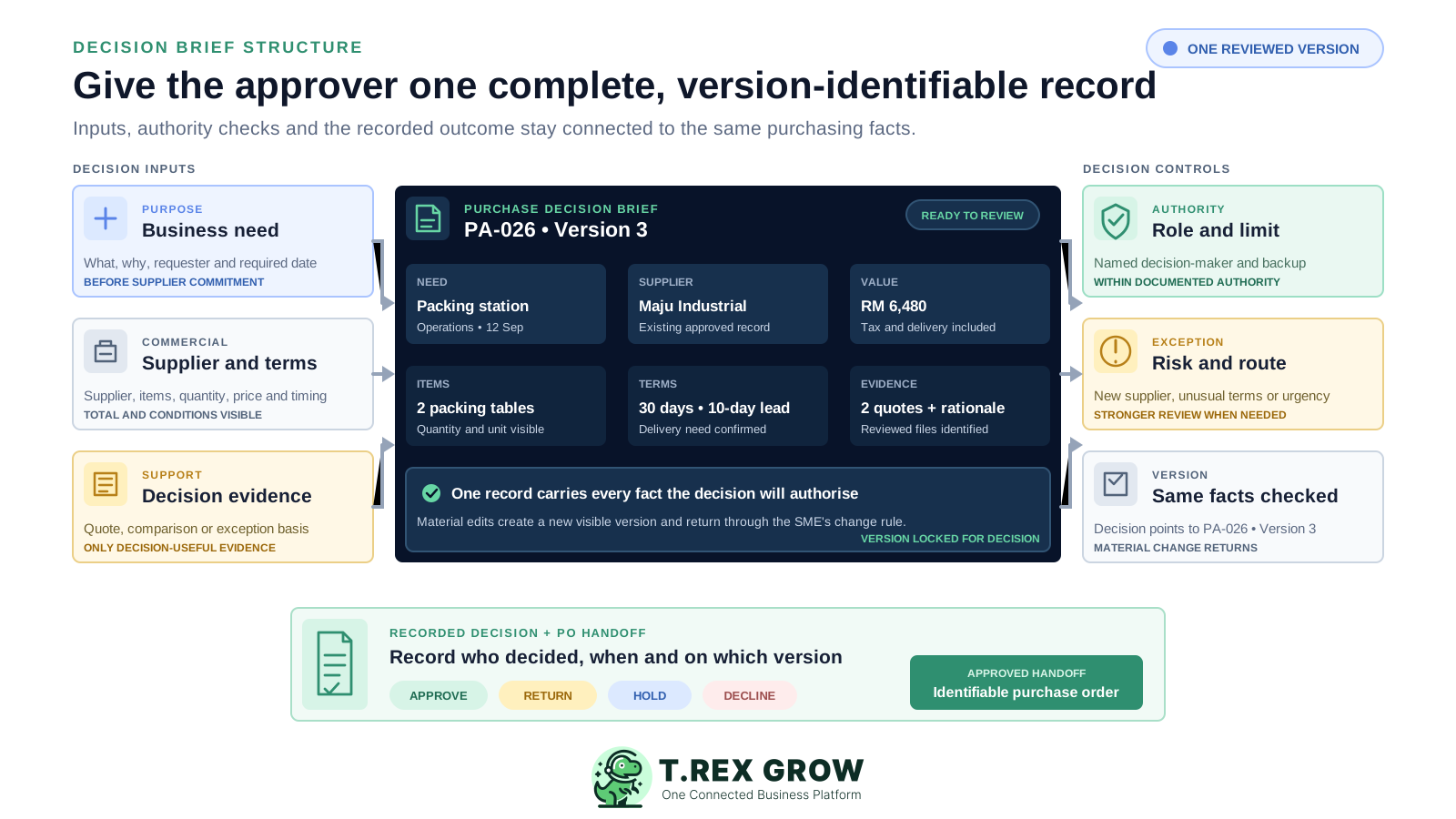
Describe what is required, why it is required, the requesting team, required date and the operational consequence of delaying or not buying.
Bring together the proposed supplier, products or services, quantities, prices, taxes, terms, timing, evidence and material alternatives or exceptions.
Route the complete brief to a person authorised for that category, value, risk and exception type before issuing the supplier commitment.
Turn the authorised facts into one current supplier-facing PO and preserve the link between the decision, version, decision-maker and issue record.
Record what was actually delivered or accepted separately from what the PO expected, including partial, damaged, rejected or service-completion differences.
Review the supplier invoice and authorise payment under the SME's finance process instead of treating purchase approval as approval of every downstream event.
A value limit alone does not create a workflow. Document the scope, trigger, decision authority, minimum evidence, permitted outcomes and final record together. Common internal-control frameworks emphasise management-designed control activities, defined authority, documentation and proportionate separation of incompatible duties, but the SME must adapt those principles to its own operations and professional advice.
State whether the rule covers goods, services, subscriptions, capital items, supplier changes, emergency buys, replenishment or another clearly defined purchase class.
Use value together with categorical signals such as an unbudgeted need, new supplier, sensitive category, unusual terms, conflict concern, price variance or emergency route.
Name the role authorised to decide within each limit, the responsibility of the requester and reviewer, and an approved backup for absence or urgent work.
Define the business purpose, supplier and item facts, quantity, value, delivery need, commercial terms, comparison or exception basis and version the approver must see.
Allow the decision-maker to approve, approve with recorded conditions, return for clarification, hold, decline or cancel under the SME's policy.
Record who decided, when, on which facts, with which conditions, and which PO or supplier-facing version resulted from the decision.
Keep the sequence short enough to use consistently. The objective is one complete decision before commitment, followed by one identifiable handoff—not an elaborate chain that staff immediately bypass.
Record the current facts in one shared place.
Confirm what is known and what needs attention.
Make the next decision or follow-up accountable.
Complete the next task and record the outcome.
Refresh the shared view when facts change.
A dependable workflow keeps the shared record and the next action aligned.
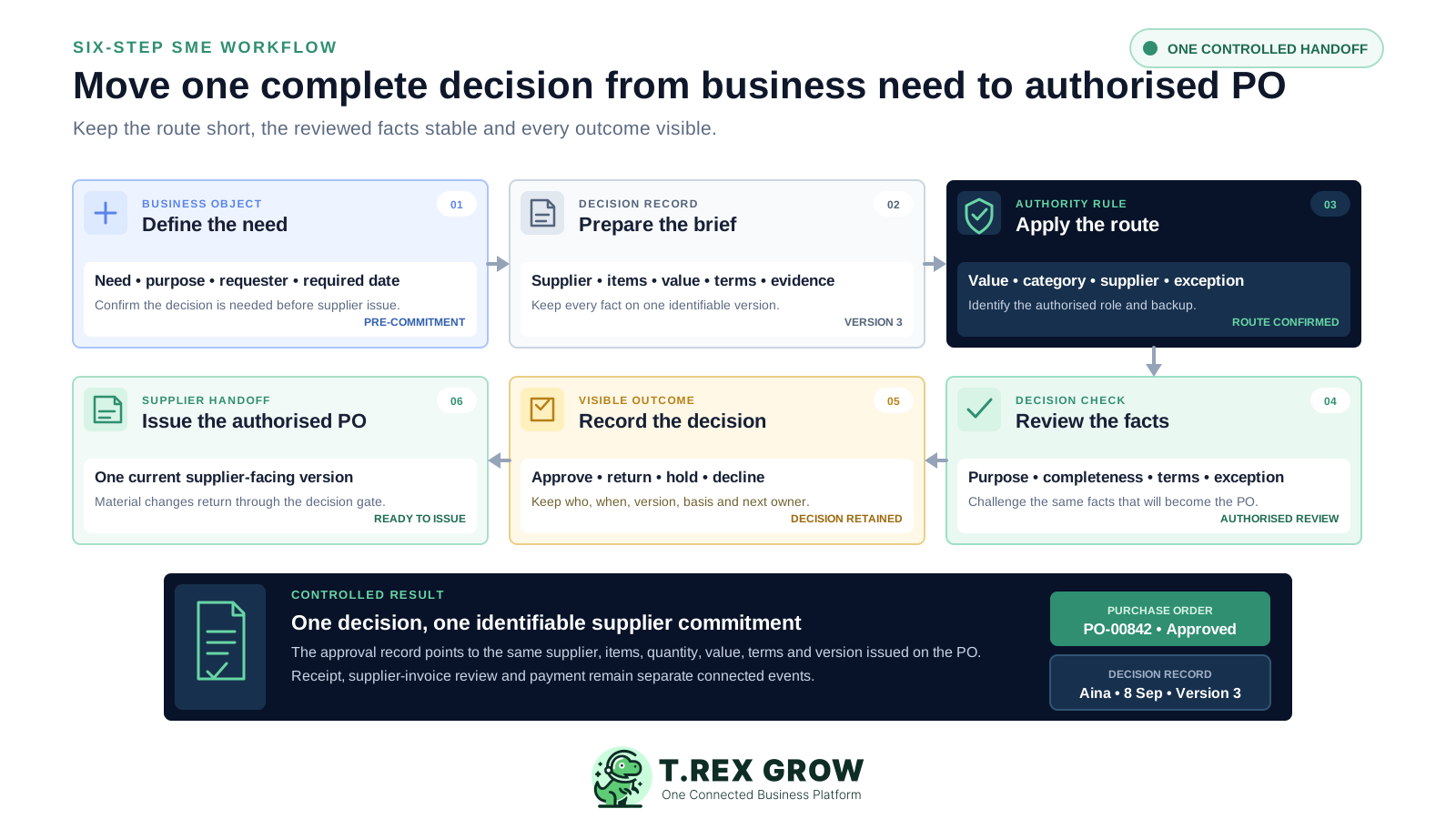
Define the need: record what is required, why, who requested it, when it is needed and whether an existing contract, stock position or approved supplier route already covers it.
Prepare the decision brief: add the proposed supplier, products or services, quantities, prices, taxes, delivery, payment terms, relevant quotation or comparison evidence and known exception.
Apply the routing rule: use the SME's approved value, category, risk, supplier and exception triggers to identify the authorised decision-maker and backup.
Review the same purchasing facts: check purpose, completeness, supplier basis, commercial reasonableness, available authority, conflicts, timing and any condition needed before commitment.
Record the outcome: approve, conditionally approve, return, hold, decline or cancel with the decision-maker, date, reviewed version, reason or condition and next owner where applicable.
Issue and preserve the PO handoff: create or finalise one identifiable supplier-facing purchase order from the authorised facts, communicate it through the SME's process and route any material change back for review.
Start with recent purchases and choose triggers that capture material or unusual decisions without sending every routine order to the owner. The examples below are design prompts, not universal thresholds, Malaysian law, tax advice or audit requirements; approve the SME's actual limits and revisit them as purchasing volume, staffing and risk change.
A low-value purchase can still need review when it involves a new supplier, sensitive access, unusual terms, a related party, safety implications or an exception to the normal route.
The most senior person is not automatically the best reviewer. Assign a role that understands the need, can challenge the evidence and has documented authority within the stated limit.
Require enough information to understand the commitment and exception without collecting attachments that do not change the decision.
State which changes to supplier, item, quantity, price, total, delivery or terms require a return to approval and how minor administrative corrections are recorded.
Track emergency routes, after-the-fact requests, repeated returns, long pending times, threshold clustering and frequent conditions to improve the rule rather than merely process more approvals.
Replace every example trigger with limits and roles formally chosen for the SME; use more or less evidence according to the decision's value, category, urgency and risk.
| Purchase situation | Possible trigger | Minimum decision evidence | Possible authority and outcome |
|---|---|---|---|
| Routine repeat purchase | Within approved supplier, item, quantity, price and delegated limit | Need, current supplier record, items, quantity, total, expected date and source reference | Delegated purchasing role; direct route or recorded approval under policy |
| Purchase above a delegated value | Total exceeds the requester's or department's documented authority | Complete decision brief, commercial basis, available authority and relevant comparison | Higher authorised role; approve, condition, return, hold or decline |
| New or changed supplier | First order or material supplier identity, bank, ownership or term change | Supplier identity, reason for selection, commercial facts and checks required by the SME | Named purchasing or owner role; approve supplier route, request checks or decline |
| Unbudgeted or exceptional need | Outside the normal plan, category, contract, price tolerance or delivery route | Business impact, cost, timing, exception reason, alternatives and proposed owner | Role authorised for exceptions; conditional approval, hold, return or decline |
| Emergency purchase | Delay would create the specific operational impact defined by the SME | Immediate need, supplier, expected cost, person authorising, time and follow-up evidence | Named emergency authority; time-bound approval and prompt documented review |
| Material change after approval | Supplier, item, quantity, price, total, delivery or terms cross the SME's change rule | Earlier authorised version, changed facts, reason, commercial effect and supplier status | Original or higher authority as defined; reapprove, amend, cancel or return |
The best practice is to make the next action clear before the situation becomes urgent.
More approvers do not automatically create more control. A workflow fails when it delays routine work, hides the real decision in private channels or records approval after the supplier commitment is already underway.
Recurring issues usually point to workflow-control gaps, not one isolated data-entry mistake.
A later signature documents awareness but cannot provide the same pre-commitment review as a decision made before the supplier receives the order.
Value alone misses new suppliers, sensitive categories, unusual terms, conflicts, emergencies and repeated splitting just below the limit.
A universal queue weakens attention and creates delay. Delegate routine authority clearly and reserve stronger review for material or unusual decisions.
A copied total cannot show exactly which supplier, items, quantities, prices, terms and evidence will become the final commitment.
If a material fact changes, preserve the earlier decision and apply the documented change rule instead of treating the old approval as permanently transferable.
A returned or held request needs a reason, missing evidence, next owner and resubmission rule or staff will restart the purchase outside the workflow.
Define an authorised backup and limit rather than borrowing another person's access and losing individual responsibility for the decision.
Threshold clustering, frequent exceptions, long delays and repeated after-the-fact approvals can show that the rule, delegation, evidence or operating process needs adjustment.
A small SME may not be able to separate every duty among different employees. Focus the strongest independent check on higher-impact combinations, state which role each person is performing and document a prompt compensating review when practical separation is unavailable.
For material or unusual purchases, avoid making the person who selects the supplier and prepares the commitment the only person who authorises it.
Being able to create or edit a purchasing record does not by itself establish authority to approve every category, value or exception.
Document who can act during leave or an operational emergency, which limits and evidence still apply, and how the temporary decision will remain attributable.
When one person must perform several responsibilities, route higher-impact cases for prompt owner or independent review of the evidence, decision and resulting PO.
Periodic review should examine bypasses, returns, holds, after-the-fact requests, emergency use, repeated conditions and material changes as well as approved volume.
Walk several routine and unusual examples through the matrix to find unclear triggers, missing evidence, overloaded roles and purchases that would still escape review.
TREX Grow can support the purchase-order stage after the SME has defined its policy. Its current verified behaviour is a direct request-to-approve path for supported purchase orders, not a promise of purchase requisitions, budget enforcement, amount-based routing, several approval levels or enterprise procurement orchestration.
The company can separate relevant purchase-order access from request and approve responsibilities for supported users instead of relying on one shared purchasing login.
A creator whose purchase orders require approval can submit the record into Pending Approval rather than producing the official order immediately.
Matching approvers can receive an email containing the PO number, supplier, item count and a link to review the purchase-order record.
The approved purchase order can retain who approved it and when, keeping the decision outcome connected to the operating record.
A draft PO PDF carries a DRAFT watermark; the official purchase-order PDF is generated after approval or authorised direct finalisation.
Where the SME's permission design does not require the request handoff, an authorised creator can finalise the supported purchase order directly.
Document value limits, category rules, budgets, supplier checks, conditions, backup authority, returned work and multi-stage needs separately, then verify current product capability before relying on them.
Choose one routine purchase and one unusual purchase. Write the need, trigger, decision-maker, backup, minimum evidence, allowed outcomes, change rule and final PO record for each. If either example cannot follow the rule without a private message, fix that gap first.
A purchase approval workflow is the documented path used to turn a defined business need and decision brief into an authorised supplier commitment. It states which purchases need review, who can decide, what evidence they must see, which outcomes are allowed and which purchase order or other final record results from the decision.