Goods arrive before the receipt is recorded
The warehouse can see the cartons, but sales and purchasing still see the old balance because receiving waits for a paper check, spreadsheet update, or end-of-day batch entry.

TREX Grow helps Malaysian SMEs connect purchasing receipts, customer fulfilment, returns, adjustments, and location activity to one current stock position. Your team can see what is available, incoming, and reserved while keeping the movement source close enough to explain why the quantity changed.
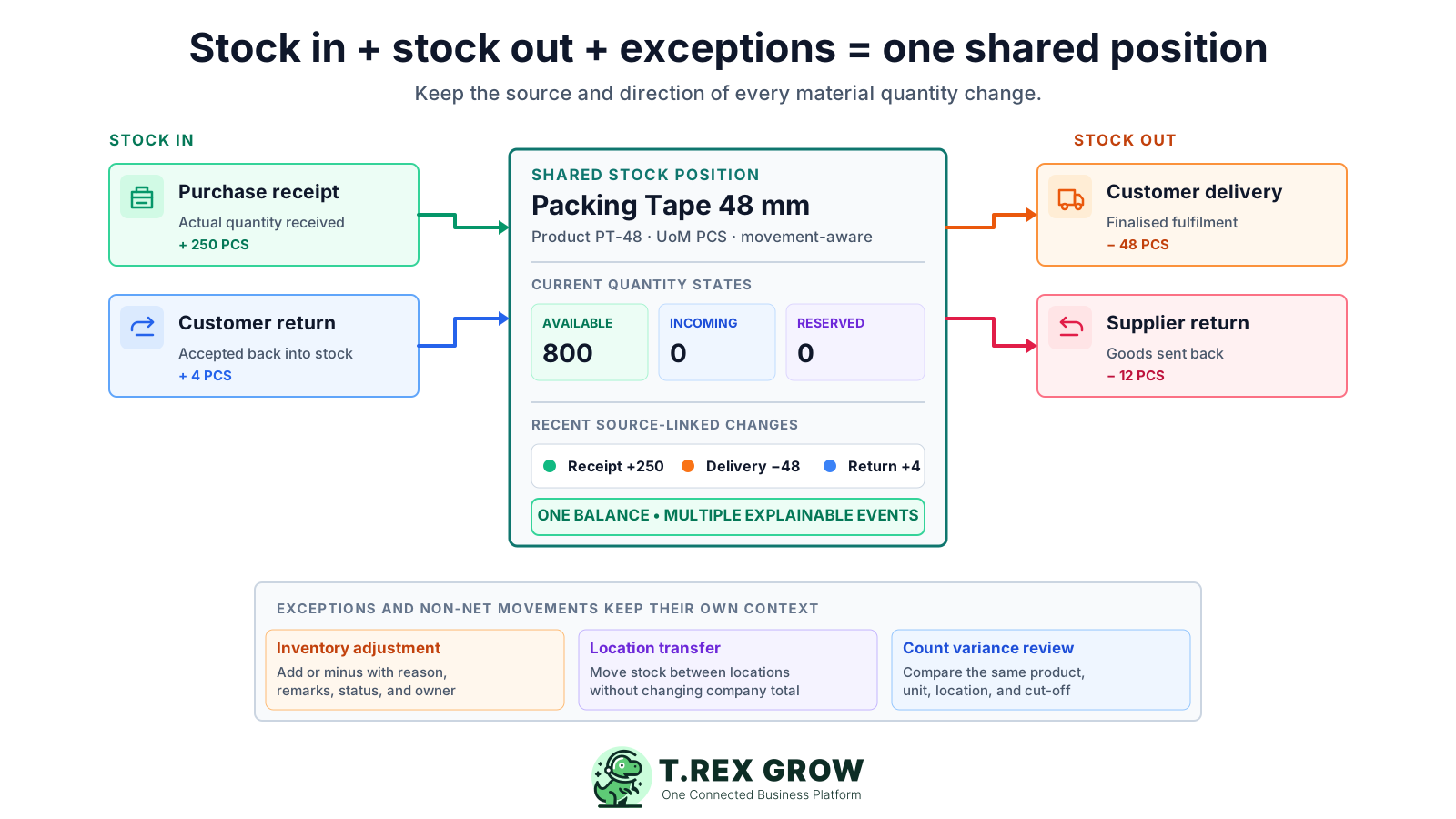
A stock balance is useful only when it reflects the same item, quantity, time, status, and location as the physical event. When the team moves goods first and records them later, sales, purchasing, warehouse, and finance begin working from different versions of reality.
Operational pressure
When records live in different places, the person responsible has to reconstruct what happened before they can make a confident decision or follow up.
The warehouse can see the cartons, but sales and purchasing still see the old balance because receiving waits for a paper check, spreadsheet update, or end-of-day batch entry.
A delivery is prepared or completed, but the stock sheet is changed by another person later. The business can temporarily promise units that have already left.
Customer returns can add stock after inspection, while supplier returns remove stock from the business. Treating both as one generic return makes the quantity effect harder to verify.
The team notices a mismatch and edits the total. The current number improves, but the purchase receipt, delivery, return, damage, or timing gap that caused the difference is still unresolved.
The units may still be physically present, but they are already committed to customer work. A total-on-hand figure alone can overstate what the next salesperson can promise.
Stock moves from general storage to a bin, damaged area, return area, or another warehouse, but the item total is updated without showing where staff should find or avoid the units.
A spreadsheet can add and subtract quantities, but it does not automatically preserve the source, status, responsibility, and location behind each movement. The operational gap appears when several users or document types affect the same item.
Recurring issues usually point to workflow-control gaps, not one isolated data-entry mistake.
Changing the latest balance removes the sequence between the previous position, the event, and the new position. A later reviewer cannot reconstruct which movement was missed or duplicated.
The purchase order describes the supplier commitment. Stock-in should reflect what was actually received and checked, including partial delivery, shortage, or rejected units.
Warehouse or sales staff update a shared file after delivery rather than from the supported fulfilment record. Busy periods turn small delays into several unrecorded movements.
A direct adjustment is used even when the correct source should have been a stock entry, delivery, sales return, purchase return, or location transfer. The ledger becomes a list of corrections rather than operations.
A planned delivery, pending receipt, finalised movement, and cancelled document can all appear as active rows. Staff cannot tell whether a quantity should already affect the shared position.
Staff compare a physical count with a spreadsheet that includes later receipts or excludes earlier deliveries. The resulting difference is a timing mismatch rather than a true stock variance.
Focus the evaluation on movement discipline. The software should show which event changed the quantity, whether that event is complete, which stock state or location it affected, and who can review or correct an exception.
Use a purchasing receipt, customer delivery, sales return, purchase return, location transfer, inventory count, or documented adjustment instead of an unexplained balance edit.
Record the quantity physically received, delivered, returned, transferred, or counted. Preserve the difference from what was ordered or planned for follow-up.
Distinguish draft, pending approval, finalised, archived, returned, or other workflow states so a planned event does not silently become an actual quantity change.
Keep available, incoming, and reserved quantities visible so the business can distinguish usable stock, expected stock, and existing commitments.
Use add or minus adjustments with a quantity, reason, remarks, supporting files, owner, and review status when the normal transaction path cannot explain the difference.
Add system or custom locations, transfers, ledgers, picking, and count sessions as the warehouse grows, rather than treating the company-wide balance as proof that every item can be found.
TREX Grow keeps the product, source document, actual quantity, direction, status, date, owner, location context, and exception reason closer together. The goal is not only to show the latest balance, but to preserve enough evidence to rebuild it.
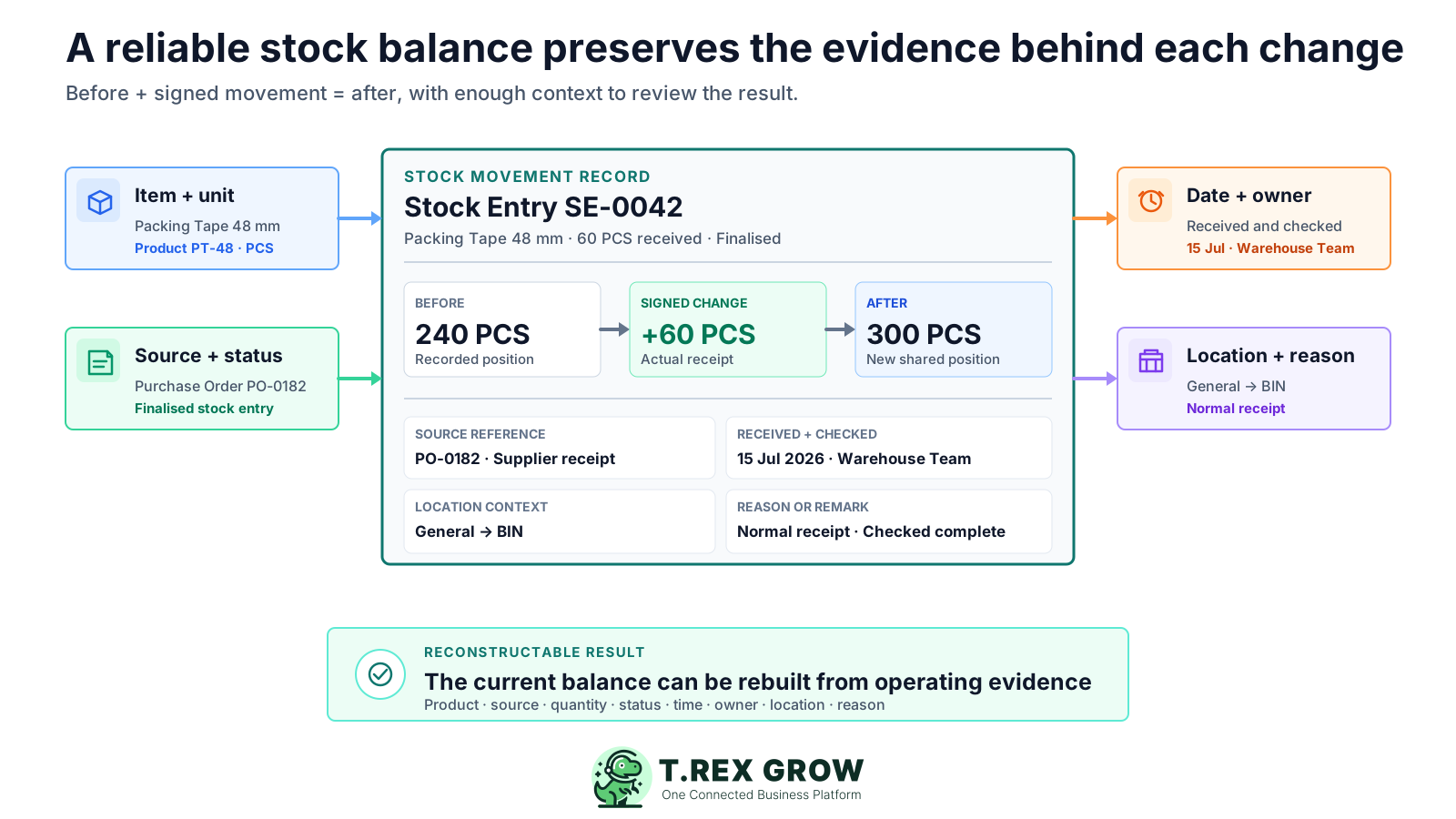
Tie the movement to the controlled product record and unit of measure so the quantity is not posted to a duplicate item or incompatible pack size.
Keep the purchase order and stock entry, delivery order, return note, transfer, count session, or inventory adjustment close to the movement it produced.
Show whether the event adds stock, removes stock, moves stock between locations, or changes a state without assuming every document has the same effect.
Make it clear when a movement is draft, pending, finalised, returned, archived, or otherwise complete and which receipt, delivery, or posting date applies.
Use permissions and approval rules to show who created, checked, finalised, approved, or corrected a sensitive stock event.
Keep the source and destination location for transfers and retain a useful reason, remarks, and evidence when an adjustment changes the quantity.
TREX Grow supports a practical sequence that starts with the operating document, captures the actual quantity, applies the correct status and location context, and preserves an exception or count trail when the result needs review.
Record the current facts in one shared place.
Confirm what is known and what needs attention.
Make the next decision or follow-up accountable.
Complete the next task and record the outcome.
Refresh the shared view when facts change.
A dependable workflow keeps the shared record and the next action aligned.
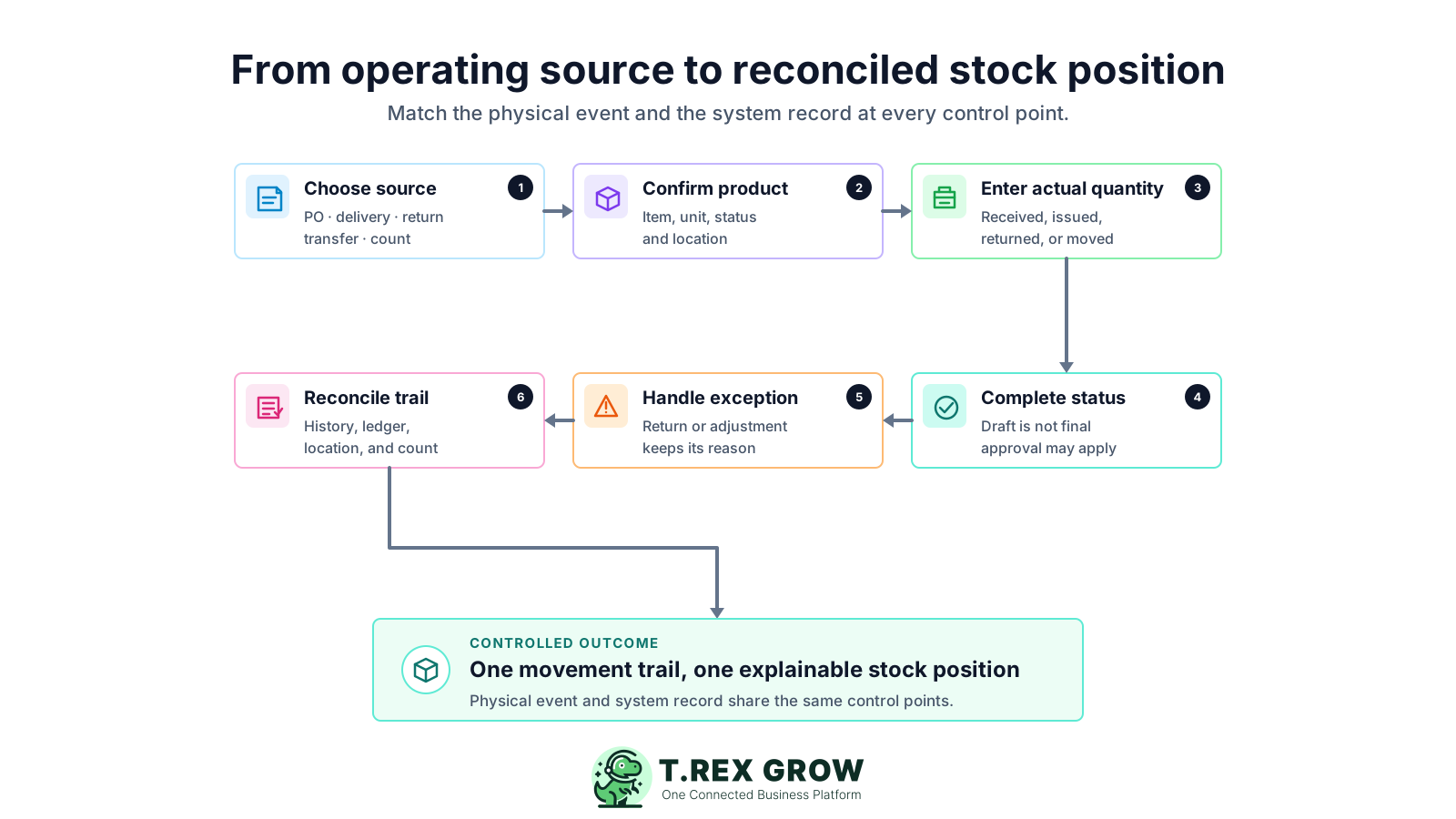
Choose the correct source: begin with the purchase order, delivery or fulfilment document, sales return, purchase return, location transfer, count session, or adjustment workflow that matches the physical event.
Record the actual item and quantity: confirm the product, unit, and quantity physically received, delivered, returned, transferred, or counted instead of copying an expected amount from another document.
Confirm the movement status: keep draft or pending work separate from finalised or approved movement. Use the workflow status and permissions to decide when the event should affect the shared stock position.
Apply the correct location or fulfilment context: show where the stock entered, left, moved, or remained reserved. Do not use a quantity adjustment when the real event is a pure location transfer.
Handle returns and exceptions explicitly: use the relevant sales return, purchase return, or inventory adjustment path with the direction, quantity, reason, remarks, evidence, and review required.
Reconcile the history and physical count: review the product movement trail and, where warehouse controls are used, compare the location or count-session result with the same product, unit, status, and cut-off.
TREX Grow connects daily stock events to product, purchasing, sales, return, adjustment, and warehouse records. Access depends on the plan and permissions, so test the exact movement path your team will use before rollout.
Review separate quantity states from the product context instead of relying on one total that hides expected receipts or customer commitments.
Start stock-entry work from a supported purchase order or purchase return workflow and record the quantity actually received with receiving and checking context.
Keep delivery orders, sales returns, purchase returns, and related product history close enough to review how customer or supplier activity affected stock.
Add or remove quantity with a product, reason, remarks, attachments, status, and permission-aware workflow when an exception genuinely requires an adjustment.
Search and filter movement records by date, status, supplier, archive state, and other supported fields rather than reviewing a long undifferentiated stock sheet.
Use plan-dependent system or custom locations, pure location transfers, product and location summaries, and ledger views when company-wide stock is no longer enough.
Premium warehouse workflows add delivery picking, picking list PDFs, location-aware visibility, and cycle-count or stock-take sessions for structured reconciliation.
The Create Stock Entry screen starts from a purchase order or purchase return note. This example shows a stock entry opened from a demo purchase order, carrying supplier context, expected quantity, received quantity, and match status into the receiving workflow.
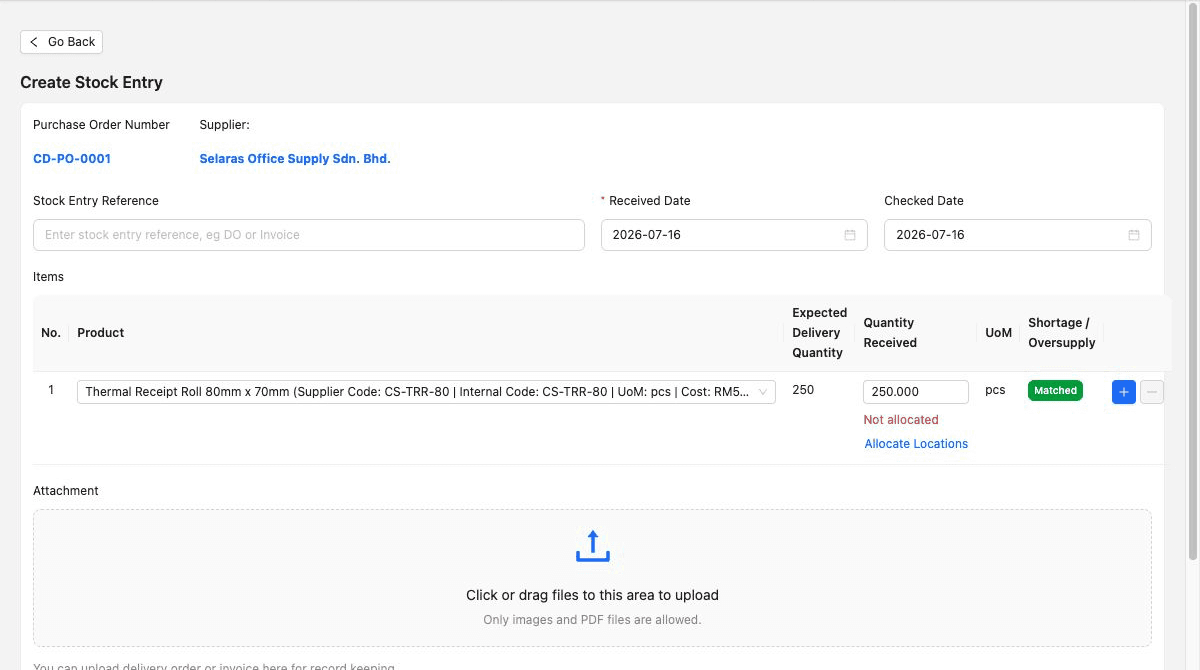
The user starts from the relevant purchase order or purchase return note before the stock-entry details are prepared.
Source selection keeps the receiving event related to purchasing context instead of treating every stock-in as an independent quantity edit.
Normal receipt belongs in stock-entry work. A genuine exception belongs in the adjustment or return workflow with its own reason and review path.
TREX Grow is a practical fit when the main need is to connect daily stock changes to sales, purchasing, returns, adjustments, and warehouse work. Separate broader inventory planning and specialist requirements so the evaluation stays honest and testable.
List every real receipt, fulfilment, customer return, supplier return, transfer, damage, sample, internal use, and count event before configuring the workflow.
If the movement came from purchasing, delivery, return, or transfer, record that event through its intended workflow. Reserve adjustments for genuine exceptions and corrections.
During count or reconciliation, compare the physical stock with system history for the same product, unit, status, location, and time.
Decide who can create, request approval, edit, approve, archive, delete drafts, transfer stock, and reconcile variances.
Do not evaluate only a perfect full receipt. Test a partial receipt, short delivery, customer return, supplier return, damage adjustment, location move, and count variance.
Use the broader inventory solution page for product-master, reorder, and warehouse evaluation. Verify manufacturing, POS, e-commerce, serial, batch, expiry, forecasting, scanning, and integration needs separately.
Use this table to match TREX Grow's stock-control workflow to the movements your Malaysian SME needs to record and review.
| Requirement | TREX Grow workflow | What to verify |
|---|---|---|
| Stock in | Stock entries started from supported purchase orders or purchase return notes with actual received quantity | Partial receipt, checking, approval, and Essential-plan access |
| Stock out | Delivery, fulfilment, and supplier-return context connected to product movement history | The exact document status that affects stock in your workflow |
| Current stock state | Available, incoming, and reserved quantities visible from product records | How each state maps to customer commitments and receiving |
| Returns and corrections | Sales returns, purchase returns, and add or minus inventory adjustments with reasons and remarks | Inspection, evidence, permissions, and approval rules |
| Locations and reconciliation | System or custom locations, transfers, ledgers, picking, and inventory count sessions according to plan | Whether Essential or Premium warehouse depth fits your sites |
| Specialist stock scope | Connected SME stock, purchasing, sales, return, adjustment, and warehouse operations | Separate MRP, POS, e-commerce, serial, batch, expiry, forecasting, scanner, and integration needs |
The best practice is to make the next action clear before the situation becomes urgent.
The solution suits SMEs that need day-to-day movement control more than another static stock list. It is especially relevant when one item is affected by purchasing, delivery, return, adjustment, and location work across several users.
The team needs the quantity actually received to remain connected to the supplier commitment and receiving context.
Sales and warehouse teams need delivery, return, and quantity information to remain understandable from the same product history.
The business wants to separate normal stock movements from genuine exceptions and retain the reason, owner, status, and evidence behind corrections.
Staff need a clearer distinction between what is physically present, what is expected, what is committed, and what can be offered to the next customer.
The operation is adding system or custom locations, transfers, ledger review, picking, or formal inventory counts as movement volume grows.
The team understands when to use the broader inventory management solution for product, reorder, and warehouse evaluation and when specialist systems need separate verification.
Create a TREX Grow workspace, add one current product, then test a partial purchase receipt, customer fulfilment, return, adjustment, location move, and count review. Start with core product records and use the paid-plan trial when your team is ready to evaluate stock-entry and warehouse controls.
Stock management usually focuses on day-to-day quantity states and movements such as receipts, deliveries, returns, adjustments, transfers, and counts. Inventory management is broader and can include product master data, replenishment rules, suppliers, planning, categories, valuation, and warehouse design. TREX Grow connects both areas, but this page focuses on movement control.