The approver sees only the bill
The PO, contract, receipt, service acceptance and earlier supplier conversation live elsewhere, so the approver must guess whether the charge is expected.

A supplier invoice should reach an approver with its purchase basis, fulfilment evidence, value checks, exceptions and decision authority already visible. The approval then records one clear outcome and amount before the invoice enters a separate payment-authorisation process.

The PDF may contain a supplier name, total and due date, yet the business still needs to prove why it owes that amount. Approval fails when the decision is reduced to a reply, signature or status without the underlying purchase and fulfilment facts.
Operational pressure
When records live in different places, the person responsible has to reconstruct what happened before they can make a confident decision or follow up.
The PO, contract, receipt, service acceptance and earlier supplier conversation live elsewhere, so the approver must guess whether the charge is expected.
Authority to place an order proves the commitment was permitted. It does not prove the supplier billed the right items, quantities, prices or completed work.
Someone changes a quantity, total or due date in the register to make it agree, removing the visible difference that the approver should decide.
A shortage, price change, missing PO or tax question is discussed, but the invoice has no named resolver, target date or documented outcome.
A reviewer approves the document but does not state whether the full amount, a supported portion or a net amount after adjustment can proceed.
The team skips the separate checks over payee details, payment batch, banking authority and settlement evidence because the invoice already says approved.
Supplier invoice approval is one control gate in a longer purchase lifecycle. Define the question answered at each gate so a valid decision is not stretched into proof of something that happens earlier or later.
Before commitment, decide whether the business need, supplier route, scope and expected spend are authorised under the SME's policy.
Record the supplier's original invoice once, preserve its identity and received date, and check whether the same obligation may already exist.
The person closest to delivery or service completion confirms what was actually received, accepted, rejected or still outstanding.
An authorised reviewer decides whether the invoice and evidence support a defined payable amount, or whether the item must be returned, held or rejected.
A separate control confirms the payee, bank details, payment date, funding and authorised release through the SME's external payment method.
Payment evidence, remaining balance, adjustments and the accounting treatment are recorded without rewriting the earlier approval decision.
The approval pack should combine the supplier's unaltered invoice with the business records that explain it. The approver needs enough evidence to decide, but not a folder full of unrelated documents.
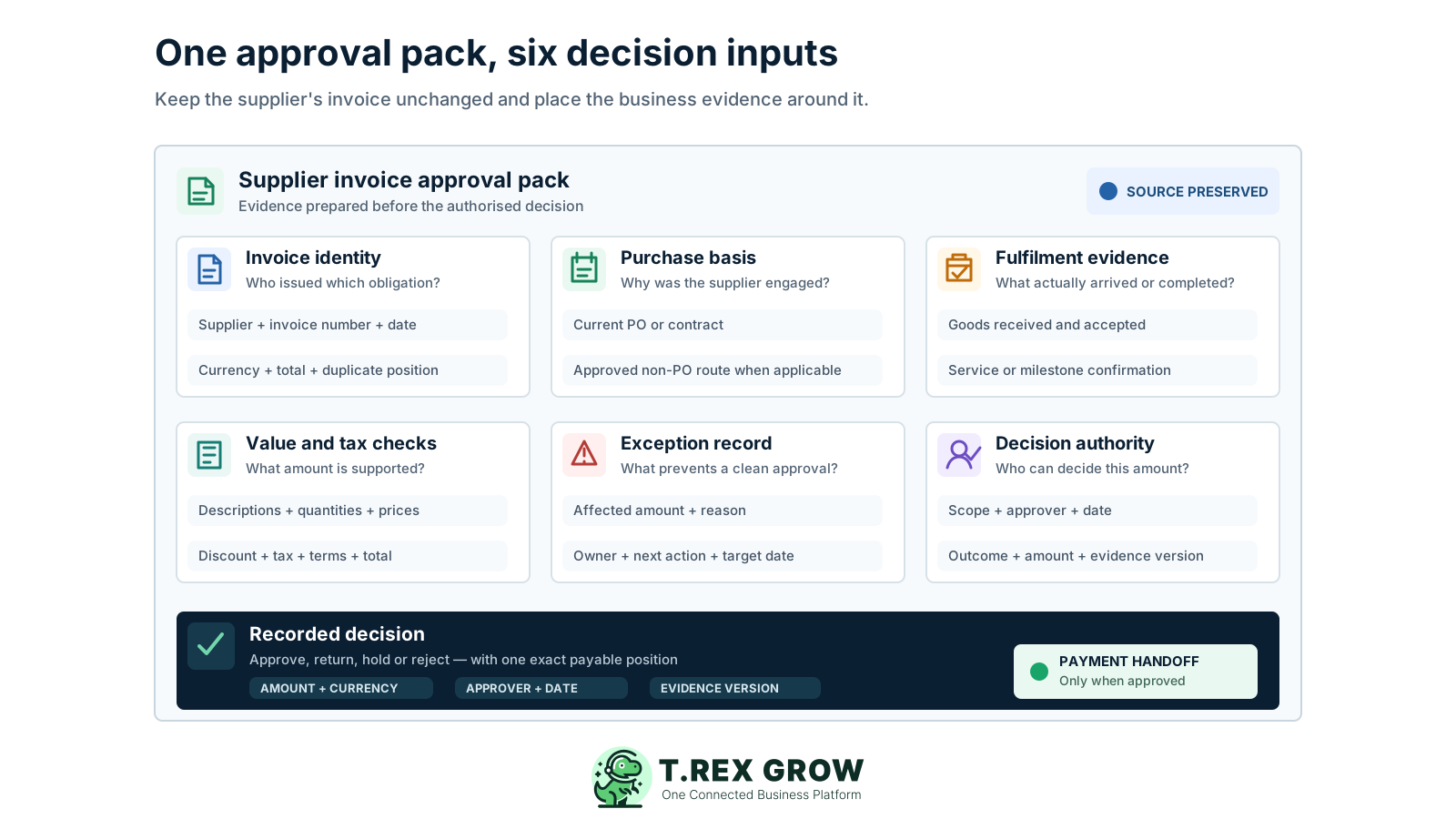
Supplier legal or recognised trading identity, invoice number, invoice date, received date, currency and a duplicate check using more than the number alone.
The current PO, contract, approved recurring arrangement or documented non-PO exception that explains why the supplier was engaged.
Goods-received evidence, delivery record, service acceptance or milestone confirmation from the person able to verify what occurred.
Descriptions, quantities, prices, discounts, tax, currency, totals, terms and due date compared with the agreed basis and actual fulfilment.
The difference, affected amount, owner, next action, target date and supporting supplier or internal response, without editing away the original fact.
The approver's scope, the exact amount and currency decided, outcome, date, reason or condition, and the evidence version used for the decision.
The sequence prepares the evidence before it reaches the approver and keeps the decision separate from payment execution. Adapt the owner and level of review to the invoice's value, risk and complexity.
Record the current facts in one shared place.
Confirm what is known and what needs attention.
Make the next decision or follow-up accountable.
Complete the next task and record the outcome.
Refresh the shared view when facts change.
A dependable workflow keeps the shared record and the next action aligned.
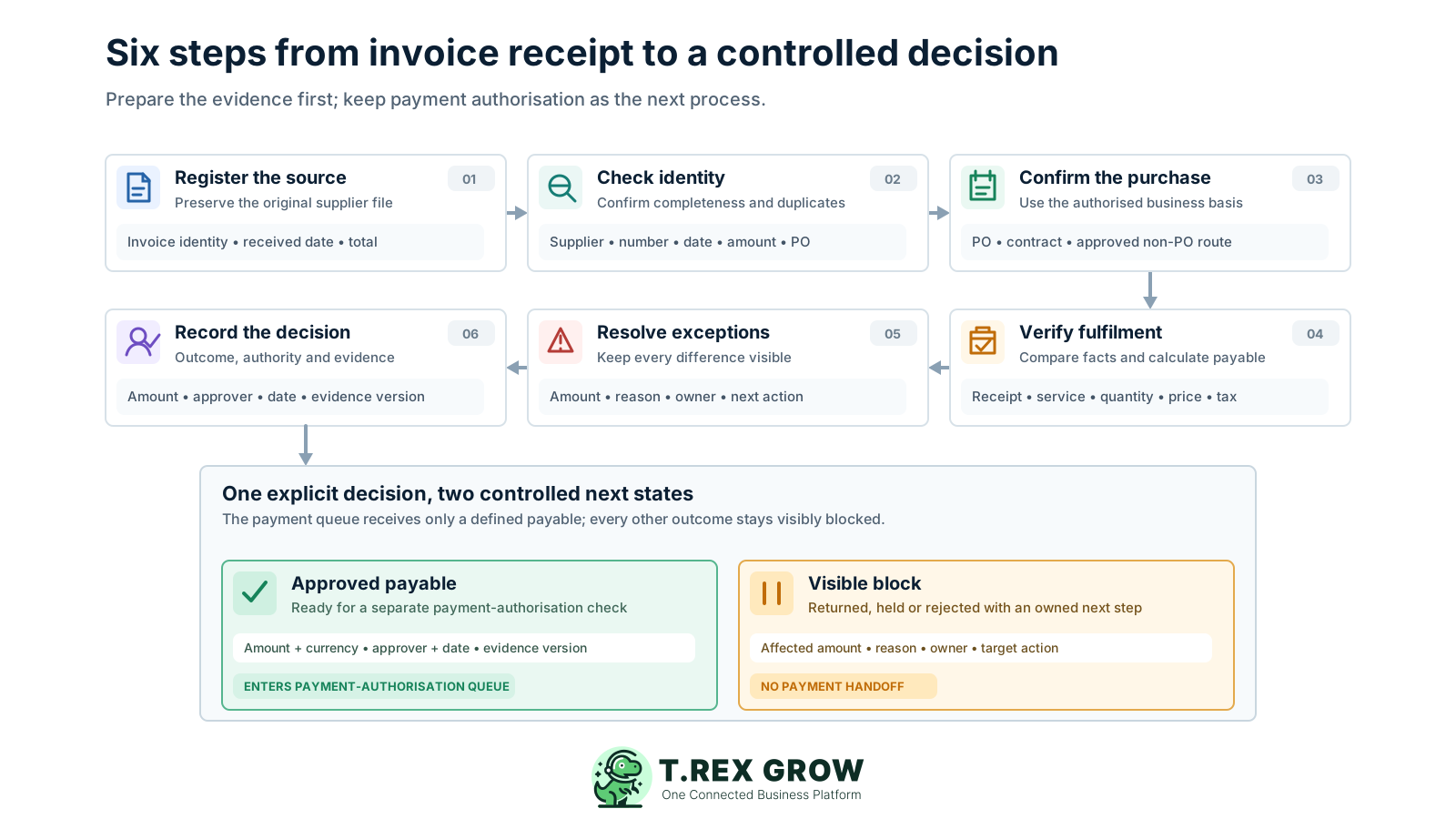
Register and preserve the source: capture the original supplier invoice, received channel and date, supplier identity, invoice number, currency, total and current attachment without changing it to match internal records.
Check identity, completeness and duplicates: compare supplier, invoice number, date, amount and purchase reference with existing records, then flag missing information or suspicious changes before routing.
Confirm the purchase basis: link the current PO, contract or approved non-PO route and confirm that the original commitment was made by someone with the relevant authority.
Verify fulfilment and values: obtain goods-received or service-acceptance evidence, compare descriptions, quantities, prices, discounts, tax, totals, terms and due date, and calculate the supported payable amount.
Resolve or expose every exception: assign discrepancies to an owner, preserve the affected amount and evidence, obtain a correction or documented decision, and prevent unresolved items from disappearing inside an approval.
Record the outcome and handoff: capture the authorised outcome, approver, date, amount, currency, reason or condition, then send only the approved payable position into the separate payment-authorisation queue.
A binary approve-or-reject button can force uncertain invoices into the wrong state. Define a small set of outcomes with a required record and next owner so approval never hides an unresolved difference.
Use labels that fit the SME's policy, but keep the decision meaning and next action explicit.
| Outcome | When to use it | Required record | Next action |
|---|---|---|---|
| Approve for payment | The evidence supports a defined payable amount | Approver, date, amount, currency and evidence basis | Enter payment-authorisation queue |
| Return for information | A document or confirmation is missing but the invoice may be valid | Missing item, owner and target response date | Recheck after the pack is complete |
| Hold and resolve | A price, quantity, delivery, tax or supplier issue affects the payable | Disputed amount, reason, owner and resolution path | Keep blocked until resolved under policy |
| Reject as invalid | The invoice is duplicate, unrelated, unauthorised or cannot be accepted | Reason, reviewer and supplier or internal follow-up | Close or archive without payment |
The best practice is to make the next action clear before the situation becomes urgent.
A purchase order provides a useful comparison point, but not every legitimate SME cost starts with one. Define approved exceptions rather than pretending every invoice follows the same document path.
Compare the invoice with the current PO and the quantities actually received and accepted. Keep partial delivery, returns and back orders visible.
Use the agreed scope, rate or milestone plus confirmation from the service owner. A delivery note may not be the relevant evidence.
Link the contract, approved schedule, service period and expected charge, then investigate unusual increases, new fees or changed bank details.
Require the business purpose, requesting owner, authority evidence and receipt or service confirmation specified by the SME's exception policy.
Record why the normal route could not be followed, who authorised the exception and what after-the-fact review is required without normalising the bypass.
A small company may not be able to give every step to a different employee. The answer is a documented alternative review matched to risk, not a claim that segregation is either perfect or impossible.
Where practical, keep supplier-detail changes, receipt confirmation, invoice preparation, invoice approval and payment release from being controlled by one person.
Define who can approve which categories, values or exceptions, and review those limits as the business changes. Do not copy another company's thresholds.
A complete, low-risk invoice can use a lightweight route while unusual suppliers, mismatches, urgent requests or changed bank details receive independent review.
The person asking for approval should not pre-select an outcome or hide the unresolved amount. Present the evidence and difference neutrally.
Periodically check who can create, edit, approve and release payments, plus any invoices repeatedly handled outside the normal route.
Keep the source invoice, supporting records, exception resolution and approval evidence retrievable under the SME's current legal, tax and accounting retention policy.
The best practice is to make the next action clear before the situation becomes urgent.
Shortcuts are dangerous when they create the appearance of a decision without proving what was checked, what amount was accepted or what remains blocked.
Recurring issues usually point to workflow-control gaps, not one isolated data-entry mistake.
A supplier name and total do not establish the purchase basis, actual fulfilment, duplicate position or supported amount.
The PO records a commitment. It does not show what arrived, whether a service milestone was accepted or whether an item was rejected.
Different purchases need different evidence. Define which records matter for goods, services, contracts and approved non-PO costs.
Preserve the supplier's source facts and record any correction, credit, replacement or authorised difference as a separate event.
If the invoice or evidence changes after review, the team must be able to tell which amount and document set the approver decided on.
Tax-system validation and the SME's commercial approval answer different questions. The buyer must still check the purchase, fulfilment, values and internal authority.
Use this guide to define the approval control first. In the current verified product build, TREX Grow can keep useful supplier-invoice evidence connected, but it should not be described as providing a dedicated supplier-invoice approval state, threshold route or automated matching engine.
Create the supplier invoice from the relevant purchase order so the supplier and item context remain connected while invoice quantities, prices, dates and terms stay visible as their own facts.
Link a finalised stock entry when that record is relevant, while keeping the user's fulfilment and comparison checks explicit rather than claiming an automatic match.
Keep general supporting files with the supplier invoice and use internal remarks for context that should remain retrievable with the record.
Preserve the supplier invoice number, dates, payment terms, line values, tax, discount, currency and payable total in one searchable record.
Record each supplier payment amount, date, method, reference, person-in-charge details, remarks and attachments without replacing the invoice evidence.
Keep supported supplier credit, debit and refund notes connected to the invoice so later changes do not erase the original payable history.
Choose a recent supplier invoice with a partial delivery, price change, missing document or urgent exception. Rebuild its approval pack, name the decision owner and record the exact payable outcome. The missing evidence will show which control to fix first.
It is the controlled review used to decide whether a supplier invoice and its supporting purchase and fulfilment evidence justify a defined payable amount. The process records the checks, exceptions, authorised outcome and payment handoff without treating approval as payment itself.