The need is described too loosely
The requester names an item or supplier but does not state the business purpose, specification, quantity, required date, acceptance criteria or consequence of delay.

A useful procurement checklist is a short decision gate used before ordering, not a form completed afterwards. It helps the SME confirm why the purchase is needed, whether the supplier and terms fit, who may approve it, how fulfilment will be checked and which records the next person will need.

The problem is rarely that an SME has no purchase form. It is that an important question is answered too late, by the wrong person or without evidence that follows the purchase into receiving and finance.
Operational pressure
When records live in different places, the person responsible has to reconstruct what happened before they can make a confident decision or follow up.
The requester names an item or supplier but does not state the business purpose, specification, quantity, required date, acceptance criteria or consequence of delay.
The team buys again without checking usable stock, an open purchase order, an approved contract, another department's requirement or a suitable existing supplier.
The lowest figure wins even when lead time, quality, capacity, service, location, continuity or the full cost of buying makes another option more suitable.
Quantity, price, tax, freight, delivery, payment, warranty, service scope and change conditions are never assembled into one current commercial picture.
A manager approves a total or screenshot, then the supplier, quantity, price, date or terms change before the order is issued.
Receiving and finance cannot see what should arrive, what evidence matters, which exception is open or who must resolve the difference.
A checklist should make the next decision visible. Scale the evidence to the purchase's value, category, supplier, operational impact and risk, while keeping the same core questions for routine, urgent and unusual buying.
Write each check so the reviewer can answer yes, no or not applicable and explain the evidence behind that answer. Vague prompts such as 'details checked' hide what was actually reviewed.
Specify the smallest useful record for the decision: a stock check, quotation, supplier reference, specification, authority rule, approved exception or another source that fits the purchase.
A missing answer should lead to clarification, a different supplier, a revised term, an authorised exception, escalation or a stop. It should not default silently to proceeding.
The checklist should identify the supplier, scope, commercial facts and version that were reviewed so later changes do not inherit an unrelated approval.
One person may perform several tasks, but higher-impact or unusual decisions can still receive an independent sense-check from someone with suitable authority where practical.
Repeated urgent buys, supplier failures, invoice differences or missing receipts show which question, owner or evidence rule needs improvement.
The checklist becomes useful when its answers point to one compact, version-identifiable purchase record. The pack should let a reviewer understand the decision without rebuilding the story from email, chat and unrelated files.
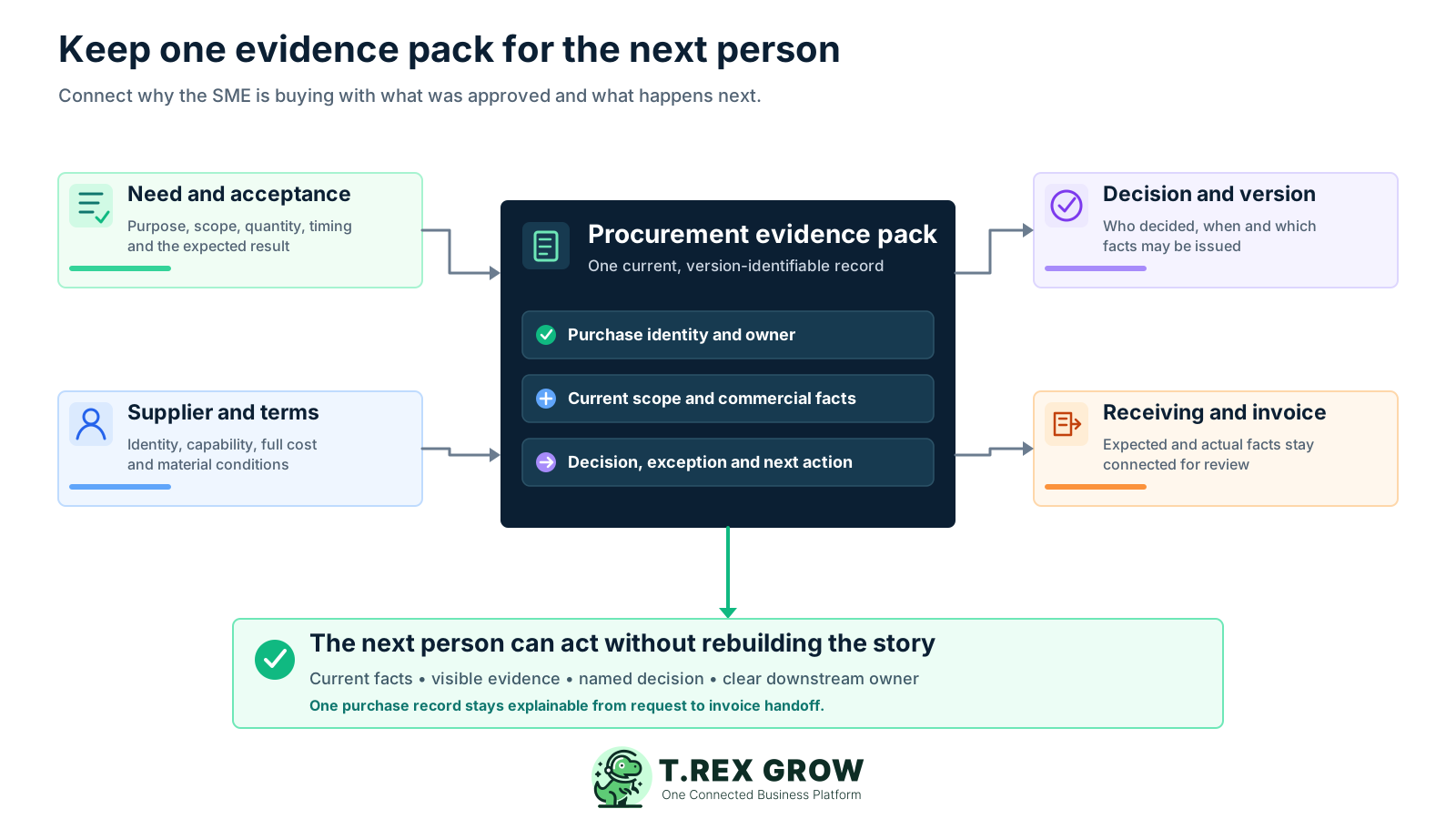
Record the business purpose, requester or owner, item or service specification, quantity, required date, delivery location and how fulfilment will be accepted.
Identify the proposed supplier, relevant checks, experience or references where needed, comparison or exception basis, and any material dependency or access concern.
Keep the unit price, quantity, currency, tax context, freight or additional cost, total, payment terms, delivery terms and other material conditions together.
Show who decided, when, under which authority or exception, what outcome was recorded and which exact facts were approved for supplier issue.
Tell the receiver what is expected, which date and acceptance check matter, and who owns shortages, damage, service gaps, substitution or late delivery.
Give finance the current purchase basis, fulfilment evidence and exception position, then retain supplier invoices and supporting documents under the SME's approved Malaysian record-keeping practice.
Use the sequence as a practical control routine. A low-risk repeat purchase may pass through it quickly; a new, sensitive or high-impact purchase may need stronger evidence and another reviewer.
Record the current facts in one shared place.
Confirm what is known and what needs attention.
Make the next decision or follow-up accountable.
Complete the next task and record the outcome.
Refresh the shared view when facts change.
A dependable workflow keeps the shared record and the next action aligned.
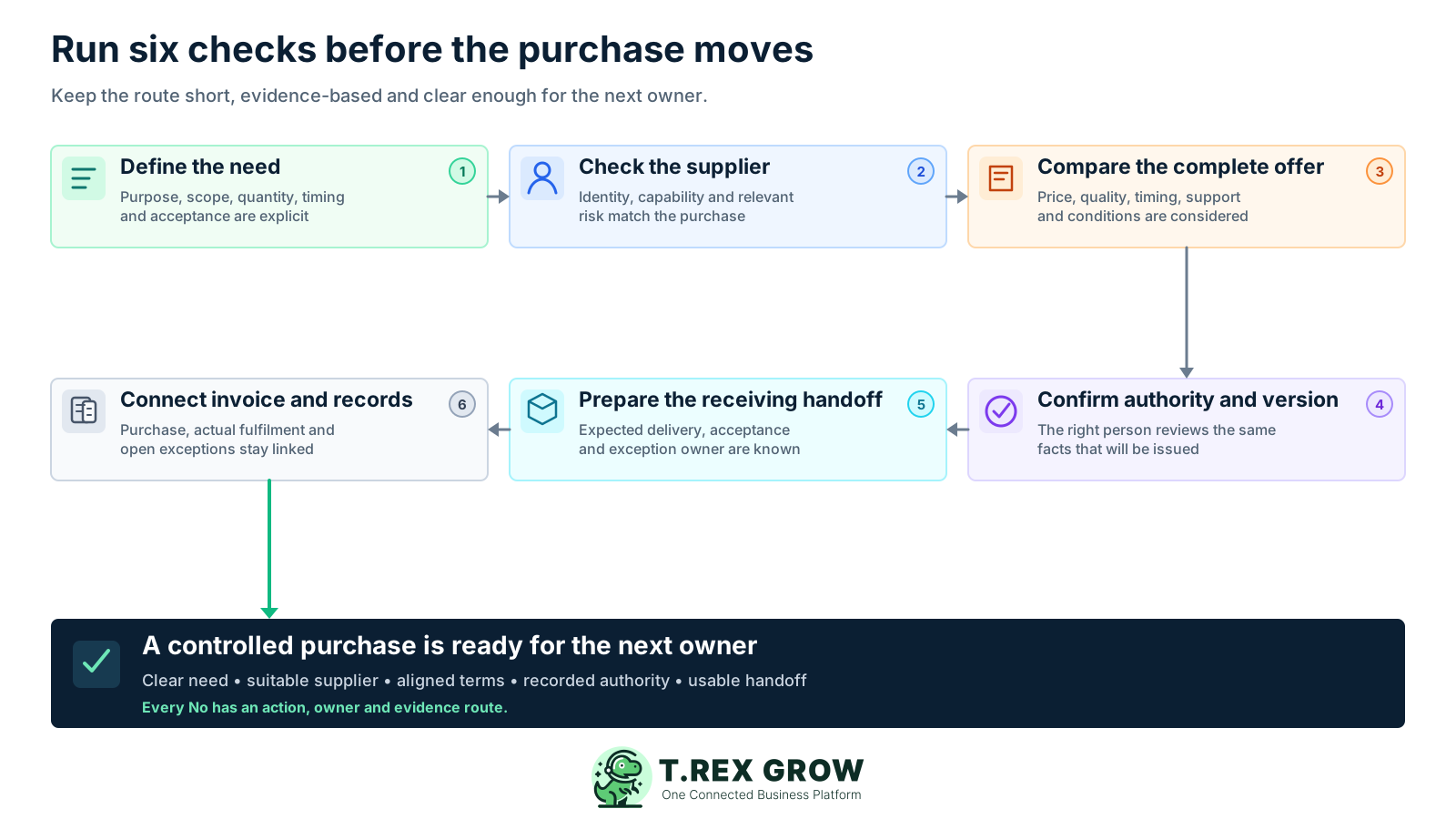
Define the need: state the business purpose, owner, specification, quantity, required date, delivery location and acceptance criteria, then check whether existing stock, an open order or an approved arrangement already covers it.
Check the supplier: confirm identity and contact details, ability to meet the specification and timing, relevant experience or references, operational fit and any risk checks required by the SME for this category.
Compare the complete offer: review price together with quality, lead time, freight, tax context, payment terms, support, warranty or service commitments, and record why the selected option fits the need.
Confirm authority and version: assemble the current supplier, items or service, quantity, total, terms and supporting evidence, then obtain the decision required by the SME before supplier commitment.
Prepare the handoff: issue one identifiable purchase record and tell the receiving or service owner what should arrive, when, how it will be checked and who owns any exception.
Connect invoice and closure evidence: give finance the purchase basis, actual fulfilment and unresolved difference, preserve the supporting records, and close or cancel only under the SME's defined rule.
The table is a starting point for internal operations. Replace examples with the SME's approved roles, limits, categories and evidence rules. A check marked not applicable should still have a clear reason when the omission could matter later.
Name who is responsible for moving the purchase through clarification, supplier follow-up, receiving exceptions and final handoff, even when several roles contribute evidence.
A low-value order may still need attention when it involves a new supplier, sensitive access, unusual terms, safety, reputation, a related party or a critical operational dependency.
If the normal comparison, timing, supplier or approval route cannot be followed, record why, who authorised the exception, its conditions and the follow-up action.
A completed tick is useful only when another person can find the quotation, specification, supplier check, decision, receipt, invoice or exception record that supports it.
Use the Yes, No or Not applicable answer together with a source record and an owner for any open action.
| Decision point | Checklist question | Minimum useful evidence | Owner or outcome |
|---|---|---|---|
| Business need | Is the purpose, specification, quantity, required date and acceptance basis clear? | Request or brief with business owner and required outcome | Requester clarifies before sourcing |
| Existing coverage | Have usable stock, open orders, current contracts and approved alternatives been checked? | Stock or order check and relevant existing reference | Buyer uses, combines or closes the duplicate need |
| Supplier identity | Is the supplier correctly identified and suitable for this type of purchase? | Supplier record and checks proportionate to the purchase | Buyer verifies, changes supplier or escalates |
| Supplier capability | Can the supplier meet the quality, quantity, timing, location and service expectation? | Quotation, specification response, reference or capability evidence | Need owner confirms operational fit |
| Comparison basis | Does the chosen offer represent suitable overall value for this need? | Comparison of price, quality, timing, support and material risk | Buyer records selection or exception reason |
| Commercial terms | Are price, currency, tax context, freight, payment, delivery and material conditions aligned? | Current quotation, agreed terms or supplier communication | Buyer resolves differences before issue |
| Authority | Has the complete current commitment reached the person authorised to decide it? | Reviewed version, decision, date, authority basis and conditions | Authorised role approves, returns, holds or declines |
| Conflict and exception | Have relevant conflicts, related parties, urgent routes or policy exceptions been declared? | Declaration, exception reason and approved follow-up | Named independent reviewer or authorised exception owner |
| Supplier issue | Will one identifiable record communicate the approved scope and terms to the supplier? | Current purchase order, contract reference or approved order record | Buyer issues and preserves the supplier-facing version |
| Receiving plan | Does the receiver know what, when and how to verify actual fulfilment? | Expected items or service, date, location and acceptance check | Receiving or service owner records actual outcome |
| Invoice handoff | Can finance connect the supplier invoice to the purchase basis and actual fulfilment? | Purchase record, receipt or acceptance and open exception | Finance reviews or returns the incomplete pack |
| Record and closure | Are supporting purchase records retained and are open balances or exceptions resolved? | Supplier invoice, receipt, adjustment, payment and closure evidence as applicable | Purchase owner closes, cancels or keeps the action open |
The best practice is to make the next action clear before the situation becomes urgent.
The same checklist questions can produce different evidence. A stock item, professional service, software subscription and emergency repair do not need identical paperwork, but each still needs an explainable need, supplier, commitment, authority and downstream handoff.
Use current stock, reorder need, supplier performance, unit and lead-time evidence. Confirm that another open order will not cover the same requirement.
Add installation, compatibility, warranty, maintenance, training, delivery access and the owner responsible for acceptance and asset handoff.
Define scope, deliverables, milestones, dependencies, acceptance owner, change route and the evidence that will support supplier-invoice review.
Add user scope, renewal and exit terms, data or system access, security and privacy review, support expectations and who removes access when the service ends.
Record the specific operational impact, time, person authorising, supplier and expected cost, then complete the missing evidence and post-purchase review under the approved emergency rule.
State why the category follows another route, which authority and evidence replace the PO, and how receiving or service acceptance reaches finance.
A checklist adds control only when an uncomfortable answer can slow, redirect or stop the purchase. These signals deserve clarification or the SME's defined escalation rather than an automatic tick.
Recurring issues usually point to workflow-control gaps, not one isolated data-entry mistake.
If suppliers are quoting different specifications, quantities or service outcomes, the prices are not yet comparable. Return to one current need before selecting.
Do not treat a changed legal name, account, contact or payment instruction as a routine edit. Apply the SME's independent verification and change procedure.
For a material or unusual purchase, consider a proportionate independent review when the same person requests, selects, approves, receives and confirms the invoice.
Several related orders just below an approval or comparison trigger may represent one commitment and should be reviewed under the SME's anti-splitting rule.
A genuine emergency should explain what fails if the purchase waits. A vague urgent label should not remove normal comparison, authority or record checks.
If nobody can say what counts as complete, correct or usable, the SME is not ready to judge fulfilment or review the supplier invoice.
A material change to supplier, scope, quantity, price, total, delivery or terms should follow the documented change rule before issue.
Late completion may preserve some facts, but it cannot recreate the preventive decision that should have happened before supplier commitment.
The best checklist is short at the point of work and detailed only where risk or exceptions require it. Test the routine with real purchases and remove fields that do not support a decision, handoff or record obligation.
Use one small set for every purchase, then reveal additional questions for new suppliers, sensitive access, high-impact categories, unusual terms, emergencies or material changes.
An open answer should identify the next action, person and review date. Otherwise the checklist records a gap without moving it toward resolution.
Do not ask staff to retype stable information on every purchase. Reuse the current supplier record and refresh only checks whose age, scope or risk requires it.
The checklist describes the expected commitment. Receiving and service acceptance must record what actually happened so shortages, changes and exceptions remain visible.
Frequent emergency routes, missing quotations, returned requests, approval delays or invoice mismatches show where the checklist or operating policy is not fitting real work.
Supplier invoices, receipts and other supporting purchase documents can matter to the business record. Align retention and tax treatment with current LHDN guidance and qualified professional advice.
The best practice is to make the next action clear before the situation becomes urgent.
Use the checklist to define the SME's policy, roles, supplier checks, comparison method and exceptions. TREX Grow can support the core record chain after the purchase facts are clear without replacing management judgement or claiming an enterprise sourcing suite.
Keep supplier details, payment terms and linked products available for supported purchasing work instead of retyping the basic identity on every order.
Record the supplier, eligible products, quantities, unit prices, currency, tax, discount, totals, expected delivery date, delivery address, terms and notes in one PO.
Supported users can prepare a PO, use the direct request-and-approve or finalisation path available to their permissions, and distinguish a draft PDF from the official document.
Create linked stock entries and record actual received quantities, dates and attachments instead of treating the ordered amount as proof of fulfilment.
Start a supplier invoice from the PO context and retain the supported invoice, due-date, attachment and payment-history details alongside the purchasing record chain.
The business still defines need approval, supplier due diligence, comparison, authority limits, non-PO routes, receipt acceptance, invoice review, external payment execution and closure.
Choose a recent purchase that involved a new supplier, urgent timing or a delivery difference. Ask whether another person can find the need, supplier basis, complete terms, authority, issued version, actual fulfilment and invoice handoff in ten minutes. Turn the first missing answer into one checklist question, owner and evidence link.
Include the business need, existing stock or order check, supplier identity and capability, comparison basis, complete commercial terms, authority, conflict or exception review, supplier-facing order, receiving plan, invoice handoff, supporting records and closure owner.