The supplier record is incomplete
A trading name, wrong address or outdated contact makes it unclear which supplier and recipient are expected to act on the order.

A useful purchase order tells the supplier exactly who is buying, what to provide, how much it costs, when and where fulfilment is expected, which terms apply and which version is authorised. This checklist helps an SME test those facts before the order leaves the business.

The supplier, receiver and finance team should not have to reconstruct the order from a quotation, message thread and spreadsheet. Missing or inconsistent fields turn a simple purchase into clarification, delay and avoidable exception work.
Operational pressure
When records live in different places, the person responsible has to reconstruct what happened before they can make a confident decision or follow up.
A trading name, wrong address or outdated contact makes it unclear which supplier and recipient are expected to act on the order.
Labels such as materials, monthly service or as quoted do not tell the next person which specification, period, unit or deliverable applies.
Quantity, unit price, discount, tax, freight and total are shown without a consistent calculation or currency.
The supplier sees a date, but the team has not stated the location, contact, split-delivery plan, service milestone or acceptance expectation.
The supplier, quantity, price or terms change after review, yet the earlier decision is treated as approval of the revised order.
Receiving and finance cannot use the PO number and ordered lines to explain actual fulfilment, an invoice difference or an open balance.
The exact layout can vary, but an issue-ready purchase order should answer six practical questions from the document itself. Add conditional fields when the purchase type or risk makes them material.
Identify the buyer entity and address, supplier identity and address, supplier contact, buyer contact and the delivery or service recipient where relevant.
Describe each item, service or milestone precisely enough to connect it to the requirement, quotation, contract and later receipt or acceptance.
State quantity, unit, unit price, currency, discounts, tax context, freight or additional charges, line totals and overall total consistently.
Show the expected date or service period, delivery address, receiving contact, shipment expectation and any agreed staging or milestone.
Include payment terms, acceptance or quality requirements, quotation or contract reference, supplier-facing notes and attachments that form part of the order.
Use a unique PO number, issue date, current revision or version, authorised status and an identifiable sender so the official commitment is unmistakable.
Reading the PO in zones is faster than checking isolated fields. Each zone should be internally consistent and should connect cleanly to the source request, supplier communication, receiving evidence and supplier invoice.
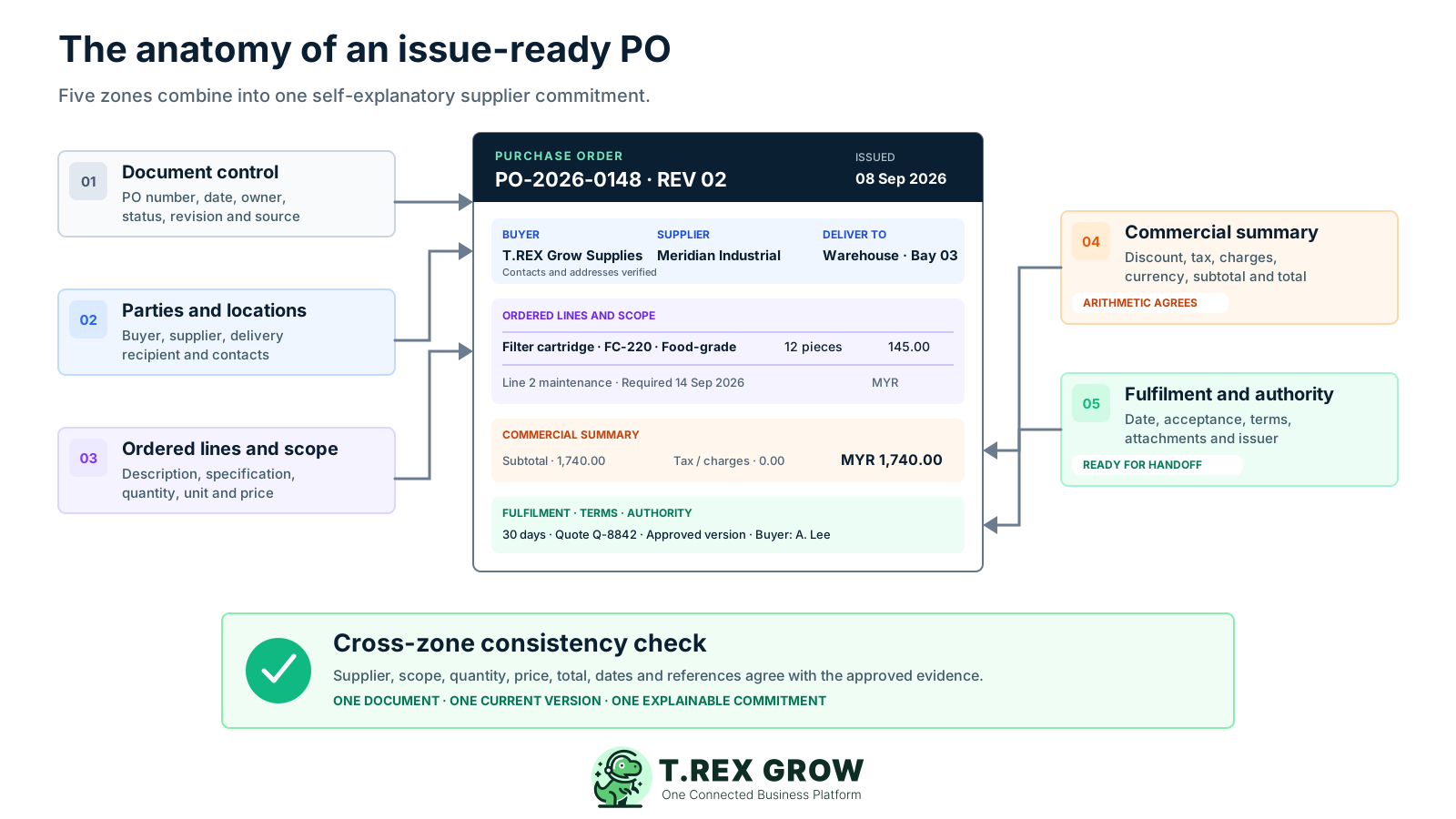
Check the unique PO number, document title, issue date, current status or revision, buyer owner and any source request, quotation or contract reference.
Verify the correct legal or trading identities, addresses, contacts, delivery recipient and service or ship-to location.
Confirm item or service descriptions, codes or references, quantities, units, prices, dates, milestones and line-specific instructions.
Reconcile subtotal, line or overall discounts, tax treatment, freight or other charges, currency, total and the agreed payment term.
State delivery or service expectations, acceptance details, supplier-facing terms, authorised decision or issuer and the contact for clarification.
Make sure the supplier, scope, quantity, price, total, dates and references agree with the approved evidence and with each other.
Use the sequence after the purchase decision has been made and before the supplier receives the official order. Return any failed check to the named owner instead of relying on a note to fix it later.
Record the current facts in one shared place.
Confirm what is known and what needs attention.
Make the next decision or follow-up accountable.
Complete the next task and record the outcome.
Refresh the shared view when facts change.
A dependable workflow keeps the shared record and the next action aligned.
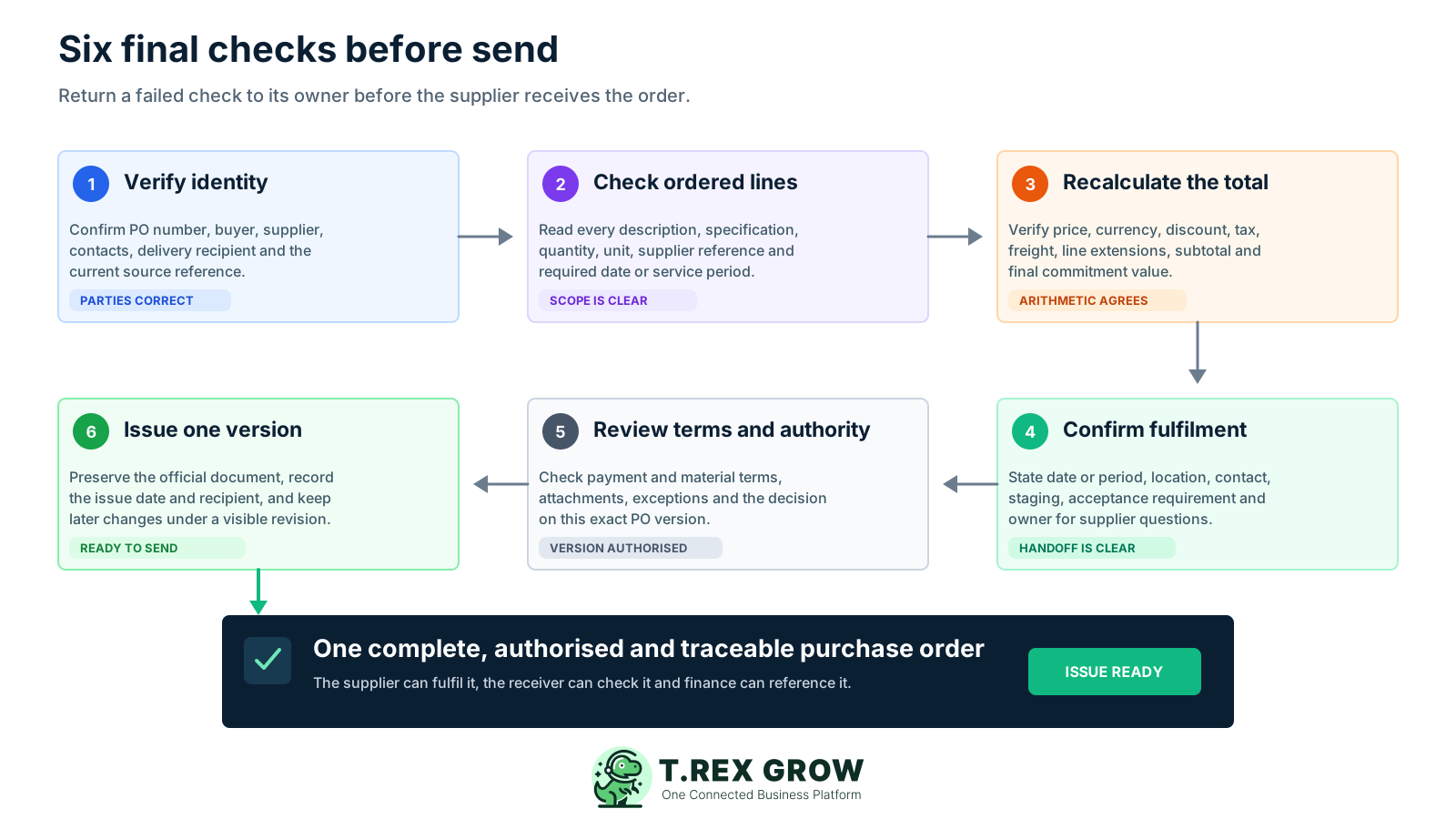
Verify identity and references: confirm the PO number, buyer entity, supplier record, contacts, delivery recipient and source request, quotation or contract reference.
Check every ordered line: confirm the product, service or milestone description, specification, quantity, unit, supplier reference and required date or period.
Recalculate the commitment: verify unit prices, currency, discounts, tax context, freight or additional charges, line extensions, subtotal and final total against the approved basis.
Confirm fulfilment instructions: state the expected delivery or service date, location, contact, staging, acceptance requirement and owner for supplier questions or differences.
Review terms, attachments and authority: confirm payment and material terms, supplier-facing notes, incorporated attachments, permitted exceptions and the decision on this exact version.
Issue one controlled version: generate or preserve the official document, record the issue date and recipient, send only that version and keep any later change under a visible revision or replacement route.
Treat the table as a working review tool. The SME can add or remove conditional fields, but each retained field should support supplier fulfilment, authority, receiving, finance or later explanation.
Ask whether a supplier unfamiliar with the internal conversation can fulfil the order correctly from the issued document and its referenced attachments.
Describe the actual goods, service period or deliverable instead of relying on a quotation number or general category as the entire line description.
Mark a field not applicable when that conclusion matters, rather than leaving the reviewer unsure whether freight, tax, discount or acceptance was overlooked.
If the PO intentionally differs from the request, quotation or normal rule, record the reason, authorised decision and person responsible for the follow-up.
The final reviewer should be able to answer each question from the current purchase record and supporting evidence.
| Area | Check before issue | Common failure |
|---|---|---|
| PO control | Unique PO number, issue date, current revision or status and accountable buyer are visible | A reused number, undated file or draft that looks official |
| Buyer identity | Correct buying entity, address and internal contact are shown | An old branch, company or employee is copied forward |
| Supplier identity | Correct supplier name, address, contact and relevant supplier reference are selected | A similar supplier, outdated contact or unverified change is used |
| Delivery party | Ship-to or service location, receiving contact and access instructions are clear | Billing address is mistaken for the delivery location |
| Item or service | Each line has a precise description, specification, code or supplier reference where useful | The line says materials, service or as quoted without usable scope |
| Quantity and unit | Quantity, unit of measure and any pack or conversion basis are consistent | Pieces, boxes, hours or months are mixed without explanation |
| Price and currency | Unit price and currency match the approved quotation or agreement | A copied price, wrong currency or expired quotation is used |
| Discount, tax and charges | Discounts, tax context, freight and other charges are included and applied consistently | The supplier and buyer calculate a different payable amount |
| Totals | Line extensions, subtotal and final total can be reproduced from the document | Rounding, quantity or discount makes the total disagree |
| Delivery or service timing | Expected date, delivery pattern, service period or milestone is stated | ASAP or a verbal date becomes the only timing instruction |
| Acceptance | The receiver or service owner can tell what counts as complete and acceptable | Nobody can judge a substitution, short delivery or unfinished service |
| Payment and material terms | Payment term and any material supplier-facing condition agree with the approved basis | Terms conflict with the quotation, contract or supplier record |
| References and attachments | Request, quotation, contract, project and incorporated attachment references are current | The PO points to a missing or superseded document |
| Authority and issue | The exact version has the required decision and only the official document will be sent | Approval covers another version or a draft is sent as final |
The best practice is to make the next action clear before the situation becomes urgent.
A stock order, one-off machine, professional service and subscription should share a stable core, then add the fields needed to make that particular commitment clear. Avoid forcing every category into one generic line description.
Include internal and supplier item references, pack size, unit, quantity, expected date, delivery location and any batch, shelf-life or quality requirement that matters.
Add model, configuration, accessories, installation scope, site requirements, warranty, training, commissioning and the acceptance owner.
Define deliverables, service period, milestones, dependencies, rate or fee basis, acceptance evidence and the route for scope changes.
State users or scope, plan, start and end dates, renewal position, billing period, support, access owner and any approved contract reference.
Show the covered category or service, start and end dates, permitted users, release or call-off method, ceiling or other limit, and how usage will be tracked.
Record the operational reason, authorised exception, original PO or failed supply reference, remaining exposure and the person who will close or reduce the earlier commitment.
A warning sign does not always stop the purchase, but it should trigger clarification or the SME's documented exception route before supplier issue.
Recurring issues usually point to workflow-control gaps, not one isolated data-entry mistake.
A reference can support the order, but the PO should still identify the goods, service, quantity or period clearly and point to the exact current quotation.
The same total can represent a different supplier, scope, quantity or term. Review the complete supplier commitment rather than one number.
Apply the SME's independent supplier-change verification before using a new legal name, contact, address or payment-related instruction.
Replace vague urgency with a required date, location, operational consequence and owner for any supplier response or exception.
A quantity without pieces, boxes, kilograms, hours, months or another defined unit can create a material difference in cost and fulfilment.
A material change to supplier, scope, price, quantity, date or terms should follow the SME's revision or reapproval rule before issue.
An after-the-fact document may help record the transaction, but it cannot provide the preventive check that should occur before commitment.
If nobody owns actual receipt or service acceptance, ordered quantities can be mistaken for completed fulfilment.
The pre-issue checklist creates a reliable baseline. Keep that baseline intact when the supplier acknowledges, fulfils, invoices or asks to change the order so later teams can compare expected and actual facts.
Keep the official issue date, recipient and supplier-facing version instead of relying on the latest file in a shared folder.
Record whether the supplier accepted the order, proposed a change or raised a question. Acknowledgement remains separate from actual fulfilment.
Preserve the earlier issue, state what changed and why, obtain the required decision and make the replacement version clear to the supplier.
Record actual quantities, dates, condition or service acceptance separately so partial, rejected or substituted fulfilment stays visible.
Connect the supplier invoice to the PO and actual receipt or acceptance, then assign an owner to price, quantity, tax or documentation differences.
Resolve or cancel residual balances, preserve the closure basis and retain relevant purchase records under the SME's policy and current Malaysian requirements.
The best practice is to make the next action clear before the situation becomes urgent.
Use the checklist to define the SME's required fields, conditional evidence, authority and exception rules. TREX Grow can support the core purchase-order record and downstream links without replacing supplier verification or management judgement.
Create a PO from a supplier and select supported supplier-linked products instead of rebuilding basic supplier and item context for every order.
Record quantities, unit prices, currency, tax, discount, totals, expected delivery date, delivery address, payment terms and notes in one PO.
Use the supported permission-based request-and-approve route or direct finalisation path so the official PO comes from an authorised workflow.
Generate a draft document for review and the official PDF after the supported decision, helping staff avoid treating a working version as the supplier order.
Create a PO revision with previous revision history when the supported purchase record changes instead of silently overwriting the earlier version.
Create linked stock entries with actual received quantities and dates, and start a supplier invoice from the PO context for the downstream review.
Choose the next planned order and give it to someone who did not join the original conversation. If they cannot identify the supplier, scope, quantity, total, delivery expectation, terms, authority and official version in five minutes, improve the document before sending it.
A practical PO should include a unique number and issue date, buyer and supplier details, precise goods or service lines, quantities and units, prices and currency, discounts, tax context, charges and total, delivery or service expectations, payment and material terms, references, authority and the current version.