Phase 1 Procurement Visibility Guide

Procurement Visibility for Small Businesses: A Practical Guide

Procurement visibility is the ability to explain the current position of every material supplier purchase: what was committed, what should have arrived, what actually arrived, what was invoiced or paid, what is different, and who owns the next action. Start with a useful operating view, not a decorative dashboard.

Procurement visibility control view connecting commitments, fulfilment, supplier invoices and exceptions to one current position and next action
Problem

The business keeps buying, but nobody can explain what is still open

A small team can create purchase orders, receive deliveries and record supplier bills while still lacking visibility. The weakness appears when management asks for the current position and every answer requires a different inbox, spreadsheet, folder or person.

Operational pressure

The next action is easy to lose when context is scattered.

When records live in different places, the person responsible has to reconstruct what happened before they can make a confident decision or follow up.

Scattered recordsUnclear ownershipAvoidable surprises
High risk

An issued purchase order is mistaken for the current commitment

The original order does not explain approved changes, cancellations, partial fulfilment or what remains open. The team needs the current authorised position and its supporting record, not only the first PDF sent to the supplier.
Expected delivery and actual fulfilment live in different places

Purchasing may know the promised date while receiving knows what arrived. Without a linked record, management cannot quickly see late, partial, rejected or outstanding quantities and services.

Finance sees invoices without the operating context

A supplier invoice can show the amount and due date but not by itself prove what was authorised, accepted or disputed. Finance then depends on messages and memory to rebuild the purchase basis.

High risk

Exceptions disappear inside comments and chat threads

A price difference, damaged delivery, missing document or duplicate concern remains unresolved when the issue has no affected amount, owner, next action and review date.

One status hides several different questions

Approved, received, invoiced and paid are different states. Compressing them into Done or Pending can make a purchase look complete while an operational or financial action remains open.

A neat report can still be stale

If events are entered only before a management meeting, the view explains the past rather than the decision in front of the business. Visibility depends on timely updates at important workflow events.

Education

Define procurement visibility before choosing a dashboard

Procurement visibility is a management capability, not a screen type. A useful view is current, complete enough for the decision, traceable to reliable source records, understandable across teams and explicit about uncertainty. It should answer six questions without pretending that every purchasing fact belongs to one status.

What has the business committed to buy?

Show the current approved or issued purchase basis, supplier, items or service, value, currency and commercial terms. Separate a proposed purchase from a supplier commitment that already exists.

What should have happened by now?

Keep expected delivery, milestone or service dates beside the responsible buyer and supplier follow-up. This gives lateness a clear reference point instead of relying on recollection.

What actually happened?

Record goods received, services accepted, quantities, dates, evidence and outstanding balance. Preserve partial activity instead of overwriting the order with the latest event.

What payable position now exists?

Show supplier invoices, due dates, current review or exception position, adjustments and recorded settlement evidence separately from the fulfilment state.

What is different or at risk?

Surface overdue deliveries, quantity or price differences, missing evidence, duplicate concerns, disputed amounts, blocked invoices and other exceptions that change the next decision.

Who owns the next action and when will it be reviewed?

Every material open item needs a named owner, a specific action and a review date. Visibility that identifies a problem but not its owner remains descriptive rather than operational.

Education

Build one minimum procurement visibility record

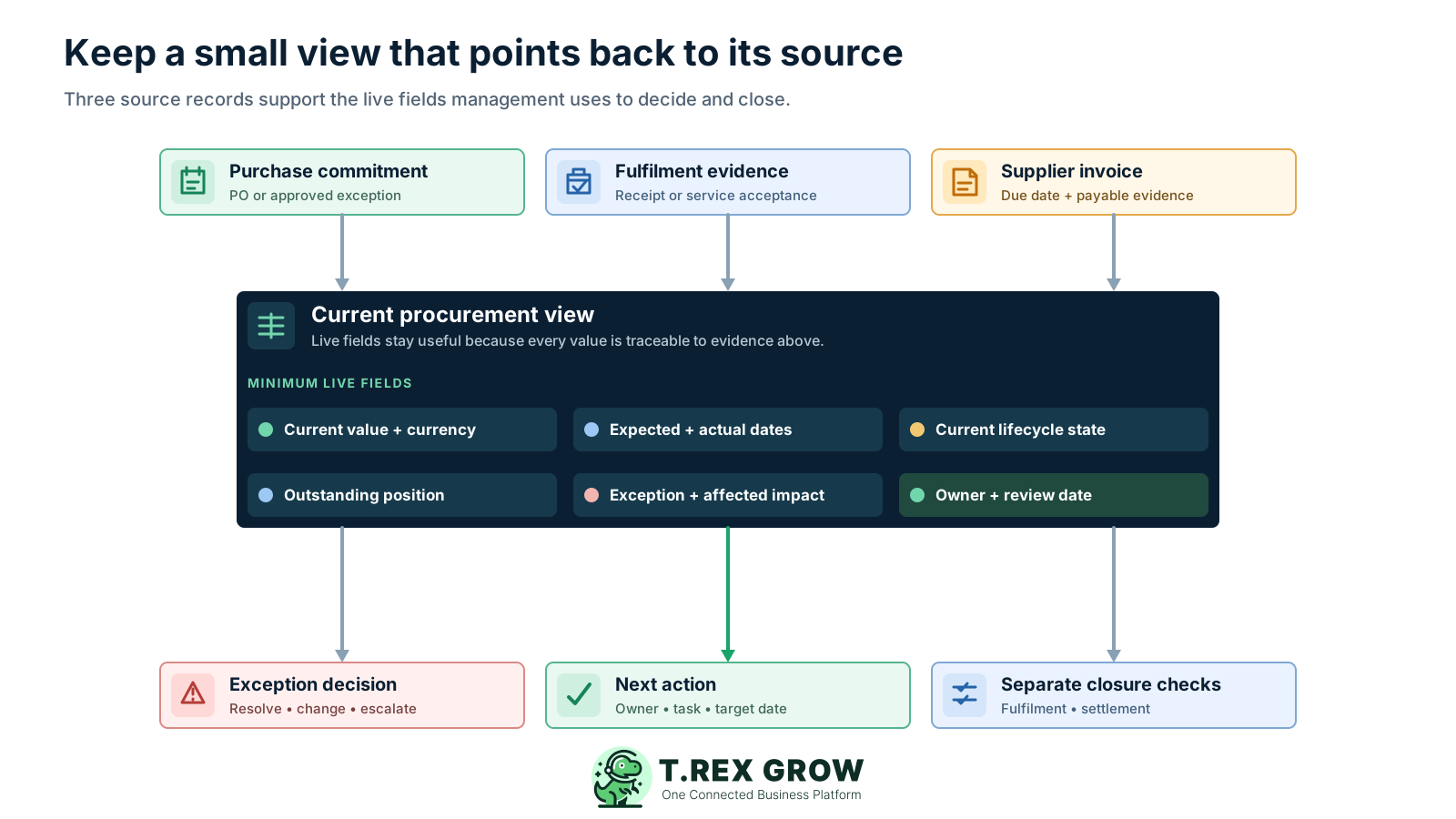
The view does not need every field from every document. It needs a compact control record that points back to the source evidence and preserves the few live facts management uses to understand exposure, progress, exceptions and ownership.

Minimum procurement visibility record linking purchase orders, receiving evidence and supplier invoices to current status, exceptions and next actions

Purchase identity and basis

Keep the PO, contract or approved exception reference, current version, supplier, buyer or requester and the date the commitment became active.

Value and commercial terms

Record the current committed value, currency, relevant tax or discount context, payment terms and any authorised change that affects the expected total.

Expected fulfilment

Show expected dates, milestones, quantities or service outcomes and the supplier confirmation or latest follow-up that supports the expectation.

Actual fulfilment and evidence

Keep the received or accepted quantity, date, condition and evidence, plus the remaining quantity or service work that is still open.

Invoice and payment position

Link invoice identity, invoice and due dates, current payable amount, adjustments and settlement evidence without treating payment as proof of receipt.

Exception, owner and next action

Describe what differs, the affected amount or quantity, who must act, the next action, target date and evidence required before the issue can close.

Workflow

Use this six-step procurement visibility routine

The routine begins with management questions and source records, not a reporting tool. Update the view when important events occur, use the review to resolve exceptions, and close operational and financial work deliberately.

A repeatable operating workflow

Capture

Record the current facts in one shared place.

Check

Confirm what is known and what needs attention.

Assign

Make the next decision or follow-up accountable.

Act

Complete the next task and record the outcome.

Review

Refresh the shared view when facts change.

A dependable workflow keeps the shared record and the next action aligned.

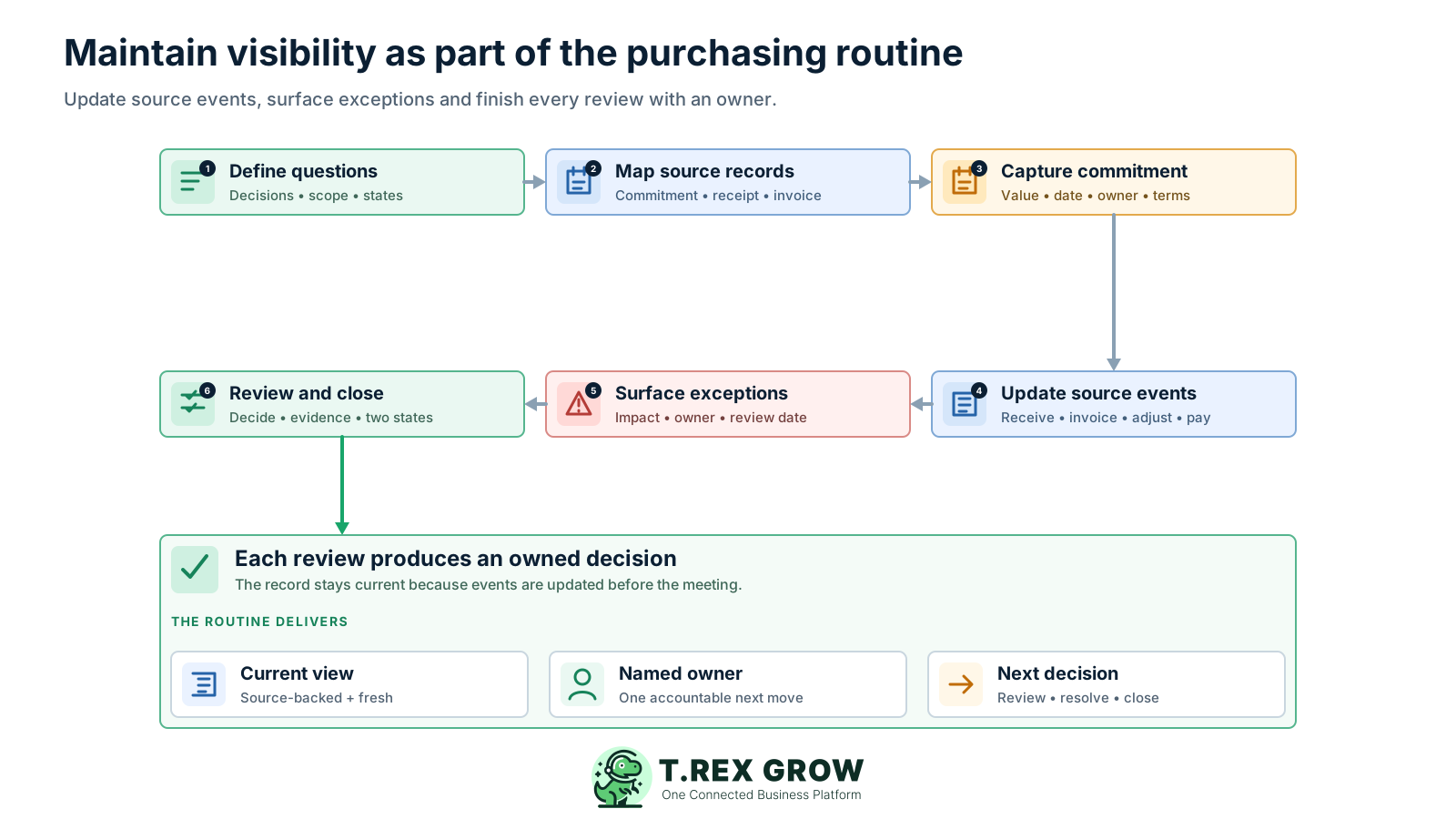
Six-step procurement visibility routine from defining management questions through source records, event updates, exception ownership and separate closure
1

Define the decisions and boundary: agree which purchases are material enough to include, which questions management must answer, what the view does not cover, and how proposed, committed, fulfilled, invoiced and paid positions differ.

2

Map each answer to a source record: identify the purchase basis, supplier confirmation, goods receipt or service acceptance, supplier invoice, adjustment, payment evidence and exception record that support the live view.

3

Capture the commitment when it becomes real: record the approved or issued value, supplier, items or service, expected date, owner and terms when the business creates the external commitment, not after the supplier invoice arrives.

4

Update important events at the source: record partial or final fulfilment, invoice receipt, approved changes, disputes, adjustments and payments with their own dates and evidence. Do not overwrite earlier facts merely to make the row look current.

5

Surface exceptions with an owner and next action: compare expectation with reality, describe the difference, show its affected value or quantity, assign the responsible person and set the next review date.

6

Review, decide and close two positions: use a short operating review to act on overdue or blocked items, then close fulfilment and financial settlement separately only when their evidence supports closure.

Best practices

Use management questions and exception measures, not vanity totals

A large dashboard can create noise. Start with measures that point to an operational decision, define the source and owner, and keep the frequency proportionate to purchase volume and risk. These are management-view examples, not claims that TREX Grow automatically calculates each measure.

Do this

Show the value and count of open commitments

Use the current active commitment less cancelled or genuinely closed work. Let managers drill back to the supplier, purchase and expected fulfilment evidence behind the total.

Do this

Separate late from partially fulfilled

A late order with nothing received and a partial delivery may need different supplier action. Keep expected date, actual activity and outstanding balance visible together.

Do this

Measure unresolved exceptions by age and impact

Count alone can hide one old, material issue. Show how long the exception has been open, the affected value or quantity, and whether a decision owner exists.

Do this

Keep due payables separate from unresolved invoices

An invoice may be due soon and ready for the next payment process, or it may be blocked by missing evidence or a dispute. Do not combine those positions into one overdue total.

Do this

Review data freshness

A last-updated date and source owner help management judge whether the view reflects current operations. Investigate important records that have not moved despite an expected event.

A practical procurement visibility scorecard

Begin with a few questions that lead directly to a follow-up, correction or closure decision.

Management questionMinimum evidenceTypical ownerReview action
Which commitments are still open?Active purchase basis, current value and closure statePurchasingConfirm supplier and next milestone
What is late or only partly fulfilled?Expected date, receipt or acceptance and outstanding balanceBuyer or operationsFollow up, revise or escalate
Which invoices are blocked or unexplained?Invoice, purchase basis, fulfilment evidence and exceptionPurchasing and financeAssign evidence or resolution
What is due for the next payment process?Current payable, due date, adjustments and required reviewFinancePrepare the payment decision
Which exceptions are ageing?Issue date, impact, owner, next action and review dateNamed exception ownerResolve, change owner or escalate
What can be closed?Fulfilment evidence and separate settlement evidenceOperations and financeClose each state deliberately

The best practice is to make the next action clear before the situation becomes urgent.

Education

Treat exceptions as managed work, not comments

The value of visibility is tested when the purchase does not follow the expected path. A visible exception should preserve the original facts, explain the difference and move toward a documented decision without rewriting history.

Name the exception type

Use a small, consistent set such as late, partial, over-supplied, damaged, price difference, quantity difference, missing evidence, duplicate concern, disputed or cancelled.

Show the affected position

Record the quantity, value, date, item, service or invoice balance affected so the team can judge materiality instead of treating every issue equally.

Preserve the expected and actual facts

Keep the committed terms and the real event side by side. Do not overwrite the order, receipt or invoice merely to make the documents agree.

Assign one accountable owner

Several people may contribute, but one person should own the next movement. Name the supplier follow-up, internal decision or evidence request required.

Set a review date and escalation point

The next date should reflect risk, due date and business impact. Define when an unresolved issue must move to a different decision-maker.

Record the resolution and downstream effect

Show whether the outcome changed the commitment, receipt, invoice, adjustment, payment or closure position and retain the evidence supporting that result.

Best practices

Run a review cadence that matches the speed of the business

Visibility should be maintained through ordinary work, then checked at a rhythm that catches stalled or material items. The exact cadence depends on purchase volume, delivery sensitivity, cash pressure and team capacity; the roles below are a starting point rather than a universal rule.

Do this

At each event: update the source record

Record a new commitment, supplier change, receipt, invoice, adjustment, payment or exception when it occurs. The review should test current facts, not become the only time data is entered.

Do this

Frequently: scan urgent and due items

Check deliveries needed for operations, supplier invoices nearing due date, blocked purchases and exceptions whose next action cannot wait for the weekly review.

Do this

Weekly: review open commitments and exceptions

Focus on material changes, late or partial fulfilment, unresolved invoice issues, ageing exceptions, missing owners and actions due before the next review.

Do this

Monthly: reconcile and improve definitions

Confirm closure states, investigate stale records, compare source totals with the management view and revise field definitions or responsibilities that repeatedly create confusion.

Do this

After material change: test the view again

New suppliers, currencies, locations, approval rules, payment terms or product lines may change the information management needs. Update the view when the operating model changes.

The best practice is to make the next action clear before the situation becomes urgent.

Mistakes

Avoid procurement visibility that creates false confidence

Visibility can look sophisticated while still being unreliable. These shortcuts produce attractive totals without the source, timing, ownership or workflow distinctions needed for a safe decision.

Recurring issues usually point to workflow-control gaps, not one isolated data-entry mistake.

Common

Starting with dashboard widgets instead of decisions

A chart is only useful when the team knows the management question, source record, definition, owner and action it supports.

High risk

Treating scanned files as structured visibility

A folder of PDFs may preserve evidence but still require manual searching to identify status, outstanding quantity, exception, owner or next date. Keep searchable control fields beside the source file.

Common

Using total spend as the whole procurement position

Historical expenditure does not show every current commitment, future fulfilment, blocked invoice or next action. Spend analysis and operating visibility overlap but answer different questions.

High risk

Combining fulfilment, approval and payment into one status

A purchase can be authorised but not received, received but not invoiced, invoiced but disputed, or operationally complete while settlement remains open.

Common

Confusing procurement visibility with inventory availability

Procurement explains supplier commitments and their progress. Inventory visibility explains stock on hand, locations, reservations and movements. Link them where relevant but do not use one as a substitute for the other.

High risk

Closing an exception by changing the original record

Overwriting the committed quantity, expected date or invoice amount can remove the evidence that explains the variance. Record the authorised change or adjustment separately.

Common

Assuming software will repair unclear ownership

Connected records help only when the SME defines who updates each fact, who decides exceptions, which dates matter and what evidence supports closure.

Solution

Where TREX Grow can support the underlying visibility record

Use this guide to define the management questions, fields and review cadence first. TREX Grow can then keep useful parts of the purchasing record chain connected and searchable. The current verified capabilities support source visibility; this page does not claim a consolidated procurement dashboard or enterprise analytics suite.

Operations work better when records and next actions are connected

Search and filter purchase orders

The purchase-order list can show PO number, status, supplier, associated stock entries, associated supplier invoices and total amount, with search and filters for created date, status and supplier.

Keep commitment facts on the purchase order

A purchase order can retain supplier, products, expected delivery date, payment terms, tax context, delivery address, discount, notes and attachments, with permission-based creation and review states.

Record actual receiving from the purchase order

PO-linked stock entries carry the supplier and ordered items into receiving, where the team records the quantity received, received date, checked date and supporting attachments.

TREX Grow Operations Hub

Connect supplier invoices and payment evidence

Supplier invoices are created from the relevant PO, retain invoice and due dates, items and attachments, and can keep payment-history facts such as amount, date, method, reference, person-in-charge and evidence.

Keep the management routine SME-owned

TREX Grow does not replace the SME's definitions, exception policy, review cadence or management judgement. This guide does not claim automated three-way matching, requisitioning, budget enforcement, supplier performance analytics or one ready-made procurement control tower.

Next step

Build the view from five real purchases before expanding it

Choose five recent purchases: one open, one late or partial, one invoiced, one paid and one with an exception. Test whether your team can explain the commitment, expected and actual fulfilment, invoice or payment position, owner, next action and separate closure states without searching through messages. The first missing answer is the first visibility field or handoff to fix.

See How TREX Grow Connects Purchasing

Procurement visibility is the ability to explain the current position of supplier purchasing from reliable records: what the business committed to buy, what should and did arrive, what was invoiced or paid, what is different, and who owns the next action.