Back to business solutionsFor Malaysian manufacturing SMEs

Business Software for Manufacturers

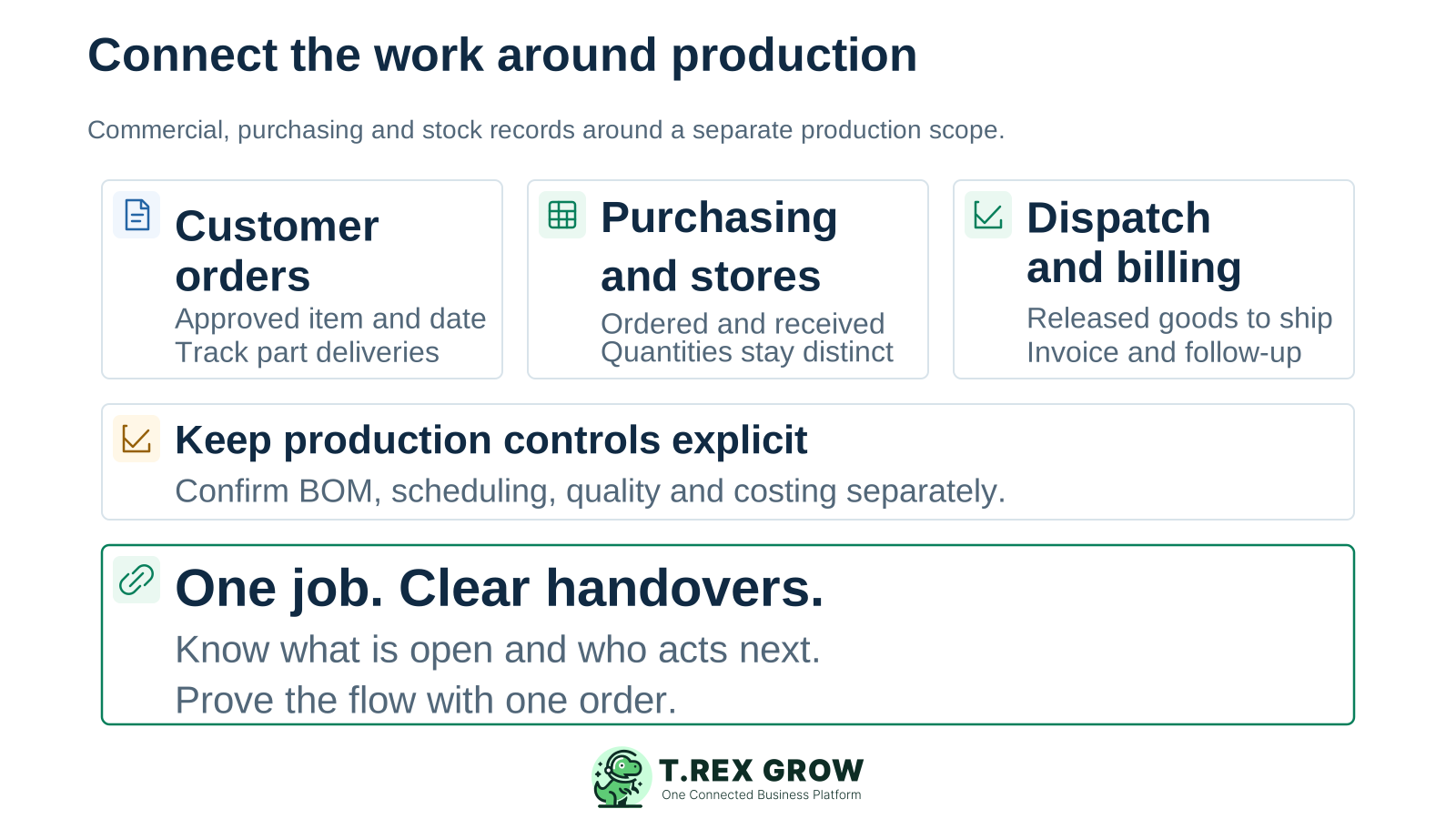
Connect the customer orders, purchasing, stock and dispatch work around production. TREX Grow gives your team business records to review together, while production planning, shop-floor control and specialist traceability remain requirements to evaluate separately.

Manufacturing business software scope covering customer orders, purchasing and stores, dispatch and billing, with production controls evaluated separately
Problem

Make the handovers around production easier to explain

For a manufacturer, a customer commitment, an incoming delivery and a released finished item represent different stages of work. Give sales, purchasing, stores, production and finance a shared way to explain those stages.

Operational pressure

The next action is easy to lose when context is scattered.

When records live in different places, the person responsible has to reconstruct what happened before they can make a confident decision or follow up.

Scattered recordsUnclear ownershipAvoidable surprises
High risk

A quotation is not a production promise

Agree the product code, specification or drawing reference, quantity and requested date. Have the responsible production owner confirm feasibility before treating a customer commitment as a supported delivery date.

Ordered materials are different from received materials

Track the supplier commitment and actual receipt separately. A short or late delivery should leave a clear outstanding quantity and a responsible follow-up action.

Material receipt is different from usable output

Stores may have received material while the job is still in progress or awaiting inspection. Make the production and release evidence explicit before treating finished goods as available to dispatch.

High risk

A partial dispatch leaves more than one open task

Sales needs the remaining delivery commitment, stores needs the permitted quantity, and finance needs the correct billing basis. Keep those questions tied to the accepted customer order.

Workflow

Test the manufacturing business workflow with one order

Map the material and information handovers before choosing the software scope. Use one order and involve the people who own each stage; production operations and their recording method need their own acceptance evidence.

A repeatable operating workflow

Capture

Record the current facts in one shared place.

Check

Confirm what is known and what needs attention.

Assign

Make the next decision or follow-up accountable.

Act

Complete the next task and record the outcome.

Review

Refresh the shared view when facts change.

A dependable workflow keeps the shared record and the next action aligned.

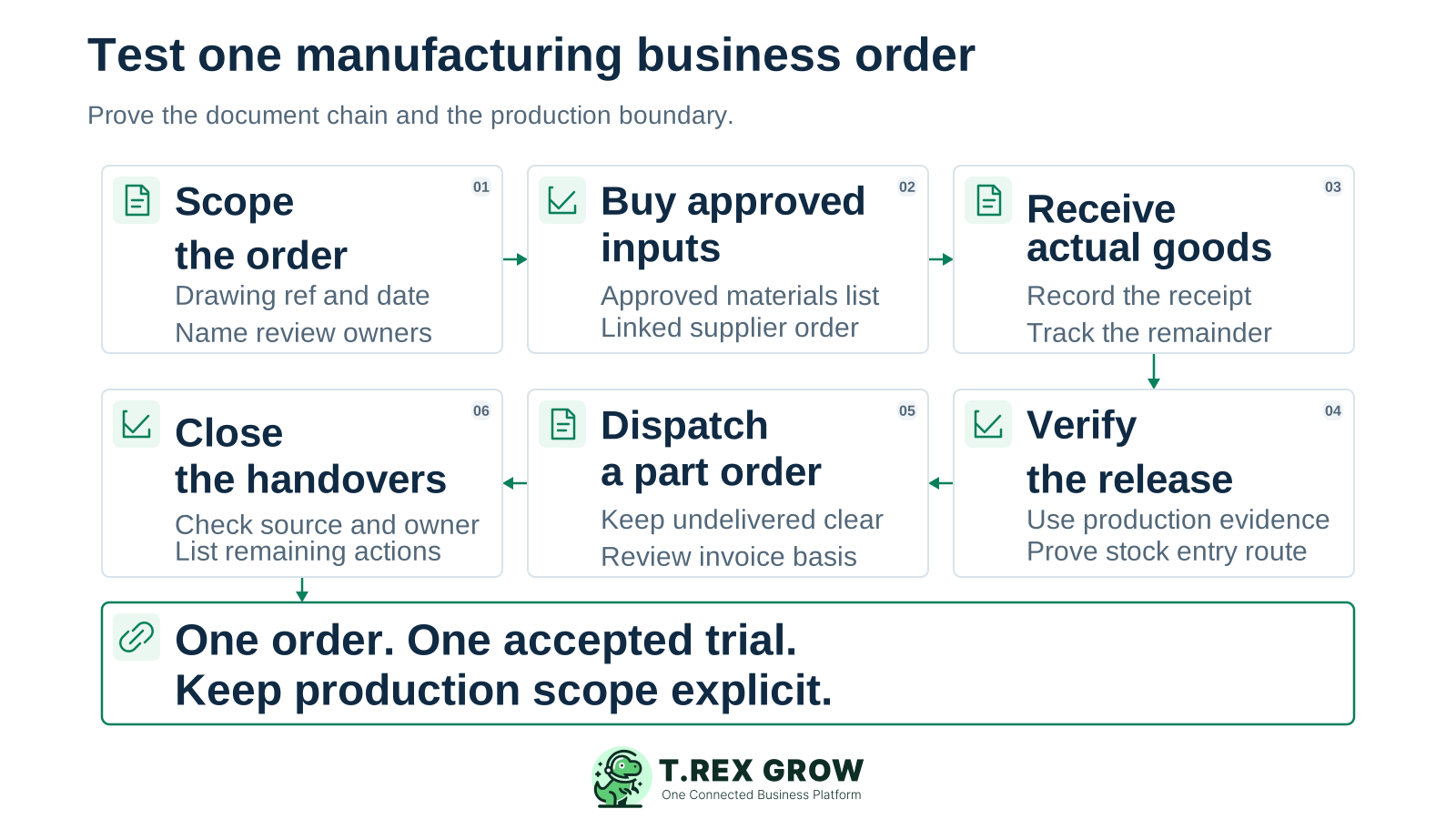
Six-stage manufacturing business trial covering customer order, approved purchasing, actual receipt, production release evidence, partial dispatch and remaining handovers
1

Scope the customer order: agree the product and drawing or specification reference, quantity, requested date and acceptance owners. Confirm what sales may promise from the production plan.

2

Buy the approved needs: use the material, packaging or consumable requirements approved by the production owner to prepare the relevant supplier order. Do not assume the software has calculated these quantities from a bill of materials.

3

Receive the actual goods: follow the purchase order into the receipt, compare ordered and received quantities, and keep shortages or other exceptions visible for review.

4

Verify released output: have the production owner provide accepted completion and release evidence. Demonstrate the supported method for recording finished-goods availability before including that output in live stock or dispatch.

5

Dispatch the accepted quantity: use the customer order and verified available finished goods to test the delivery documents, a part delivery and the agreed invoice basis. Keep the undelivered balance explainable.

6

Close the handovers: review supplier billing, customer billing, payment follow-up and remaining actions. Confirm that another responsible user can trace the records and identify what still needs attention.

Solution

Where TREX Grow supports the work around manufacturing

Consider TREX Grow when the priority is clearer commercial, purchasing and stock records around a production process that already has an owner. Test the scope against your actual item types, handovers and exceptions.

Operations work better when records and next actions are connected

Customer and sales records

Review reusable customer and product details, quotations, accepted sales orders and relevant delivery and invoice documents. Keep the approved specification reference clear without assuming engineering revision control is provided.

Supplier orders and receiving

Follow purchasing into actual receipts and supplier billing. Test a shortage so the buyer and storekeeper can distinguish the supplier commitment from what has arrived.

TREX Grow Operations Hub

Stock and warehouse records

Review the product, source document, quantity, date and available location detail supported by the selected plan. Treat raw materials and finished goods as distinct item identities where needed; verify conversions and production movements separately.

Permissions and follow-up

Use the demonstrated record permissions, applicable approval paths and reminders to assign the next action. A business document approval should not be assumed to certify production quality or product release.

Education

Choose modules and plans around the handovers you need

Match the trial to the actual work. A manufacturer testing purchasing, receipts and stock needs broader scope than a team preparing only customer and product records.

Review production and accounting scope separately

These plans do not establish the manufacturing controls required by your factory. Accounting Beta is included in paid plans, needs setup and explicit activation, and may produce incomplete or inaccurate outputs. Obtain qualified accounting review before relying on those outputs.

Confirm the full setup before committing

Check current pricing, eligible trial terms, data preparation and the work needed for any retained production system. No fixed rollout duration, integration or manufacturing cost-saving result is assumed.

Plan scope for a manufacturing business evaluation

Work to testRelevant TREX Grow scopePlan check
Prepare customer and product recordsCore records, quotations and invoices for the first commercial test.Start with Free for included work, then check the document scope required by the next stage.
Accept customer orders and prepare sales documentsComplete sales documents, attachments and multi-currency document work.Starter and above; confirm the evidence and source references your team needs.
Buy supplies and review actual receiptsPurchasing, stock entries, supplier invoices and core stock operations.Essential and above; this is the relevant starting scope for the purchasing-and-stores trial.
Add detailed warehouse workLocation-level warehouse records, picking and structured inventory counts.Premium; evaluate the specific location and dispatch controls without assuming production planning is included.
Education

Inspect the fields used for purchase-order receiving

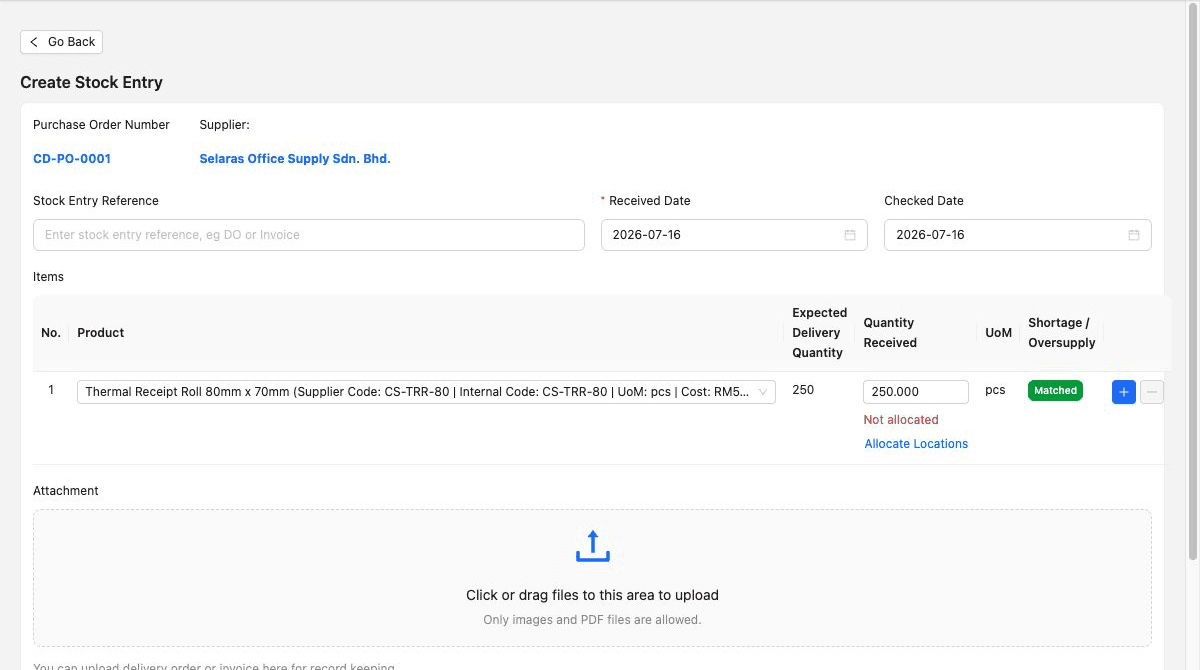
This existing TREX Grow demo form links stock entry to purchase order CD-PO-0001 and a supplier. It shows expected delivery quantity, entered received quantity, dates and allocation context. It illustrates receiving fields, not a completed receipt or a manufacturing quality decision.

Existing TREX Grow demo stock-entry form showing purchase order and supplier references, received dates, expected and entered quantities and allocation context
Existing TREX Grow demo form; illustrates receiving fields rather than a completed factory transaction.

Use the supplier source when checking a delivery

In your trial, compare the supplier document and actual goods with the expected quantity. Ask the storekeeper to explain a shortage and the buyer to identify the remaining supplier action.

Keep inspection and release responsibilities explicit

An entered received quantity or checked date does not establish inspection criteria, a quality result or permission to consume material. Demonstrate the controls your factory requires before relying on them.

Education

Keep the accepted customer order separate from delivery progress

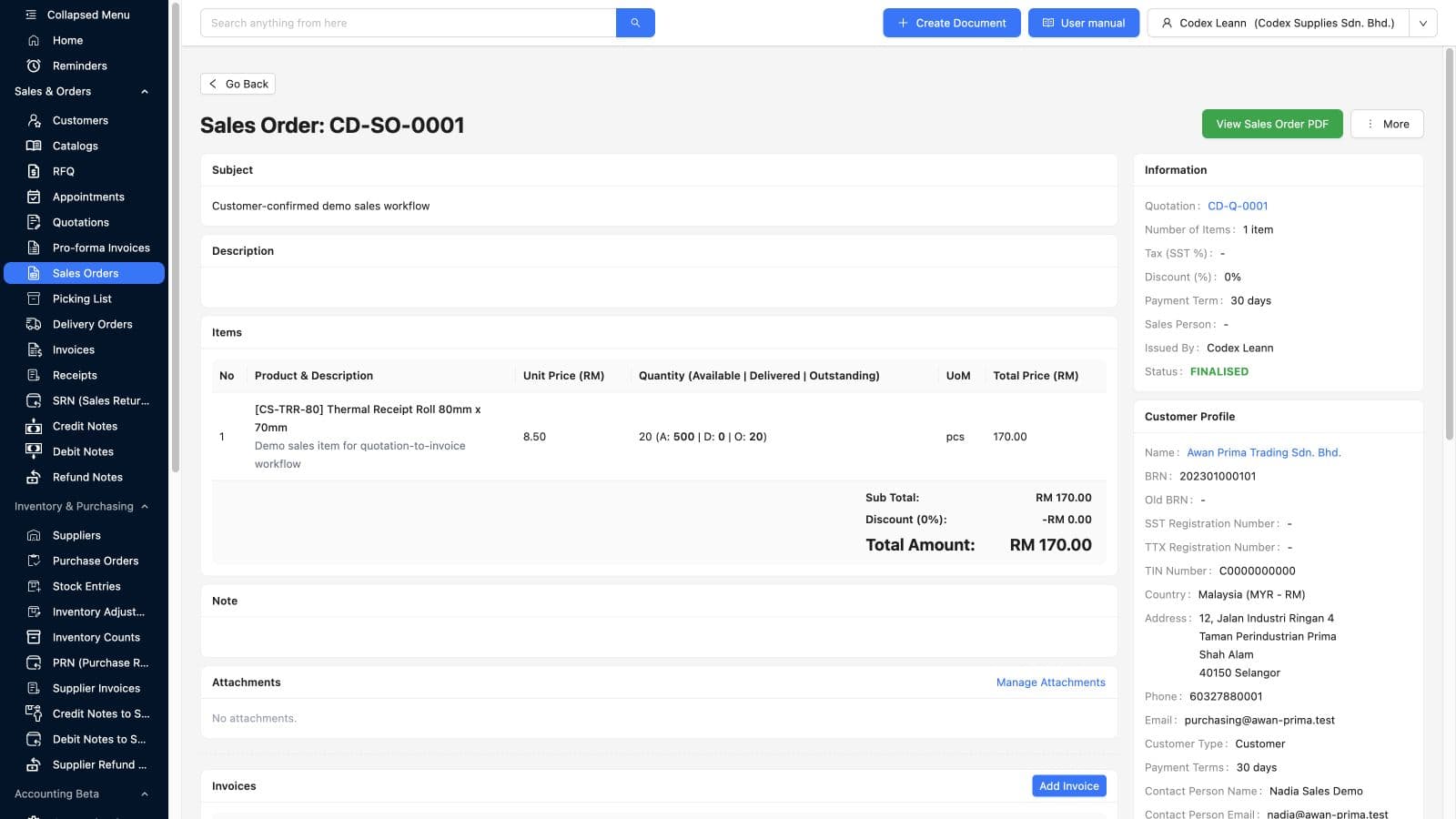
This existing demo sales order shows its quotation source and separate ordered, available, delivered and outstanding quantities. The demo line has 20 ordered, 0 delivered and 20 outstanding. Its finalised document status does not mean the goods have been delivered.

Existing TREX Grow demo sales order with quotation reference, finalised status and 20 ordered, 0 delivered and 20 outstanding units
Existing TREX Grow demo record; illustrates sales-order relationships and quantity states.

Trace the customer commitment

Ask sales and dispatch to find the quotation reference, agreed item and order quantity. In a manufacturing trial, retain the approved specification or drawing reference through the supported document process.

Prove the part-delivery case

Use a realistic trial to check the quantity permitted for dispatch, the delivery record and the remaining customer commitment. The available quantity in this demo does not prove that manufacturing output was recorded or accepted.

Education

Give production controls their own acceptance evidence

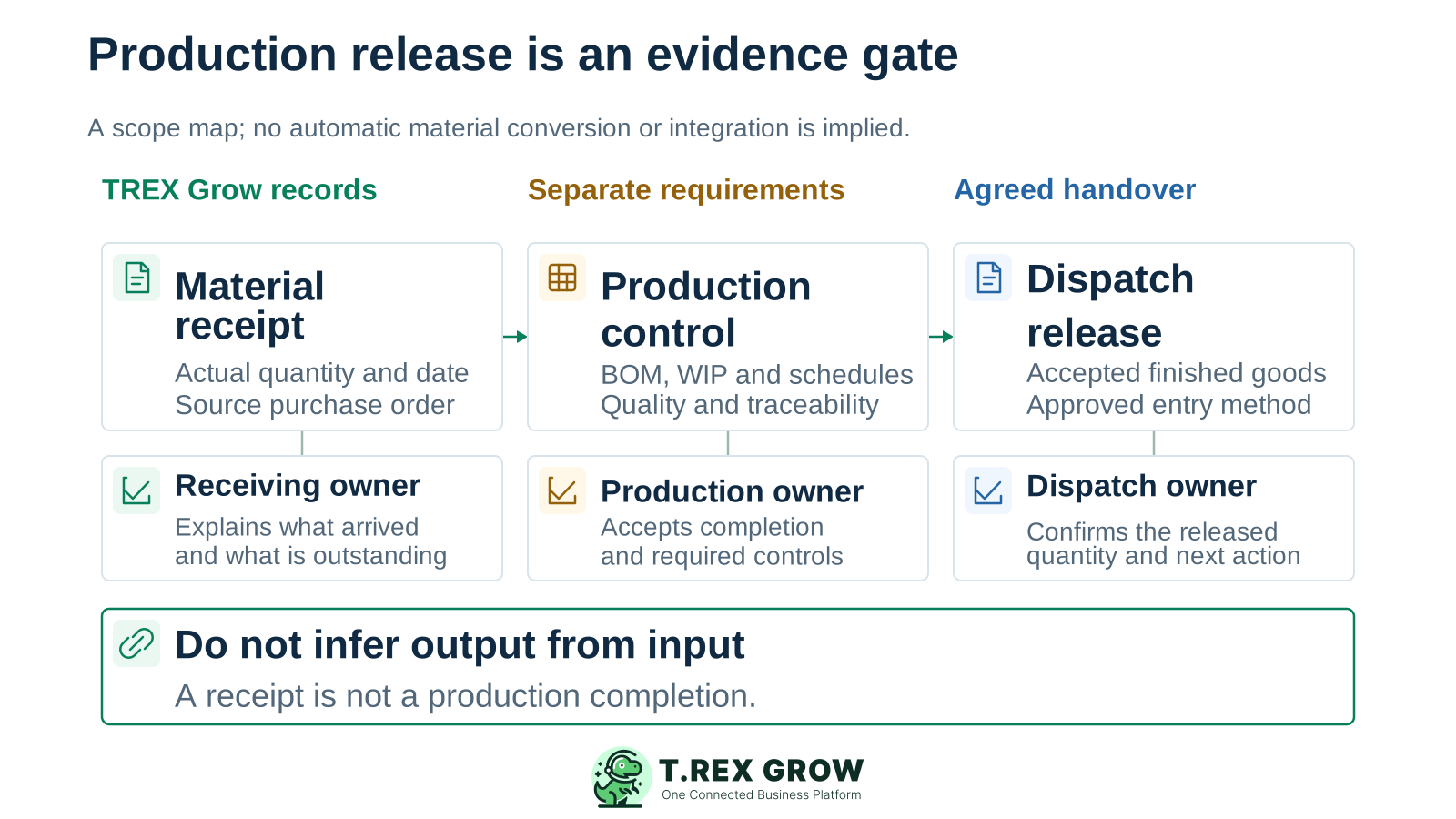
The business records shown here do not establish a manufacturing planning or execution system. If any of the following is essential, include it in the written requirements and test the actual proposed solution before deciding that the scope fits.

Scope map separating material receipt, production controls and accepted dispatch release, with a receiving owner, production owner and dispatch owner

Manufacturing requirements to verify separately

RequirementEvidence your team needsBoundary for this evaluation
Bills of materials and material requirementsApproved component versions, quantities, units, substitutions and the method used to calculate demand.No automatic BOM explosion or raw-material-to-finished-goods conversion is established here.
Routings, capacity and schedulingThe job sequence, resource constraints, promised dates and response to a late material or machine issue.A customer order or supplier receipt is not a production schedule.
Work in progress, yield and manufacturing costThe treatment of material consumption, labour, overhead, scrap, rework and accepted output.Operational quantities and Accounting Beta do not establish accepted WIP valuation or manufacturing cost roll-up.
Lot, serial, expiry and recall evidenceThe trace from a specific input or output to the records and downstream items your requirements demand.A stock-entry reference, product barcode or general record history does not by itself prove specialist genealogy.
Inspection, quality hold and releaseInspection criteria, results, responsibilities and a demonstrated restriction on use or dispatch where needed.A checked date or document approval is not evidence of a complete quality-control module.
Production-system connections and finished-goods entryThe actual recording method, source identifiers, timing, failure handling and reconciliation owner.No native MES, machine, MRP or production-output integration is established by this page.
Education

Illustrative scenario: one fabricated-bracket order

This is a planning example, not a TREX Grow customer case or measured result. A small Selangor fabricator accepts an order for 100 brackets to an agreed drawing reference and delivery schedule. Its production process remains separately controlled.

Purchasing and stores explain the packaging delivery

A separate order for 200 packing sleeves receives 160, leaving 40 outstanding. The buyer and storekeeper should be able to explain that supplier balance without treating it as the bracket production position.

Production confirms which finished goods are released

The production owner reports 60 accepted brackets and 40 not yet released. Before dispatch, demonstrate how the accepted 60 enter the finished-goods stock record through a supported and reviewed method. An unresolved entry route is an unresolved rollout condition.

Sales and finance explain the remaining customer work

Test a 60-unit delivery against the 100-unit customer order and an invoice prepared on the agreed commercial basis. The remaining 40-unit delivery commitment should stay clear. No automatic yield calculation, production posting or revenue recognition is assumed.

Best practices

Use a cross-team trial before expanding the scope

Choose one representative order and one awkward case, such as a supplier shortage or partial dispatch. Ask each owner to accept the records and responsibilities needed for their stage.

Do this

Sales and production accept the promise

Confirm the item, specification reference, quantity and date. Record where production feasibility is checked and who can approve a changed commitment.

Do this

Purchasing and stores accept the receipt

Trace the supplier order into the actual receipt and outstanding quantity. Keep inspection or quality decisions distinct from the receipt fields demonstrated in the app.

Do this

Production and dispatch accept the boundary

Prove the source of released finished goods and its supported stock-entry treatment before testing dispatch. Confirm any location, picking or count scope required by the selected plan.

Do this

Finance and the owner accept the whole setup

Review supplier and customer billing, payment follow-up, required exports and any accounting conditions. Keep the source records, remaining dependencies and trial result together before rollout expands.

The best practice is to make the next action clear before the situation becomes urgent.

Next step

Test the business workflow around your production process

Create a free TREX Grow workspace, review the plan for purchasing and stock, and use an eligible paid-plan trial for the wider operating scope. Bring one order, one receipt exception and the production handover your team needs to prove.

Start your manufacturing business evaluation

The scope verified here covers business records around production: customer orders, purchasing, receiving, stock, dispatch, billing and follow-up. It does not establish a replacement for BOM management, material planning, production scheduling or shop-floor execution. Evaluate those requirements separately.