The invoice is rebuilt from a PDF
Finance retypes the customer, items, quantities, prices, discount, tax, and payment terms from a quotation instead of continuing from a controlled source record.

TREX Grow helps Malaysian SMEs prepare quotations from reusable customer and item records, preserve approval and revision context, create invoices from the quotation source, and keep billing, payment, and e-Invoice activity visible without rebuilding the sale.
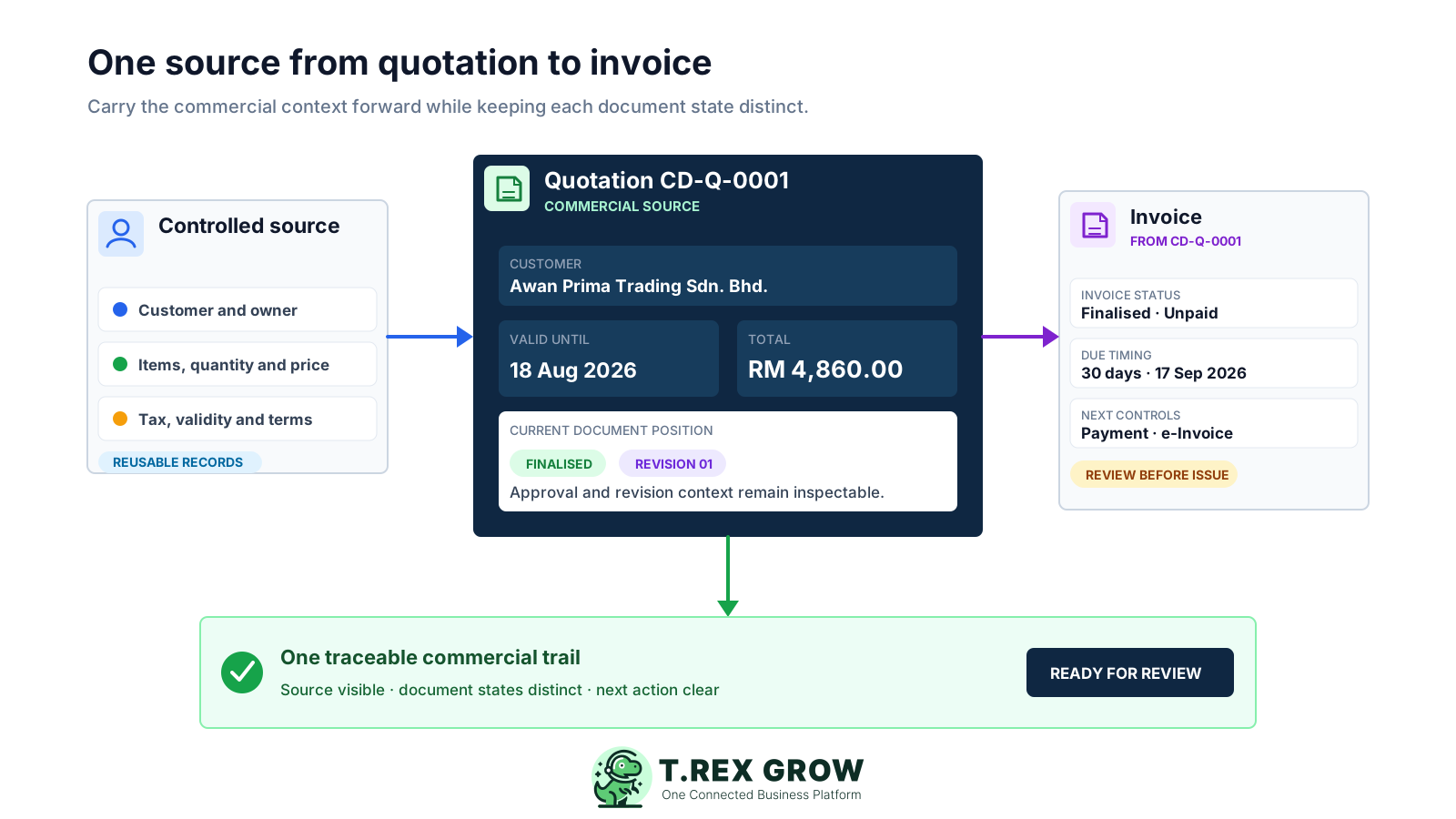
A quotation records the commercial offer. An invoice records the amount being billed. They need distinct controls, but the customer, source, items, terms, and ownership should remain traceable across both records.
Operational pressure
When records live in different places, the person responsible has to reconstruct what happened before they can make a confident decision or follow up.
Finance retypes the customer, items, quantities, prices, discount, tax, and payment terms from a quotation instead of continuing from a controlled source record.
A filename or email attachment does not reliably show whether the invoice came from the current quotation or an earlier revision.
A finalised quotation, customer decision, finalised invoice, unpaid balance, and paid invoice are different events. One shared status label cannot explain all of them.
When a quotation is overwritten, staff cannot see the earlier offer, the revised terms, or which record was used when the invoice was prepared.
Paid dates, amounts, methods, references, bank details, responsible staff, remarks, and attachments become another spreadsheet that is difficult to reconcile.
Incomplete customer and invoice data creates avoidable investigation when the team reaches its Malaysia e-Invoice submission or exception workflow.
A quotation template and an invoice generator can each produce a presentable PDF while leaving the operating trail fragmented. The risk appears when a real transaction includes approval, revision, changed quantities, due dates, or several payments.
Recurring issues usually point to workflow-control gaps, not one isolated data-entry mistake.
Finalised describes the quotation's internal document state. The business must still confirm the customer's decision through its chosen communication and control process.
The most recent email is not always the approved or current quotation, especially after price, quantity, scope, or term revisions.
Silent edits remove the evidence needed to explain which commercial promise changed and what the previous version contained.
Carried customer and item details reduce re-entry, but staff must still verify final quantities, prices, discounts, tax, milestones, terms, and billing instructions.
A single overwriteable value cannot preserve several partial payments, different references, or the evidence supporting each payment row.
Software supports the workflow; it does not replace accurate source data, responsible users, current configuration, or business-specific confirmation of the latest HASiL requirements.
Test whether the system keeps each document controlled and the relationship between them visible. A useful product should make the normal path fast without hiding the exceptions that sales and finance need to resolve.
Quotation and invoice preparation should begin from controlled customer, contact, product, service, price, and tax context rather than copied text.
Quantities, editable unit prices, discount, tax, validity, payment term, subject, description, notes, subtotal, and grand total should remain reviewable.
The team should be able to distinguish a draft from the official quotation, use permission-aware approval, and preserve numbered revisions instead of overwriting history.
When an invoice is created from a quotation, the customer and source items can be carried forward while the quotation reference remains available for later review.
Invoice finalisation, due timing, unpaid or paid position, adjustment records, and payment history should remain understandable as distinct parts of the billing record.
Where e-Invoice applies, accurate invoice data and a visible submission or exception position help the team operate the process. Confirm current obligations using official HASiL guidance.
Run one realistic customer scenario through the product before moving active sales records.
| Requirement | Evidence to test | Operational value |
|---|---|---|
| Controlled source data | Create a quotation from an existing customer and approved products or services. | Reduces re-entry and inconsistent master data. |
| Quotation control | Generate a draft, use the configured approval path, finalise the PDF, and create a revision. | Separates internal work from the current commercial record. |
| Source-linked invoicing | Create an invoice from the quotation and inspect the customer, source items, and quotation reference. | Keeps the billing record traceable to its commercial source. |
| Invoice and payment status | Review due timing, invoice state, two partial payment rows, and their references or evidence. | Shows the current billing position without another tracker. |
| Malaysia e-Invoice workflow | Review the applicable invoice data, submission mechanism, status, and exception path. | Connects compliance handling to the source invoice record. |
TREX Grow keeps the quotation and invoice journey connected without pretending they are one status or one decision. The business remains responsible for confirming customer acceptance and reviewing the invoice before it moves forward.
Record the current facts in one shared place.
Confirm what is known and what needs attention.
Make the next decision or follow-up accountable.
Complete the next task and record the outcome.
Refresh the shared view when facts change.
A dependable workflow keeps the shared record and the next action aligned.
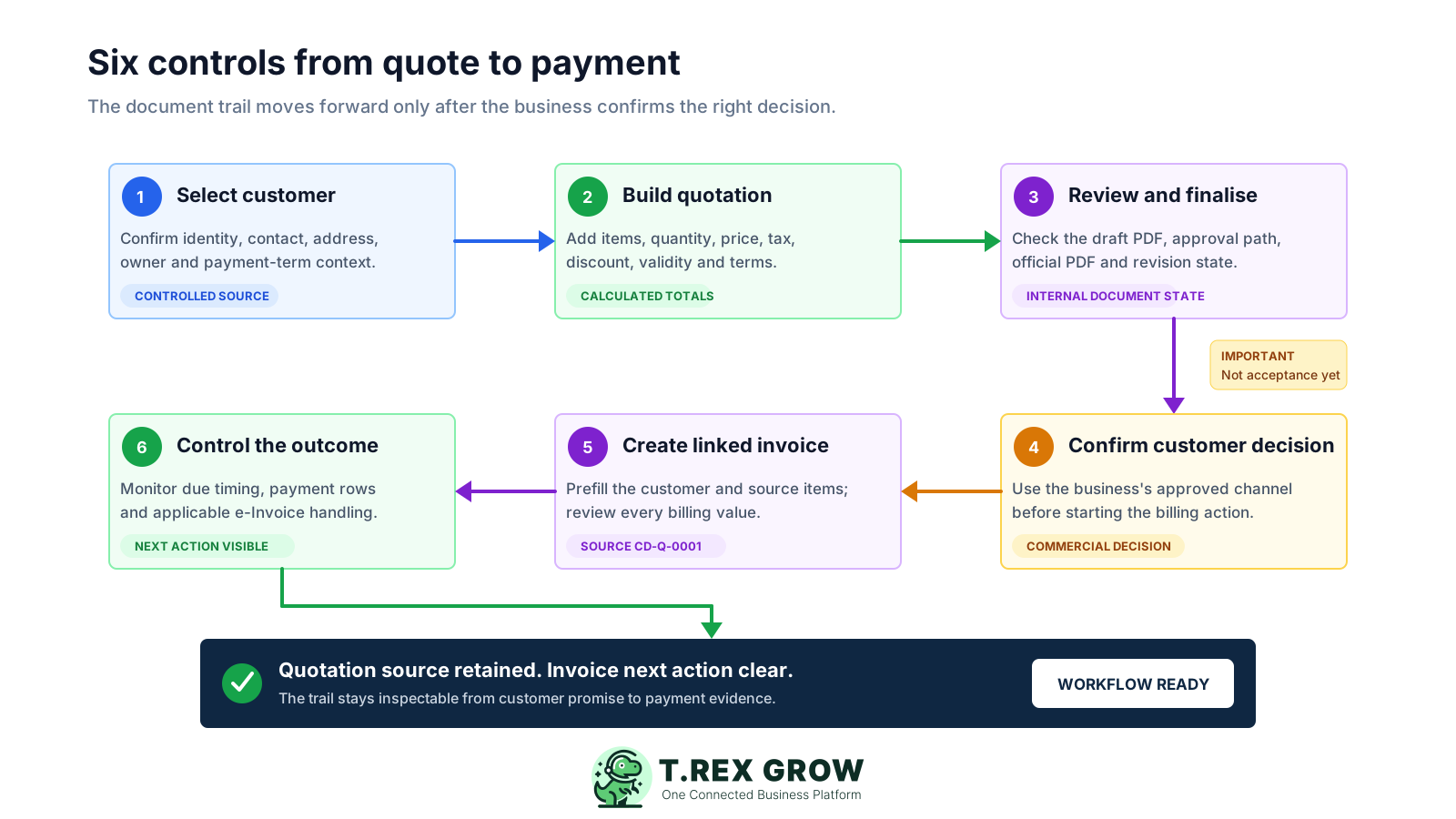
Select the controlled customer record: confirm the customer identity, contact, address, sales owner, payment terms, and the opportunity or job context used by the business.
Build the quotation: add approved products or services, quantities, editable unit prices, discount, tax, validity, payment term, subject, description, and notes.
Review and finalise: generate a watermarked draft PDF, use the configured permission or approval path, and create the official quotation PDF only after the record is ready.
Confirm the customer's commercial decision: use the business's approved communication process. A finalised quotation does not automatically mean the customer accepted it.
Create the invoice from quotation context: carry the customer and source items forward, retain the quotation reference, then verify every quantity, price, discount, tax, milestone, term, and date.
Control the billing outcome: finalise the invoice, handle the applicable Malaysia e-Invoice step, monitor due timing, and record each payment with its own reference and supporting context.
TREX Grow connects the records around the transaction while keeping their responsibilities distinct. Staff can understand where the invoice came from, which document state is current, and what action remains.
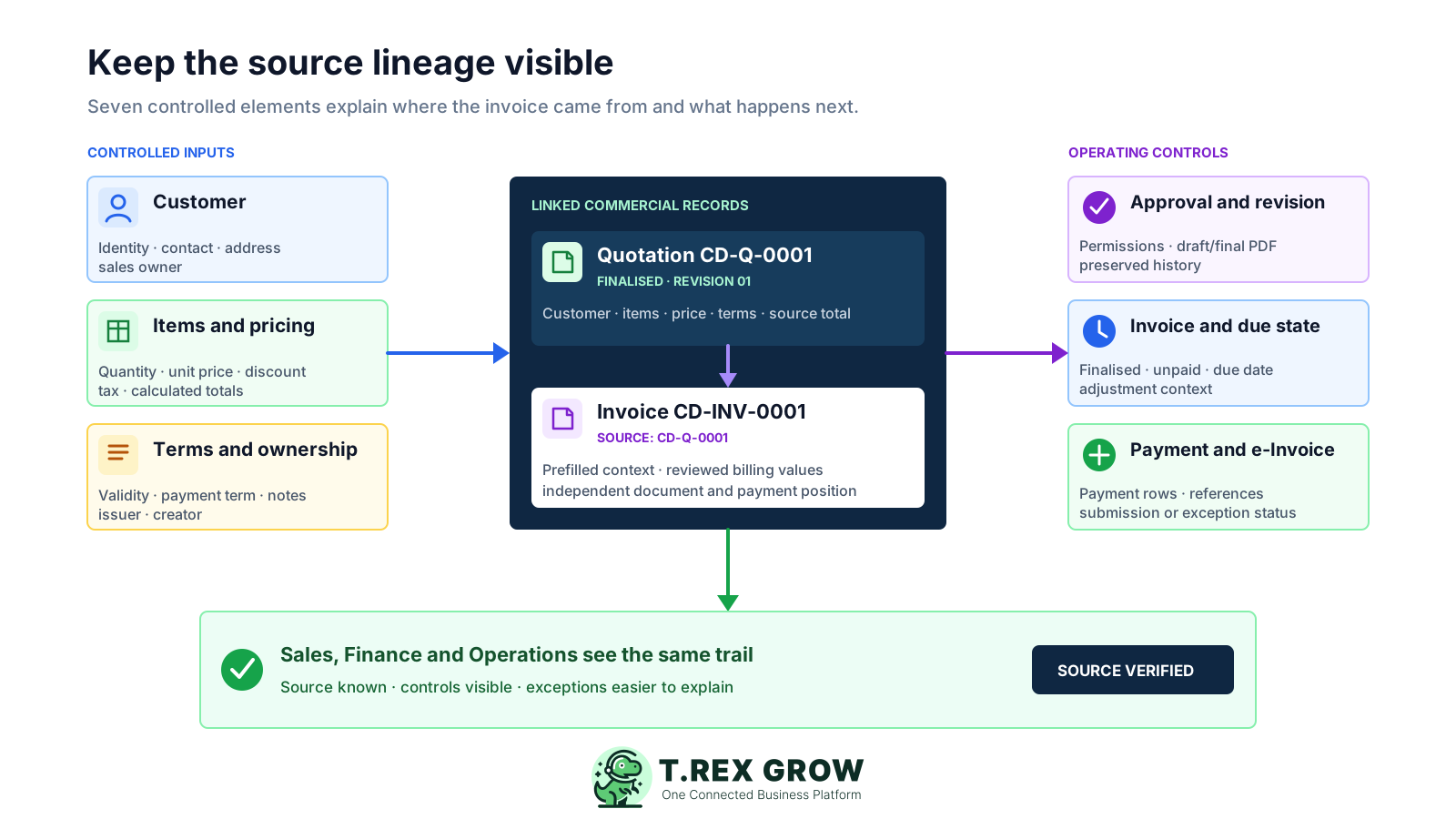
Create the quotation from an existing customer and carry that customer context into an invoice created from the quotation source.
Keep products or services, quantities, unit prices, discount, tax, subtotal, and grand total in calculable records rather than document text alone.
Use draft, pending-approval, finalised or active, completed, and archived context according to the configured workflow instead of inventing a customer-response status.
Respect permission-aware review, generate the official PDF after finalisation or approval, and preserve earlier quotations when a permitted revision is created.
Creating an invoice from a quotation can prefill the customer and source items while retaining the quotation relationship for traceability.
The invoice retains its own issue and due timing, payment term, document status, payment position, notes, and supported adjustment records.
Record payment rows and monitor the applicable Malaysia e-Invoice handling from the invoice workflow, while confirming current requirements with official guidance.
The TREX Grow quotation workspace shows the current quotation number, validity, workflow status, customer, linked downstream documents, total, creator, and created date. This safe demo screen shows the source context staff can inspect before continuing into an invoice.
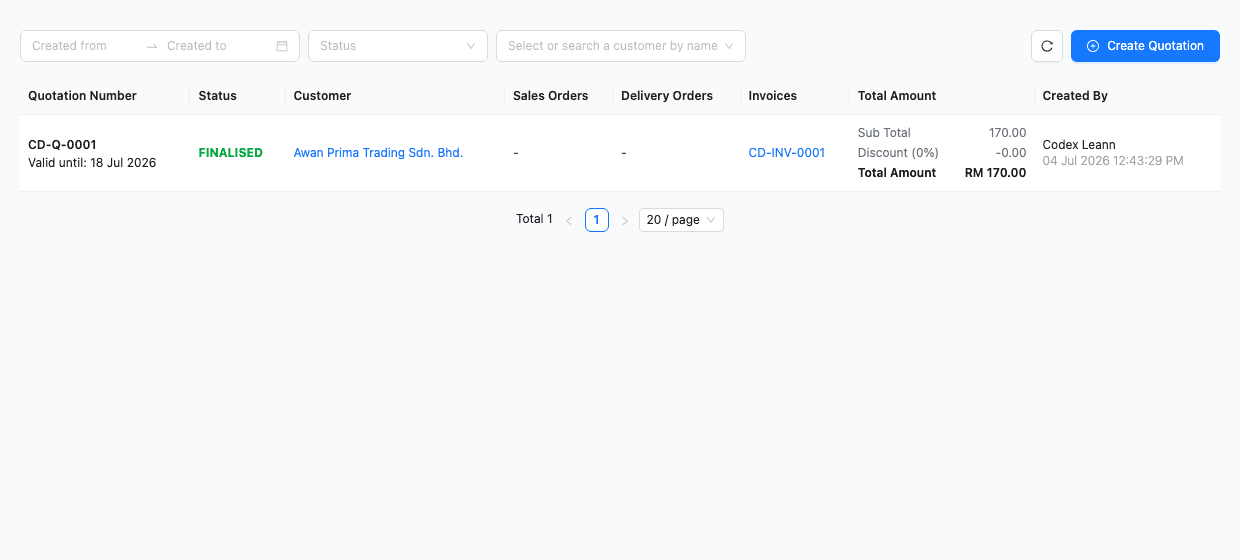
Search and filter the shared quotation list instead of comparing exported PDFs and email attachments.
See the quotation number, valid-until date, and internal status before deciding whether the record is ready for the next action.
Linked invoice and other supported sales-document references remain visible from the quotation context.
Customer, totals, creator, and created date help sales and finance identify the commercial source they are reviewing.
The TREX Grow invoice detail keeps the supporting quotation reference close to the customer, line items, totals, due timing, invoice status, paid status, and payment history. Staff can review the billing position without losing the source document that preceded it.
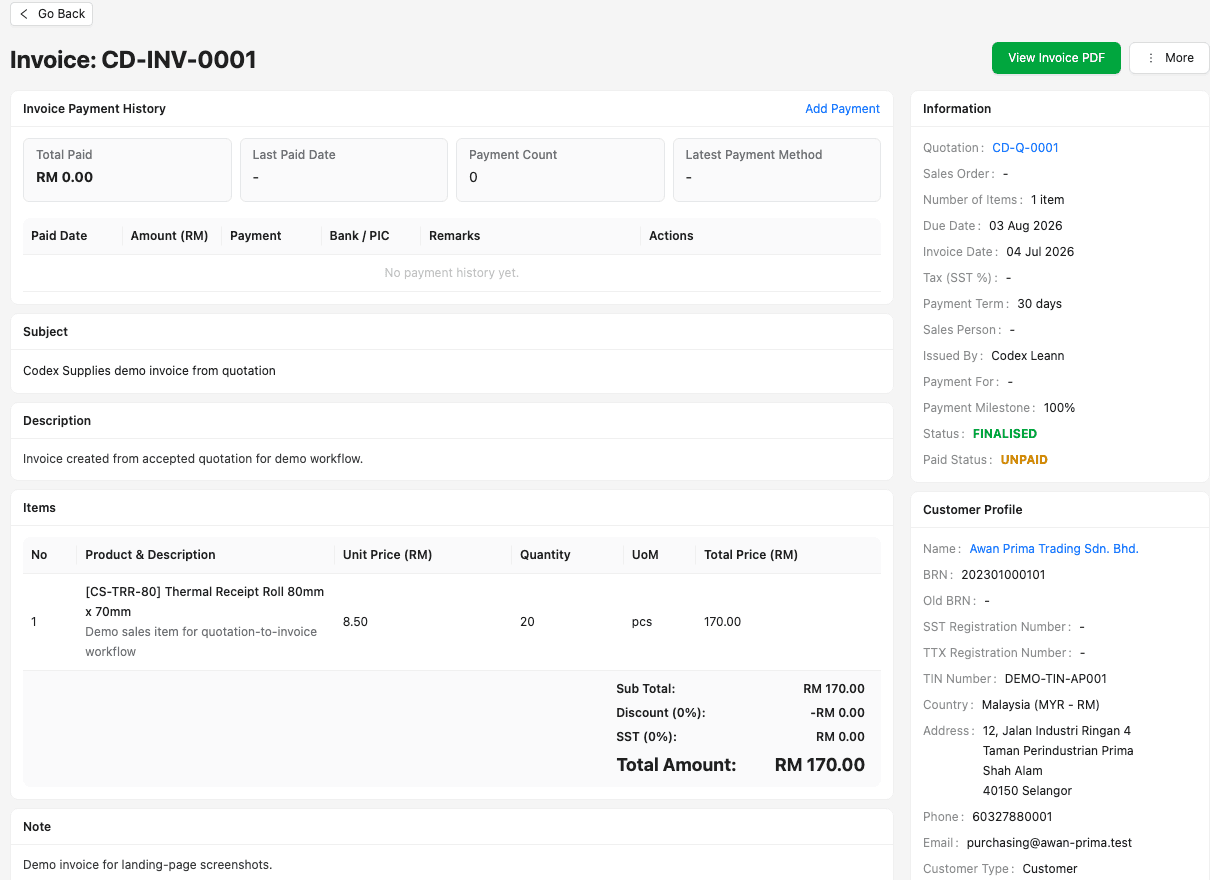
The quotation reference stays visible from the invoice so staff can trace the commercial record used to begin billing.
Customer and source-item context can be prefilled, then quantities and line details can be reviewed or adjusted for the legitimate billing event.
Finalisation, due timing, and paid status describe the invoice record; they do not overwrite the quotation's own workflow state.
Individual payment rows can retain amount, date, method, reference, bank or person-in-charge context, remarks, and attachments.
Start with one representative quotation-to-payment scenario, assign ownership, and define what makes each record current. Move active work only after staff can handle a revision, an invoice review, and a payment event.
Resolve duplicate customers, outdated contacts, inconsistent item names, old prices, and unclear tax treatment before creating new documents.
Set responsibility for customer data, prices, discounts, approval, revisions, customer confirmation, invoice creation, e-Invoice handling, and payment updates.
Train staff that finalising the quotation produces the official internal document state; it does not prove that the customer accepted it.
Before issuing an invoice, verify quantities, prices, discounts, tax, milestones, due dates, payment terms, and the actual goods or services being billed.
Keep partial payments and their dates, methods, references, evidence, and remarks distinct instead of overwriting the earlier settlement history.
Review current TREX Grow plan access and official HASiL guidance before rollout because product entitlements and regulatory requirements can change.
The best practice is to make the next action clear before the situation becomes urgent.
TREX Grow is designed for SMEs that want quotations and invoices connected to customer, sales, payment, and operating records. It is strongest when the business needs more control than separate templates but still wants a practical starting point.
Both teams benefit when the quotation source, invoice position, and next action are visible without a private reconciliation file.
Approval and revision history matter when scope, quantity, price, discount, tax, validity, or terms change before the invoice is created.
Trading, distribution, service, and project SMEs benefit when an invoice can begin from quotation or other supported sales-document context.
Accounts receivable staff can retain partial-payment and evidence context without reducing the record to one Paid field.
TREX Grow's current Free plan includes core customer, quotation, invoice, and e-Invoice workflows. Review the latest pricing page because entitlements can change.
TREX Grow controls records and connected workflows; it does not confirm customer acceptance, execute customer bank payments, replace tax or legal advice, or include every downstream capability on every plan.
Create a customer and item, build a realistic quotation, review the draft and finalisation path, confirm the customer decision outside the document state, create the invoice from the quotation source, and inspect how payment and e-Invoice context stays connected.
Quotation and invoice software helps a business prepare and control customer quotations, continue agreed source context into invoices, monitor document and payment status, and retain the relationship between the commercial offer and the billing record.