Name the problem in a recent job
Describe which person could not complete which action, the record involved and what they needed to know next. Ask the current provider whether configuration, training, deployment or a module change can address it.

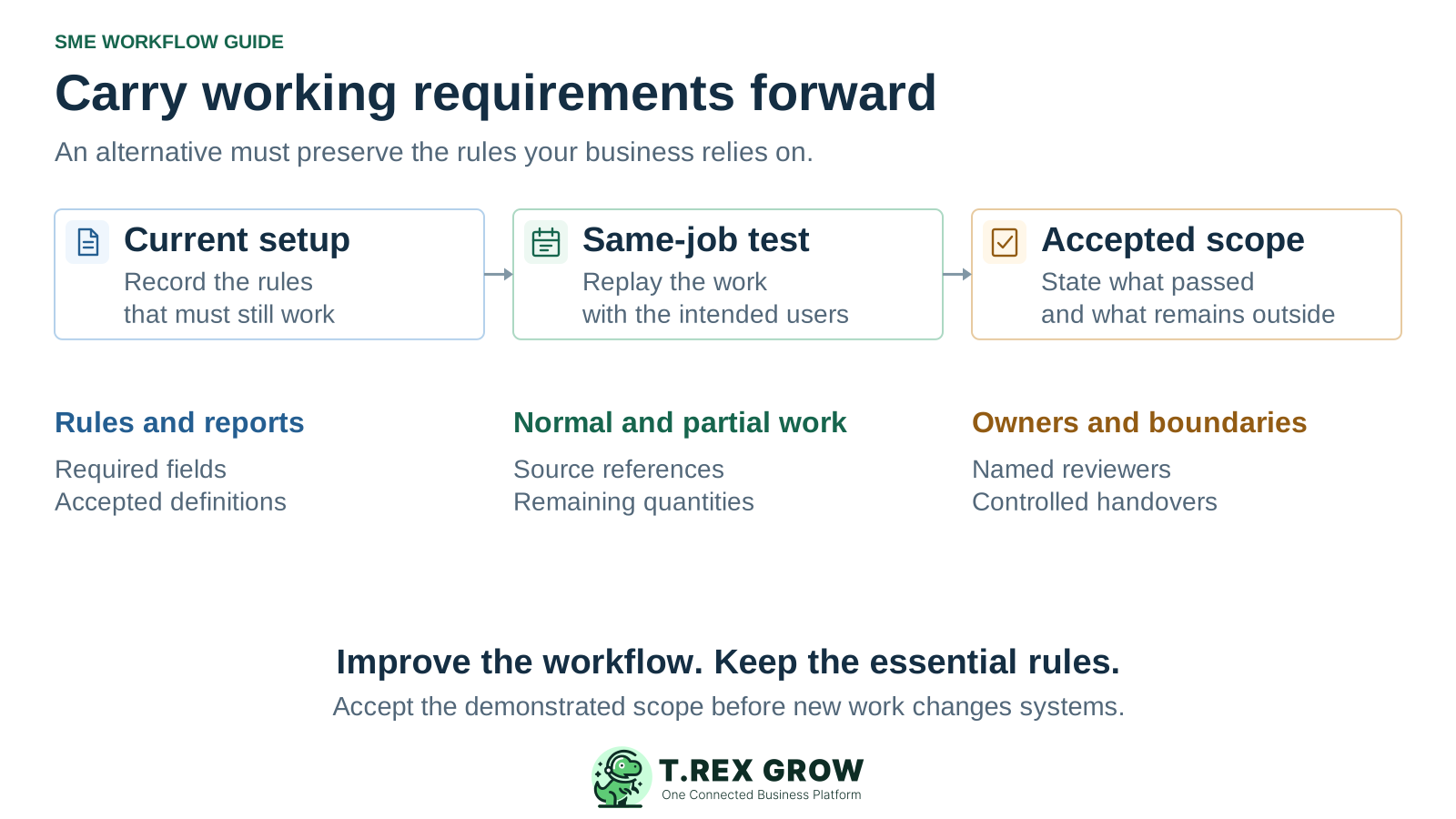
A useful SQL Account alternative must improve the work that is causing friction while preserving the rules your business depends on. List the documents, reports, access needs and accounting responsibilities that must still work. Then test TREX Grow for the operating scope you want to change, including its current Accounting Beta qualification.
This guide is for SMEs reviewing an existing SQL Account setup. SQL's official pricing describes accounting, sales and purchase documents, plan-dependent inventory, and desktop, public-cloud and private-cloud options. Establish the exact configuration before comparing alternatives. Official information was reviewed on 17 October 2026 through desk research, not hands-on SQL Account testing. TREX Grow has no affiliation with or endorsement from SQL Account.
Describe which person could not complete which action, the record involved and what they needed to know next. Ask the current provider whether configuration, training, deployment or a module change can address it.
List the documents, reports, approvals, access arrangements and external tools your team uses. Give each must-keep requirement an owner and a sample that can be checked in the proposed setup.
A sales workflow change and a complete accounting replacement have different acceptance requirements. Decide which operating records, financial outputs and historical access need to move, remain or have a controlled handover.
SQL offers customisation services for workflows, reports, forms and other product behaviour. If your setup uses them, inspect the business purpose behind each change. A familiar field name in another product does not establish an equivalent calculation, control or report.
| Requirement | Evidence to bring | Acceptance question |
|---|---|---|
| Documents and references | A quotation or order, its source references, terms and downstream documents. | Can the intended user follow the same job, including a change or partial outcome? |
| Custom fields and report rules | Required field meanings, a representative printed document and the report filters or calculation definitions. | Does the proposed setup preserve the business meaning, or is a different accepted process required? |
| Access and daily operation | User roles, devices, locations and any connectivity or local-access requirement. | Can the actual users perform permitted work and be blocked from restricted actions? |
| Finance and data continuity | Required balances, reports, open work, historical records and existing transfer processes. | Who accepts each output, and which responsibilities will remain outside the proposed system? |
The best practice is to make the next action clear before the situation becomes urgent.
A replacement decision should explain both the improvement and the work needed to preserve essential requirements. Keep unresolved gaps visible while comparing options.
Recurring issues usually point to workflow-control gaps, not one isolated data-entry mistake.
SQL describes cloud deployment and business-document capabilities. Check your selected setup and the available changes before assuming a switch is necessary for access, sales, purchasing or inventory work.
A job with no exception can hide the difficult handover. Include a partial delivery, correction or unpaid invoice and require the team to explain what remains open and who acts next.
A file that can be retained or opened in the original product is useful, but a target system still needs a verified preparation method. Check supported fields, relationships, attachments and opening positions separately.
Retaining SQL Account, moving one operating workflow and replacing a wider scope are all options to assess. Use the same requirements and complete cost for each path. No vendor is a universal winner.
| Path | When to investigate it | What must be established |
|---|---|---|
| Retain or adjust the SQL Account setup | The current provider may be able to address the gap while preserving useful reporting and established work. | Demonstrate the changed workflow and quote the required configuration, services and support. |
| Evaluate TREX Grow for a defined operating scope | The priority is supported sales, purchasing or stock work in the proposed TREX Grow plan. | Test the job, exceptions and required reports. Assign record ownership and any handover to the accounting process that remains. |
| Replace the wider operating and accounting scope | The business requires its financial responsibilities and daily workflow to move together. | Have the responsible finance reviewer accept the required outputs and opening positions. Include product maturity, missing scope and continued access to history in the decision. |
Shortlist TREX Grow for a defined document-led operating workflow. Its current plans place complete sales documents in Starter, purchasing and stock in Essential, and advanced warehouse controls in Premium. Accounting is Beta: calculations, postings and financial reports may be incomplete or inaccurate. Accounting Setup, opening balances and explicit activation are required, and outputs need qualified accountant review.
Evaluate supported quotation, sales order, delivery and invoice relationships with the actual users. Keep document status, fulfilment quantity and payment status distinct during the test.
If the proposed change includes purchasing or inventory, inspect the relevant order, receipt or movement and its effect. Verify location handling, available reports and any additional plan requirements.
List requirements that passed, remain unproven or need an external process. Keep essential financial work in an accepted process until the replacement outputs meet the responsible reviewer's requirements.
This existing demo screenshot shows finalised sales order CD-SO-0001 linked to quotation CD-Q-0001. The item row displays 20 ordered, 0 delivered and 20 outstanding. Use it to identify the references and quantity evidence to inspect in a trial. It does not demonstrate a completed delivery, stock posting, payment, financial output or transfer from SQL Account.
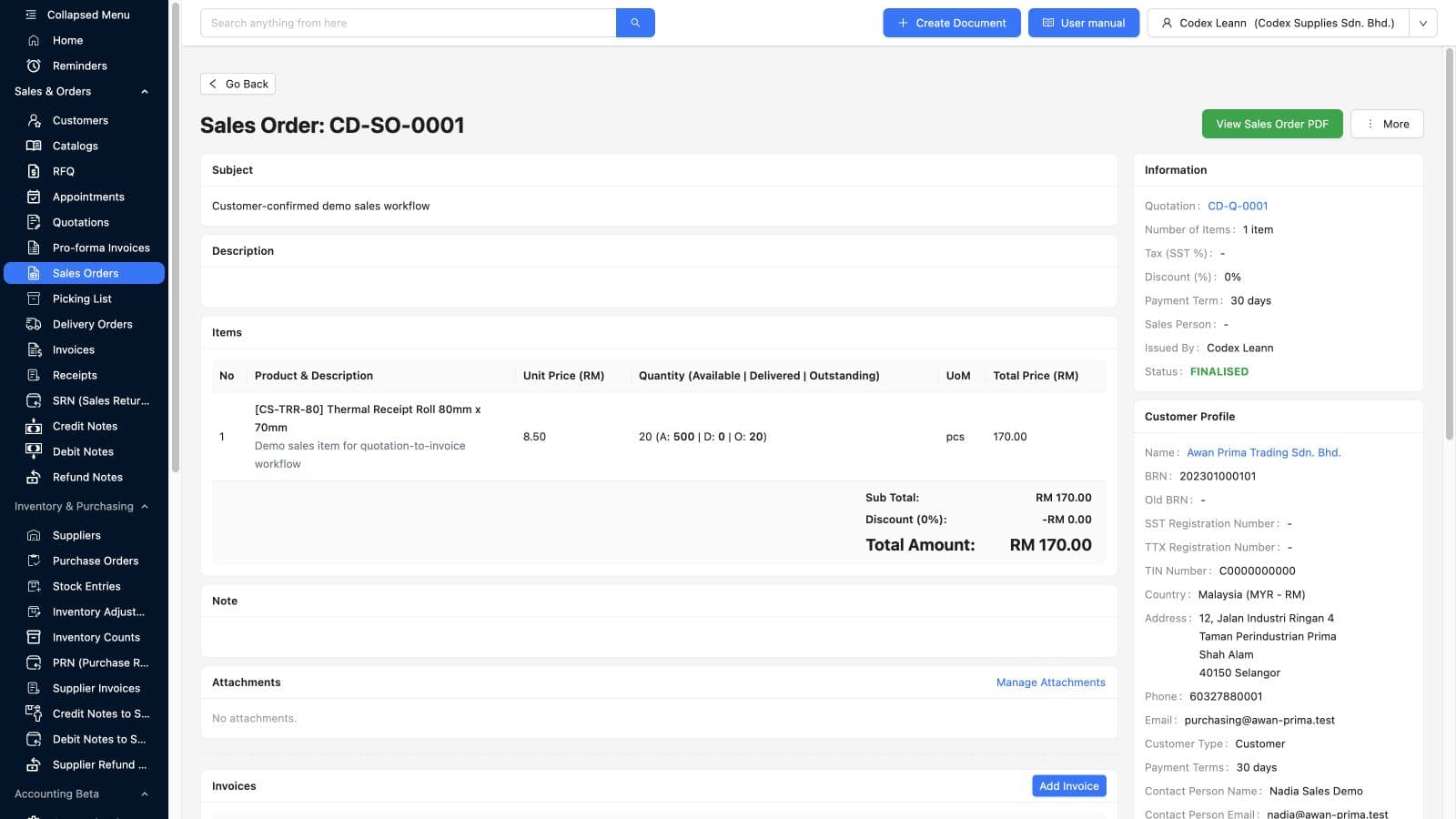
Have the intended user inspect the source document and complete the relevant next step in the proposed plan. Check the saved relationship and resulting state rather than relying on the presence of a button.
The screenshot begins with no units delivered. Run a partial outcome in the trial and inspect the resulting records. Treat the illustration below as an acceptance example, not a result shown by this screenshot.
For an illustrative test, confirm an order for 20 units, deliver 8 and leave 12 outstanding, with no cancellation or return. Require the team to explain those positions and the evidence behind them. Invoicing follows the agreed billing policy; payment and accounting acceptance need their own checks. This example is not a claim about an automatically completed workflow.
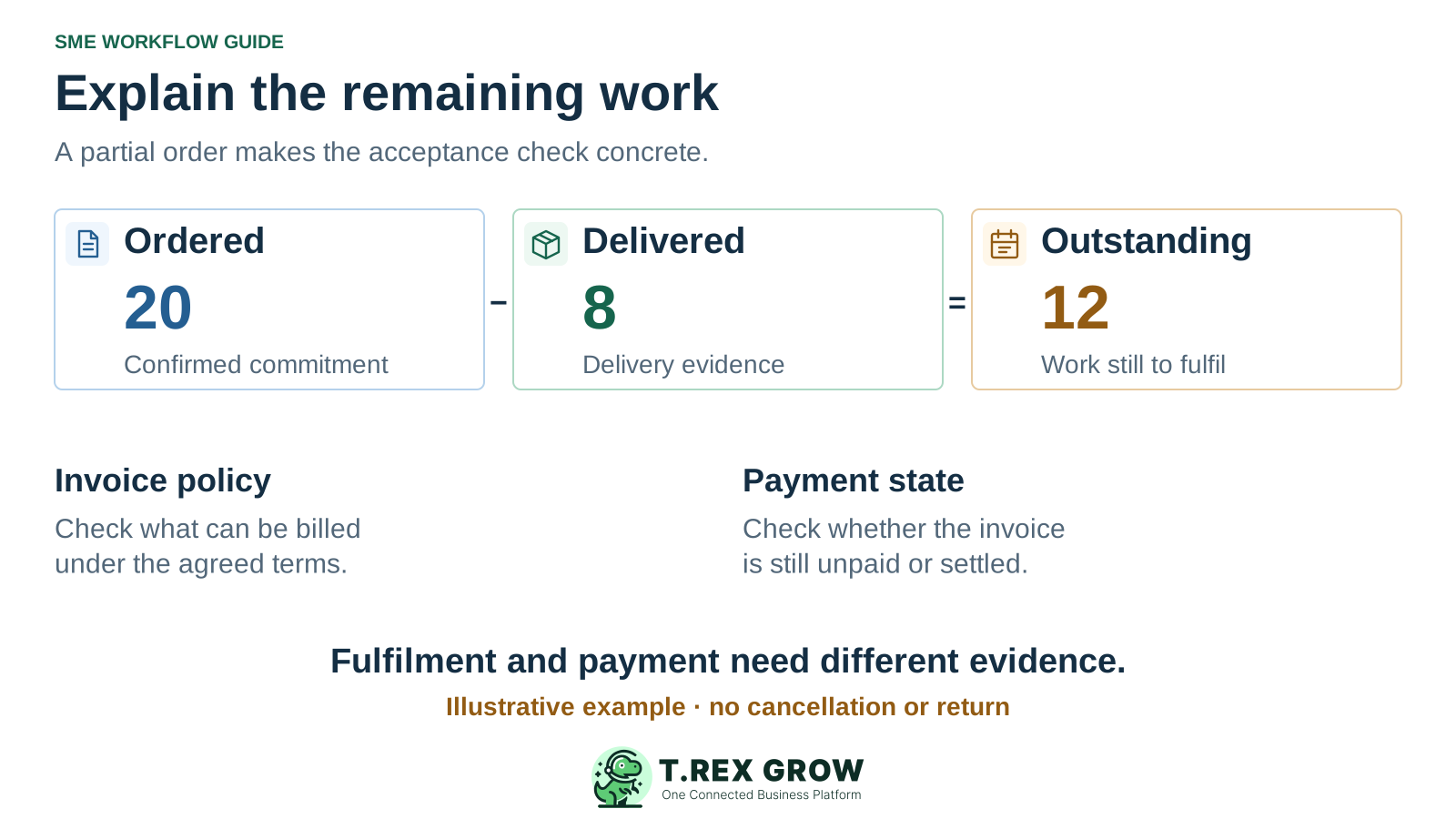
Find the order commitment, the delivery evidence and the remaining quantity. Check the same source reference and units of measure so the team can explain why 20 less 8 leaves 12 open in this example.
Confirm whether billing follows an order, a delivery or another agreed event. Then inspect the relevant invoice and payment record. A finalised order or delivered quantity alone does not establish a paid invoice.
Use the same date range, status filters and included records when comparing the old and proposed reports. Resolve a mismatch before treating a matching headline total as acceptance.
SQL's sales-report documentation describes Excel export from document listings and reports for outstanding work. Those are useful starting points for review; they do not establish a complete SQL Account-to-TREX Grow migration. Verify source extraction, target preparation and the handling of links, attachments and opening positions for the chosen scope.
Request the current SQL Account offer and review TREX Grow's live pricing for the intended scope. This guide quotes no fixed price advantage, guaranteed saving or migration duration.
If an established accounting process remains, name the authoritative record, transfer method, review frequency and exception owner. This page establishes no native SQL Account–TREX Grow connector or automatic synchronisation.
| Area | What to verify and cost |
|---|---|
| Equivalent product scope | The selected SQL Account configuration and proposed TREX Grow plan, users, modules and applicable limits. Compare current prices using the same currency, billing period and tax assumptions. |
| Preparation and essential custom work | Field mapping, duplicate checks, required document layouts, report definitions, configuration, training and support. Agree who owns each task. |
| Open work and financial review | The accepted treatment of unfinished documents, outstanding quantities and balances. Include any recurring handover or reconciliation work between retained systems. |
| History and exit | Usable access to earlier documents, attachments and reports, plus a tested way to obtain the records the business needs. A source database backup alone does not prove target compatibility. |
Use one representative job and the requirements your team relies on. Preserve the accepted current process while the proposed scope is unproven, and record the result with the final commercial scope.
Record the current facts in one shared place.
Confirm what is known and what needs attention.
Make the next decision or follow-up accountable.
Complete the next task and record the outcome.
Refresh the shared view when facts change.
A dependable workflow keeps the shared record and the next action aligned.
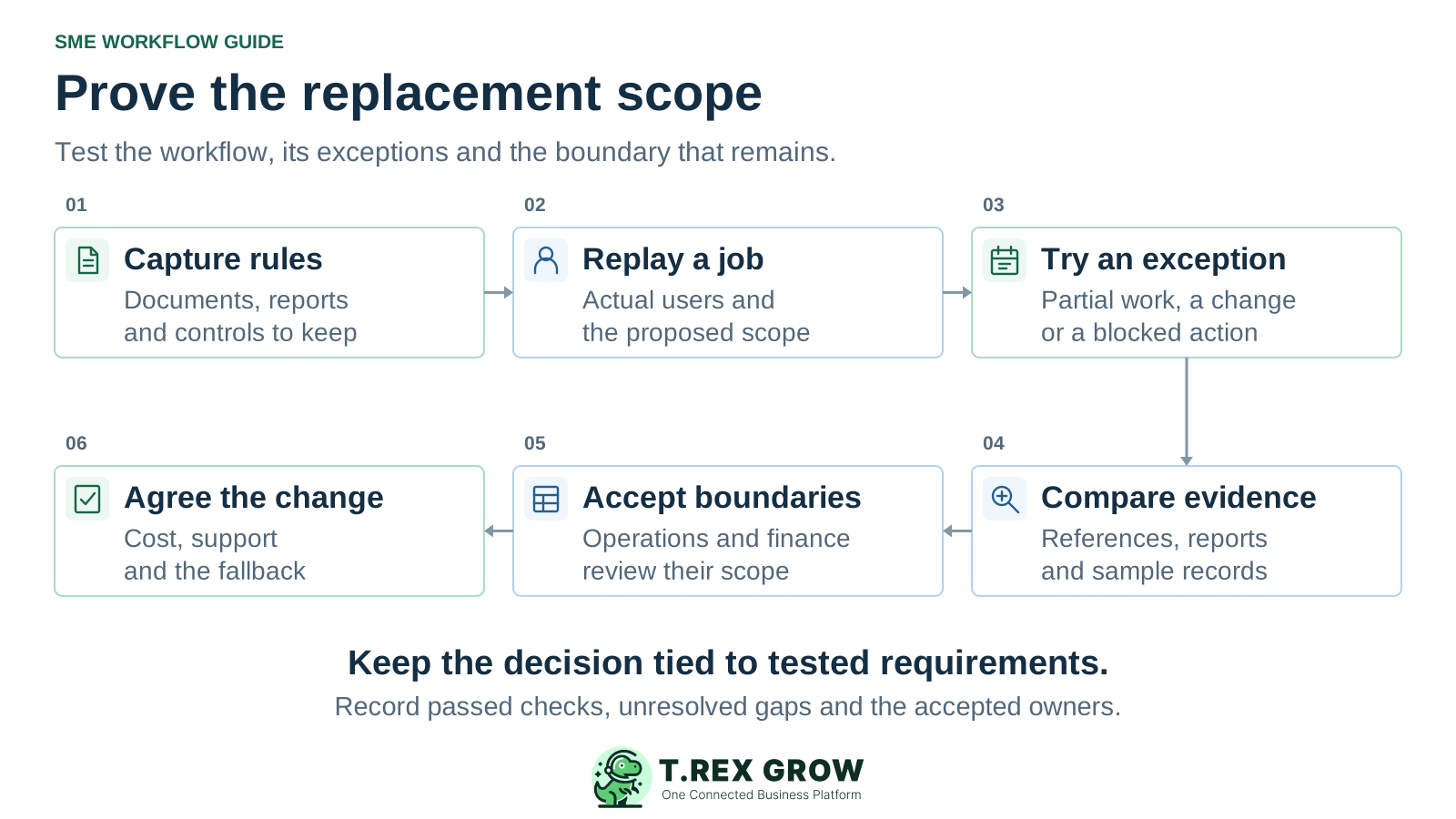
Capture the rules: list the current product and deployment, the improvement needed, and the documents, reports and controls that must still work.
Replay one job: have the actual users complete a representative flow in the proposed configuration or TREX Grow plan.
Try an exception: include a partial delivery, correction or blocked action. Inspect source references, quantities, document states and the next responsible person.
Compare the evidence: reconcile the sample records and report definitions, and test the available data preparation and historical-access methods.
Accept the boundary: have operations and finance review their required outputs. Include the published Accounting Beta qualification and assign any retained process or manual handover.
Agree the change: record passed and unresolved requirements, complete cost, support, the point when new work changes systems and the fallback if acceptance fails.
Create a free workspace, check the current plan scope and bring one representative operating job to the evaluation. Confirm trial terms before testing paid features, and review the required reports, data boundary and financial qualifications before agreeing a wider change.
Evaluate the specific workflow and plan you need. TREX Grow can be shortlisted for supported sales-document, purchasing and stock work. Carry required reports, controls and data responsibilities into the trial, and include its current Accounting Beta qualification if financial responsibility would move.